
Tariffs used to change on a schedule. Now they change randomly. Freight forwarders and 3PLs entered 2026 expecting the usual mix of fuel surcharges and seasonal capacity swings. What they got instead was a pricing environment where a single policy announcement can move landed costs by double digits before a quote even reaches the customer’s inbox. Contract rates negotiated in good faith get outrun by tariff shifts within weeks. Spot rates jump 10 to 15% on a single trade lane because a duty threshold moved overnight.
For any logistics company still managing rates in spreadsheets, shared drives, or “the one person who knows the current numbers,” this isn’t a minor inconvenience. It’s a structural risk to margin. This is why freight ERP software has moved from a nice-to-have efficiency tool to the operational backbone that determines whether a forwarder quotes accurately or absorbs the difference.
This blog looks at why manual rate management is failing under tariff volatility, what real-time rate management actually requires, and how logistics companies are rebuilding their pricing operations around ERP-driven systems.
The New Normal: Why Tariffs Are Rewriting the Rules of Freight Pricing
Trade policy has become a pricing variable in its own right, alongside fuel and capacity. Industry reporting this year has described the freight forwarding market as operating in a state of perpetual disruption, where tariff volatility and shifting trade policy, particularly around U.S. trade relationships, are complicating routing and cost forecasting for nearly every forwarder handling international lanes. Rate changes tied to duty thresholds, retaliatory tariffs, and last-minute policy reversals are no longer edge cases. They’re a recurring feature of the quoting cycle.
The knock-on effects show up everywhere in the rate structure. Carrier contracts now bundle base freight with a growing list of conditional line items like bunker adjustment factors, peak season surcharges, general rate increases, war-risk surcharges, and tariff-linked adjustments that can each move independently and without much notice. Shippers are front-loading shipments ahead of tariff deadlines, which distorts demand patterns on major lanes and forces rates to move in ways that don’t follow historical seasonal logic.
For forwarders, the practical result is that a rate card built last month may already misrepresent what a shipment will actually cost this month. Forwarders who locked in Q4 contract rates early had a stable base to quote against; those still negotiating into September found themselves pushed onto spot allocation, often at a meaningfully higher cost per container. That kind of gap between “the rate you planned around” and “the rate you’re actually paying” is exactly what breaks down when pricing depends on a document instead of a live feed.
And when pricing is wrong, someone pays for it. Either the forwarder eats the margin, or the customer gets an unpleasant surprise on the invoice. Neither outcome builds the kind of trust that keeps freight relationships intact through a volatile year.
Where Manual Rate Management Breaks Down
The forwarders feeling this most acutely are the ones still running rate management as a manual process built on individual judgment and static files rather than a connected system.
- Spreadsheet Rate Cards Can’t Keep Up with Policy Whiplash
A spreadsheet is a snapshot, not a living record. The moment a tariff schedule changes, every quote generated from that spreadsheet is working off stale data until someone manually updates it. When tariff adjustments are landing multiple times a quarter (sometimes multiple times a month), that update cycle simply can’t keep pace. Teams end up quoting from rate sheets that expired weeks earlier, discovering the gap only when margins don’t reconcile at month-end.
- The Hidden Cost of Expired Rates and Human Memory
In many forwarding operations, rate knowledge lives with one or two experienced coordinators rather than in a shared system. That’s a key-person dependency, not a process. When that person is unavailable, the team quotes from memory or from whatever file happens to be open, and errors follow. Multiply that across dozens of lanes, carriers, and commodity types, and the accumulated margin leakage becomes difficult to even diagnose, let alone fix.
- Compliance Blind Spots When Tariffs Change Overnight
Rate accuracy and trade compliance are tightly linked. When duty rates, de minimis thresholds, or classification rules shift, any pricing or documentation process that isn’t tied to a live compliance layer risks quoting or clearing shipments under outdated rules. That exposes the business to underpayment penalties, clearance delays, or client disputes — all of which are far more expensive to fix after the fact than to prevent with better tooling upfront.
What Real-Time Rate Management Actually Requires
Fixing this isn’t about hiring more people to update spreadsheets faster. It’s about removing the spreadsheet and the manual handoffs around it from the pricing workflow entirely.
- A Centralized, Live Rate Repository
Every carrier rate, contract rate, spot rate, and customer-specific price needs to live in one searchable system that sales, operations, and pricing teams all draw from. This is the foundation of any credible carrier rate management system. It is a single source of truth, with validity dates, amendment history, and surcharge line items structured consistently across every carrier and mode, so nothing gets missed when a rate changes.
- Tariff Rules Built Into the Rate Engine
Rate accuracy under tariff volatility depends on tariff logic being part of the pricing engine itself, not a separate compliance checklist run after a quote goes out. This is the core value of proper tariff management in logistics ERP. Duty schedules, trade agreements, and classification rules are applied automatically at the point of quoting, so a rate reflects current policy the moment it’s generated, not whatever policy was in effect when the rate card was last updated.
- Multi-Modal, Cross-Lane Visibility
Tariff changes rarely affect a single lane in isolation; they ripple across sourcing decisions, routing choices, and mode selection. A modern transportation management system needs to let planners compare ocean, air, and inland options side by side, factoring in current duties and surcharges, so a tariff spike on one lane doesn’t quietly erode margin because nobody checked the alternative.
From Reactive to Resilient: How Freight ERP Software Closes the Gap
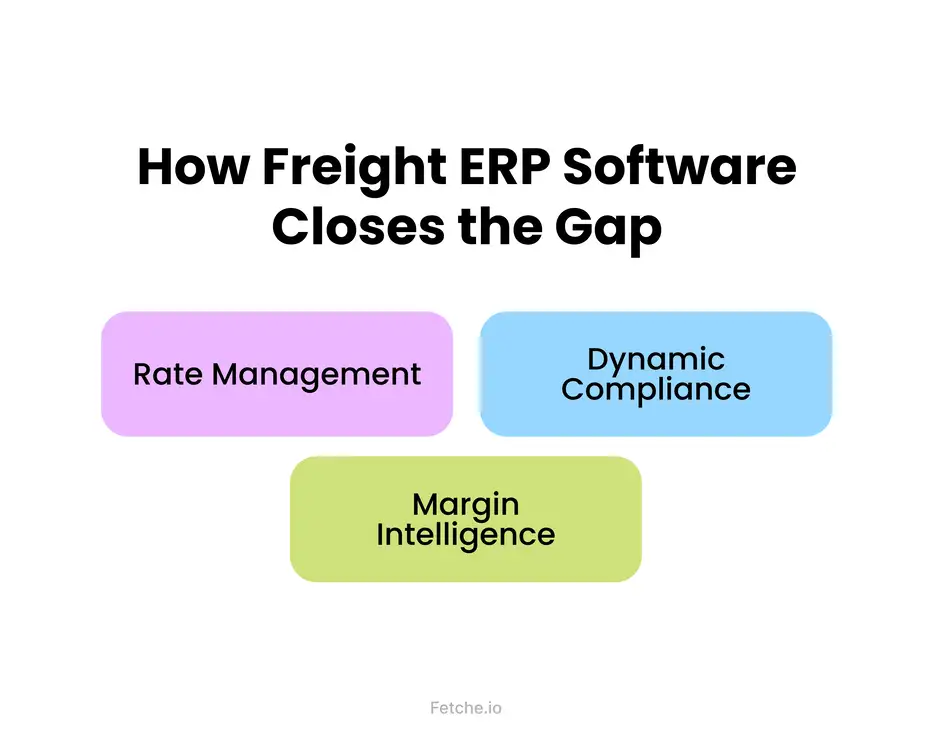
We just discussed real-time rate management requirements. Put those three requirements together (live rates, embedded tariff logic, and cross-modal visibility) and you get the case for freight ERP software as infrastructure rather than an add-on tool.
- Freight Rate Management Software Built for Volatility
The point of dedicated freight rate management software isn’t just storage; it’s automation. Rate cards update centrally the moment a carrier or customs authority publishes a change, and every quote generated afterward reflects that update automatically. Nobody has to remember to refresh a file, and nobody quotes from a version that’s already out of date.
- A Compliance Layer That Moves as Fast as Policy Does
Trade compliance software that’s actually integrated into the ERP rather than a standalone tool teams check separately closes the gap between a policy change and its reflection in day-to-day quoting and clearance. When classification rules or duty rates shift, the same system generating the quote is applying the current rule, reducing the risk of penalties or clearance delays tied to outdated data.
- Turning Rate Volatility Into a Margin Signal, Not a Surprise
This is where logistics analytics software earns its place in the stack. Instead of discovering margin erosion at month-end reconciliation, teams can see, in near real time, which lanes are absorbing tariff-driven cost increases, which customer contracts need repricing, and where quoting is consistently lagging actual cost. That visibility turns tariff volatility from a recurring shock into a manageable, trackable variable.
How Fetche Helps Logistics Teams Rebuild Rate Management
This is the operating model behind Fetche’s approach to freight forwarding software. Fetche’s Transportation Management System and Freight Forwarding ERP are built on a single platform rather than a patchwork of disconnected tools. This matters specifically because rate accuracy depends on rate data, tariff rules, and quoting logic living in the same place instead of being reconciled manually across systems.
Within that platform, carrier rates, contract terms, and surcharge structures sit in one centralized repository that updates as conditions change, rather than living in scattered files that go stale the moment a policy shifts. Route optimization, carrier management, and load planning run through the same TMS that generates the quote, so pricing decisions reflect current routing realities rather than outdated assumptions. And because compliance and documentation are automated within the same ERP teams get a rate management workflow that’s built to move at the same speed as the tariff environment around it, rather than trying to catch up to it after the damage is done.
For freight forwarders operating across multiple regions and trade lanes — where tariff exposure, customs rules, and carrier relationships all vary by geography — that kind of unified, real-time foundation is less a convenience and more a baseline requirement for staying accurate.
Why This Looks Different Depending on Where You Operate
Tariff exposure isn’t uniform, and neither is the fix. A forwarder running Trans-Pacific ocean lanes is watching duty schedules and de minimis rules tied to a handful of major trade corridors. A forwarder managing regional road freight — subcontracted fleets moving cargo between inland hubs and coastal ports — is dealing with a different mix: fuel cost swings, cross-border documentation requirements, and rate agreements with vehicle owners who aren’t always part of the same digital ecosystem.
What both have in common is that the manual workaround looks the same everywhere: someone keeping track by hand, a rate sheet that’s technically current but practically already outdated, and a pricing decision made with less information than it should have. A freight ERP platform that centralizes rate data and applies current rules automatically doesn’t just solve the tariff problem, it solves the same structural issue wherever it shows up, whether that’s a customs threshold change on one continent or a fuel surcharge revision on another. The specific variable changes by region. The need for a system that reacts to it in real time doesn’t.
Final Thoughts
Tariff volatility isn’t a temporary disruption logistics companies need to ride out. It’s the operating environment for the foreseeable future. The forwarders protecting their margins through it aren’t the ones with the most experienced pricing coordinators; they’re the ones who’ve stopped depending on individual memory and manual updates altogether. Rebuilding rate management around a connected freight ERP platform isn’t about chasing a trend. It’s about making sure the numbers on a quote still mean something by the time the shipment actually moves.
FAQ
It means the rate data inside your ERP updates continuously, reflecting current carrier contracts, spot rates, and tariff rules, and that every quote or booking generated in the system automatically pulls from that live data, rather than a static file that’s refreshed on a manual schedule.
By removing the manual step where someone has to notice a rate change and update a spreadsheet. When rate cards update automatically as carrier or tariff data changes, every user quoting from the system is working from the same current numbers, which closes the gap where expired rates typically slip through.
Because tariff and trade policy volatility has made manual rate tracking financially risky rather than just inefficient. With rate-affecting policy changes landing more frequently and with less notice, forwarders are prioritizing systems that can absorb that volatility automatically instead of relying on teams to catch every change manually.