

Oman is not quietly waiting for economic diversification to happen. It is engineering it — port by port, free zone by free zone, policy by policy. Oman Vision 2040 has placed logistics at the center of the country’s post-oil identity, and the infrastructure to support that ambition is already taking shape across Salalah, Sohar, and Duqm. What’s less discussed is what happens on the operational side of this shift. Large-scale national infrastructure creates opportunity, but it does not automatically translate into business growth for transport companies, freight forwarders, and 3PLs. Capturing that growth requires something equally serious on the technology front. For businesses that are serious about competing in this new environment, deploying the right logistics ERP software in Oman is not a future consideration — it is an immediate operational priority.
Why Vision 2040 Changes the Rules for Logistics Operators
Most logistics operators in Oman didn’t arrive at their current systems through bad decisions. They grew incrementally, adding tools as problems emerged — a transport tracking app here, a standalone invoicing system there. The result is a patchwork of data that doesn’t connect.
When a dispatcher needs to confirm container availability, they call the warehouse. When a client needs a status update, someone manually tracks the shipment and types a response. When finance needs to reconcile a billing cycle, they rebuild the data from three different sources.
Each of these moments costs time. Collectively, they cost margin. And as volumes grow, the inefficiency compounds rather than resolves itself. Modern logistics software in Oman is designed specifically to collapse that fragmentation. A unified ERP connects procurement, transport, warehousing, customs documentation, and client communication into a single operational layer — so the business runs on shared data rather than siloed updates.
How Fetche.io Delivers Practical, Measurable Value
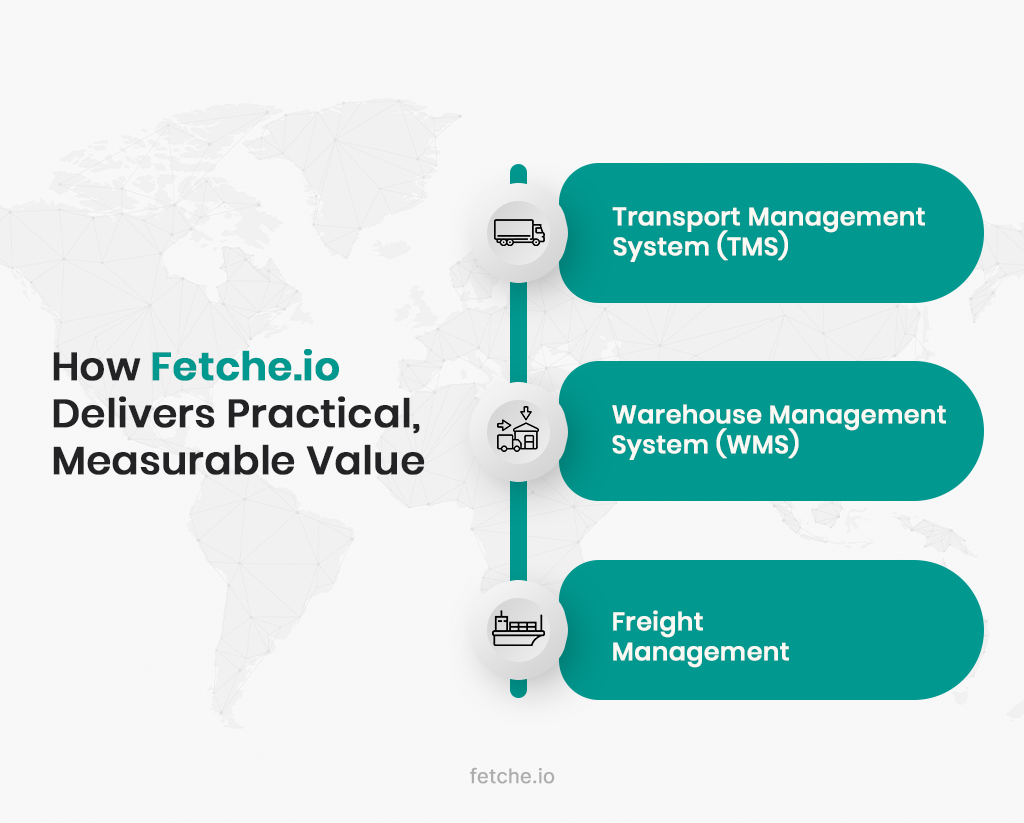
Fetche.io isn’t a generic enterprise software platform that happens to have a logistics module. It’s built ground-up for the operational realities of freight, transport, and third-party logistics in the GCC market.
Transport Management System (TMS) Fleet operators managing routes across Oman’s expanding road network know that idle time and poor routing are the two biggest drains on vehicle profitability. Fetche.io’s TMS optimizes dispatch scheduling, tracks fuel consumption per trip, and surfaces routing inefficiencies before they become patterns. When you’re running a Muscat-to-Duqm corridor regularly, even a 5% reduction in fuel overhead changes your cost structure meaningfully.
Warehouse Management System (WMS) As Oman’s free zones attract more transit cargo and manufacturing activity, warehouse throughput becomes a direct revenue driver. Fetche.io handles bin-level inventory tracking, automates cycle counts, and manages inbound and outbound workflows without manual intervention. Stock discrepancies that take hours to investigate get flagged in real time before they affect shipment schedules.
Freight Management For freight forwarders handling multi-modal shipments — combining sea freight out of Salalah with inland road delivery, for instance — managing vendor rates and booking logistics manually is where margin gets lost quietly. Fetche.io centralizes quote generation, carrier rate comparison, and booking confirmation across air, sea, and land modes. Every shipment gets routed through the most cost-effective option, and that decision is data-driven rather than habit-driven.
As the best ERP for freight forwarding in Oman, Fetche.io brings all three of these functions under one roof, which means operations directors work from one dashboard rather than switching between platforms to get a complete picture of their business.
Automating Customs Compliance Across the GCC
Cross-border trade in the Middle East carries a documentation burden that most operators underestimate until a shipment is held at the border. Requirements shift, formats vary by country, and a single missing field can delay a truck for hours — or longer.
Automating customs clearance in the GCC is one of the most tangible advantages Fetche.io delivers. The platform integrates with Oman’s Bayan customs system and generates compliant documentation automatically from data already captured in the workflow. Commercial invoices, bills of lading, and certificates of origin are produced without manual re-entry, which eliminates the transcription errors that cause the majority of customs holds.
For operators running regular lanes into Saudi Arabia or the UAE, this capability directly improves transit time reliability — which is exactly what enterprise clients evaluate when awarding long-term contracts
How to Scale a 3PL Business in Oman Without Scaling Headcount Proportionally
This is the question that separates 3PL businesses that grow profitably from those that grow their cost base faster than their revenue. How to scale a 3PL business in Oman isn’t primarily a sales question — it’s an operations question.
Every administrative task that requires a human to perform it manually is a ceiling on your scalable capacity. Client invoicing, carrier performance reporting, status update generation — these are repeatable, rules-based processes that an ERP handles automatically once configured.
Fetche.io functions as the 3PL ERP Middle East operators use to remove that ceiling. When your team isn’t rebuilding the same reports every week or chasing internal updates to answer client emails, they’re available for the work that actually requires judgment — capacity planning, carrier negotiations, client relationship management.
Client-facing portals extend this further. When shippers can log in and check their own cargo status, inventory levels, and delivery timelines without contacting your team, you’re delivering a premium service experience while simultaneously reducing inbound operational queries.
This is the operational model that positions a 3PL to win — and retain — the larger, more complex contracts that Vision 2040 is generating across the region.
The Strategic Case for Acting Now
As a cloud-based supply chain software in Muscat, Fetche.io requires no heavy infrastructure investment or lengthy on-premise deployment. Businesses can begin centralizing their operations quickly, with modules configured to match their current scale and expanded as volumes grow.
The companies that move first on supply chain management Oman modernization will hold a structural advantage as the market accelerates. They’ll have the reporting infrastructure to bid credibly on large contracts, the compliance capability to trade cleanly across GCC borders, and the operational efficiency to protect margins even as complexity increases.
Vision 2040 has set the direction. The question for logistics operators is whether their internal systems are built to match the pace of what’s coming.
Fetche.io exists to make sure the answer is yes.
FAQ
Standard ERPs cover broad business functions like HR and accounting. Logistics ERP is built specifically for freight forwarding, transport, and warehousing — with features like Bayan customs integration, multi-modal freight workflows, fleet dispatch, and bin-level warehouse tracking that generic platforms simply don’t offer.
Vision 2040 targets faster cross-border trade and higher logistics GDP contribution. Fetche.io supports this by automating customs documentation, centralizing freight operations, and giving operators the real-time visibility needed to handle growing shipment volumes without expanding their administrative overhead.
Fetche.io’s modular setup works for businesses at any scale. Smaller operators can start with the most relevant modules — freight management or customs automation — and expand as volumes grow. Cloud deployment removes the infrastructure costs that previously made enterprise software inaccessible to mid-size operators.
Most delays come down to documentation errors — wrong formatting, missing fields, mismatched data. Fetche.io generates compliant manifests, invoices, and certificates of origin directly from your existing ERP data, eliminating manual entry mistakes before shipments ever reach the border.
Start by identifying where your operations break down most — visibility gaps, invoicing delays, customs errors, or fleet inefficiency. Those pain points determine which modules deliver the fastest return. Fetche.io’s implementation is structured around this diagnostic approach rather than a one-size-fits-all rollout.
Fetche.io manages sea, road, and air freight within a single workflow — comparing carrier rates, tracking movements, and consolidating documentation across all transport modes. There’s no switching between platforms or piecing together data manually, which is where most freight forwarders currently lose time and margin.