
The world of logistics is changing faster than ever. As we move toward 2026, businesses are no longer relying on traditional supply chain methods. Instead, they are embracing smarter, faster, and more connected systems to stay competitive.
Imagine a scenario where a customer places an order. Within seconds, inventory is verified, the nearest warehouse is selected, the fastest route is calculated, and delivery is scheduled, all without human intervention.
This is not the future. This is Logistics Management in 2026.
In 2026, Logistics Management will be defined by innovation, automation, and real-time decision-making. Companies that adapt early will gain a clear advantage, while those that don’t risk falling behind.
In this blog, we explore the future of logistics management, key logistics trends in 2026, and how businesses can prepare for what’s next.
The Future of Logistics Management: What’s Changing?
The logistics industry is shifting from reactive operations to predictive and intelligent systems. With global supply chains becoming more complex, businesses need better visibility, faster execution, and improved coordination.
Here’s what’s driving this transformation:
- Rising customer expectations for faster delivery
- Increasing global trade complexity
- The need for cost efficiency and sustainability
- Rapid advancements in technology
This results in a complete redefinition of supply chain trends in 2026.
Top Logistics Trends in 2026
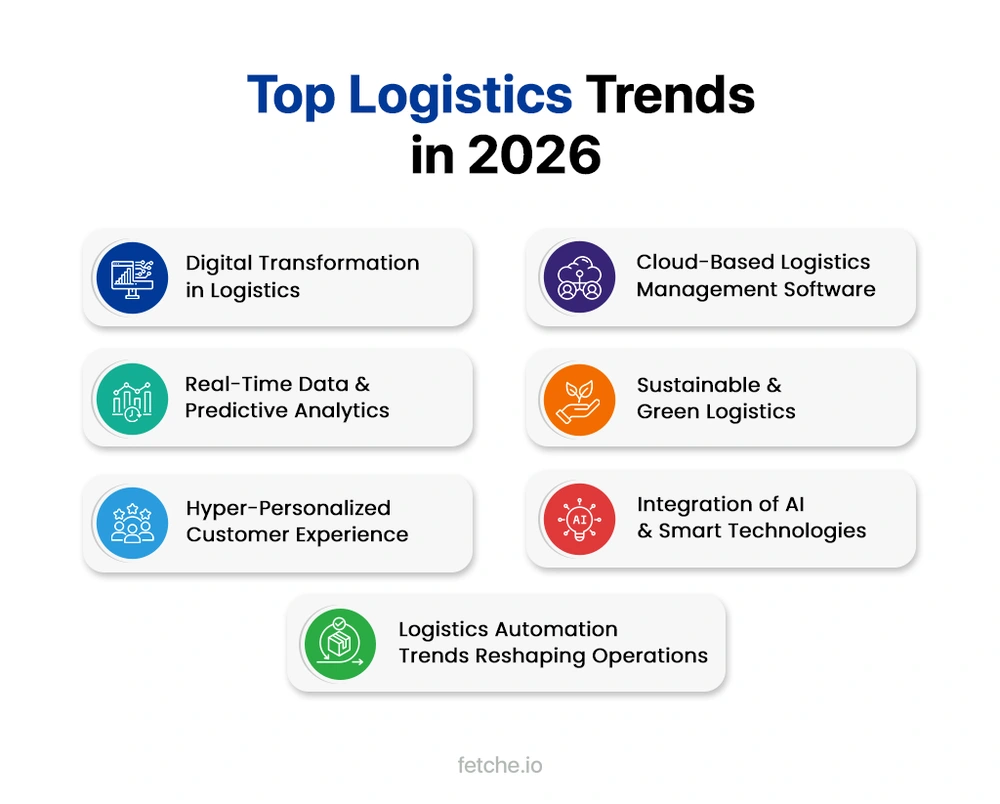
Here are the 2026 Logistics Trends That Are Changing the Game. Instead of just listing trends, let’s break them down into what they actually mean for businesses.
1. Digital Transformation in Logistics
Businesses are moving away from manual processes and adopting digital platforms that offer the following:
- Real-time shipment tracking
- Automated workflows
- Centralized data management
This shift enables companies to make faster, data-driven decisions and improve overall efficiency. So, invest in digital tools that provide full visibility across your logistics operations.
2. Logistics Automation Trends Reshaping Operations
Automation is playing a major role in improving speed and accuracy. From warehouse robotics to automated route planning, companies are reducing human error and increasing productivity. The role of automation in logistics management in 2026 is to help businesses scale operations without significantly increasing costs.
Key automation areas include:
- Automated inventory management
- AI-based demand forecasting
- Smart warehouse systems
3. Real-Time Data and Predictive Analytics
In 2026, decisions will be driven by data. The impact of technology on the logistics industry results in real-time insights that improve both efficiency and customer satisfaction. Predictive analytics allows businesses to:
- Forecast demand more accurately
- Identify potential delays before they happen
- Optimize routes and reduce fuel costs
4. Sustainable and Green Logistics
Customers are increasingly choosing brands that prioritize environmental responsibility. Green logistics will be the future trend in supply chain and logistics, which will be a competitive differentiator, not just a compliance requirement. Sustainability is becoming a top priority. Companies are focusing on:
- Reducing carbon emissions
- Optimizing delivery routes
- Using eco-friendly packaging
5. Hyper-Personalized Customer Experience
Businesses that provide seamless experiences will build stronger customer loyalty. Customer expectations are higher than ever. In 2026, logistics will be more customer-centric, offering:
- Flexible delivery options
- Real-time tracking updates
- Faster last-mile delivery
6. Integration of AI and Smart Technologies
Artificial Intelligence is transforming logistics operations. This reduces operational costs while improving efficiency.
AI-powered systems can:
- Optimize delivery routes
- Predict maintenance needs
- Automate repetitive tasks
7. Cloud-Based Logistics Management Software
Modern logistics relies heavily on cloud-based platforms. Logistics management software enables businesses to:
- Manage operations from anywhere
- Integrate multiple systems
- Scale easily as the business grows
Cloud solutions also improve collaboration across teams and partners.
Why does this shift matter in 2026?
- The rise of smart operations
- Data becomes the core of every decision
- Digital transformation is now the foundation
- Customer expectations are driving everything
- Sustainability moves from optional to essential
- Cloud-based logistics becomes the control tower
How Logistics Management Will Change in 2026
Here is a diagram that summarizes, for a quick look at how logistics in 2026 will be:
- More automated – Less manual intervention
- More connected – Seamless integration across systems
- More data-driven – Decisions based on real-time insights
- More sustainable – Focus on eco-friendly operations
- More customer-focused – Faster and personalized delivery experiences
A Day in Logistics Management in 2026: An Example
Let’s consider a real-world scenario to understand how logistics management will be in 2026.
Consider a retail business that receives a surge in orders during a sale. Below is a table that clearly shows the difference in the operation of such retail businesses with and without advanced logistics systems in modern times.
| With Advanced Logistics Systems | Without Modern Logistics Systems |
| Inventory updates instantly | Inventory mismatches occur |
| Orders are auto-assigned to warehouses | Delays increase |
| Routes are optimized in real time | Customer dissatisfaction rises |
From reactive to proactive, this is exactly how logistics management will change in 2026.
How Businesses Can Prepare for the Future
To adapt to the future trends in supply chain and logistics and to stay competitive in 2026 and beyond, businesses should focus on:
1. Embrace Digital Transformation- Replace outdated systems with integrated digital platforms.
2. Invest in Automation- Start automating repetitive and time-consuming tasks.
3. Use Data Effectively- Leverage analytics to improve decision-making.
4. Focus on Customer Experience- Make delivery faster, transparent, and flexible.
5. Adopt Scalable Software Solutions- Choose platforms that grow with your business.
Why Logistics Management Software is Essential
As logistics becomes more complex, managing everything manually is no longer practical. A robust logistics management software helps businesses:
- Streamline operations
- Reduce errors
- Improve efficiency
- Enhance visibility
- Scale effortlessly
Logistics Management Software acts as the backbone of modern logistics operations, and you just do not need a random one; you need something innovative, advanced, and future-ready, like Fetche, which is more reliable, powerful, and scalable to help your business stay competitive in the modern era and the coming future.
Stay Ahead with Fetche in 2026
To truly adapt to the future of logistics management, businesses need the right technology partner.
Fetche.io is a powerful logistics management software designed to simplify and optimize your supply chain operations. From real-time tracking to automation and data-driven insights, Fetche helps businesses stay competitive in an evolving logistics landscape.
Whether you are a growing company or an established enterprise, Fetche empowers you to:
- Manage logistics seamlessly
- Improve operational efficiency
- Deliver better customer experiences
The logistics trends in 2026 make one thing clear, change is inevitable. Businesses that embrace innovation, leverage technology, and focus on efficiency will lead the future.
The question is simple:
Are you ready for Logistics Management in 2026?
If yes, forget the manual processes and switch to Fetche.io today.
FAQ
Logistics Management in 2026 refers to the use of advanced technologies, automation, and real-time data to manage supply chain operations more efficiently. It focuses on speed, accuracy, and better decision-making.
Unlike traditional logistics, modern systems rely on automation, predictive analytics, and integrated platforms. This reduces manual work, improves accuracy, and enables faster, data-driven decisions.
Major trends include digital transformation, AI-driven automation, real-time tracking, predictive analytics, sustainable practices, and cloud-based logistics platforms.
Automation helps reduce human errors, speeds up operations, and improves scalability. It allows businesses to handle higher volumes without significantly increasing operational costs.
Real-time data helps businesses monitor shipments, predict delays, optimize routes, and make informed decisions, leading to improved efficiency and better customer satisfaction.
Logistics software streamlines operations, enhances visibility, and supports growth. It helps businesses stay competitive by improving efficiency and delivering better customer experiences.