
In 2026, the biggest challenge for freight operators is no longer winning more business; it’s maintaining healthy cash flow. Many logistics companies are profitable on paper, yet struggle with delayed customer payments, long invoicing cycles, and constant working capital shortages that impact daily operations. Traditional freight factoring, once a common solution, often comes with high fees, rigid contracts, and manual processes that reduce margins rather than improve financial flexibility. This is where logistics fintech is transforming the industry. By combining embedded payments in logistics, dynamic freight financing, and real-time invoicing for freight, modern financial technologies are helping freight operators accelerate payments, improve cash flow, and automate working capital management without relying on outdated financing models.
The Hidden Cost of the Freight Cash Flow Gap
For many freight operators, growing revenue does not always translate into stronger financial health. While shipments increase and new customers are added, cash often remains tied up in unpaid invoices. This creates a freight cash flow gap where businesses have work on the books but lack the working capital needed to keep operations running smoothly. As a result, logistics companies are forced to balance day-to-day expenses while waiting weeks or even months for payments to arrive.
Several factors contribute to this growing cash flow challenge:
30–90 Day Payment Terms
Many customers pay invoices 30, 60, or even 90 days after delivery. During this period, logistics companies must continue funding their operations without receiving revenue.
Rising Fuel Prices
Fuel is one of the highest operating costs in freight transportation. Fluctuating fuel prices can quickly strain cash reserves, especially when customer payments are delayed.
Driver Wages
Drivers must be paid on time regardless of when customers settle their invoices. Delayed cash inflows can make payroll management increasingly difficult.
Fleet Maintenance
Regular servicing, repairs, and unexpected breakdowns require immediate spending. Postponing maintenance to preserve cash can lead to higher costs and operational disruptions later.
Customer Payment Delays
Late payments extend the cash conversion cycle, reducing liquidity and making it harder to cover everyday operating expenses.
Working Capital Pressure
When cash is tied up in outstanding invoices, businesses often struggle to invest in fleet expansion, technology upgrades, or new business opportunities. Instead of focusing on growth, they are forced to manage short-term cash shortages.
Revenue doesn’t pay today’s fuel bill, cash does. Closing the freight cash flow gap has become essential for building a financially
resilient logistics business in 2026.
Why Traditional Freight Factoring No Longer Works in 2026
For decades, freight factoring has been one of the most common ways for logistics companies to manage cash flow. Under this model, a factoring company purchases unpaid invoices and provides immediate cash while collecting payment from the customer later. Although this helps businesses access working capital faster, it comes at a cost.
As the logistics industry becomes more digital and data-driven, traditional factoring is proving to be an expensive and inflexible solution for modern freight operators.
High Factoring Fees: Factoring companies often charge a percentage of every invoice, reducing already tight profit margins. Over time, these fees can become a significant operational expense.
Blanket Financing Contracts: Many providers require long-term agreements that cover all invoices, limiting a company’s ability to choose when and how to finance its receivables.
Manual Invoice Submissions: Traditional factoring typically relies on manually uploading invoices and supporting documents, creating additional administrative work and slowing the funding process.
Limited Flexibility: Businesses receive financing based on predefined terms rather than their real-time operational performance or immediate cash flow needs.
Customer Relationship Concerns: Since payments are often collected by a third-party factoring company, customer communication can become more complex and may affect long-term business relationships.
Slow Approval Processes: Document verification, credit checks, and manual reviews can delay funding, reducing the speed that businesses expect from a cash flow solution.
Traditional freight factoring was designed for a time when logistics operations were largely manual. Today’s freight businesses need financial solutions that are integrated into their day-to-day operations, providing faster access to working capital without sacrificing profitability or flexibility.
What Is Logistics Fintech?
Logistics fintech is the integration of financial technology into logistics operations, enabling businesses to manage payments, invoicing, financing, and cash flow through connected digital platforms. Instead of treating finance as a separate back-office function, logistics fintech brings financial processes directly into day-to-day logistics operations, making them faster, smarter, and more automated.
The rapid growth of cloud computing, APIs, artificial intelligence, and digital logistics platforms has accelerated this transformation. Modern freight businesses no longer rely on disconnected accounting systems or manual financial workflows. Instead, they use intelligent platforms that connect operations and finance in real time, improving visibility, reducing delays, and strengthening working capital.
Key technologies driving logistics fintech include:
- Embedded finance, allowing financial services to be integrated directly into logistics workflows.
- Digital payments that speed up collections and simplify payment processing.
- API-driven connectivity that enables seamless data exchange between logistics, banking, and accounting systems.
- ERP integration that synchronizes transportation, invoicing, accounting, and financial reporting from a single platform.
- Automation that reduces manual work, minimizes errors, and accelerates billing and payment cycles.
At its core, logistics fintech combines logistics operations with financial technology to help freight operators improve cash flow, automate financial processes, and make working capital management more efficient. In 2026, it is no longer just a financial innovation, it is becoming a competitive advantage for logistics businesses looking to grow without being constrained by cash flow.
Embedded Payments: Finance Built Into Logistics Operations
One of the biggest innovations in logistics fintech in 2026 is the rise of embedded payments in logistics. Instead of handling payments through separate banking portals or disconnected financial systems, embedded payments allow businesses to initiate, track, and reconcile payments directly within their logistics platform. This creates a seamless financial workflow where invoicing, payment collection, and reconciliation happen as part of everyday operations.
How Embedded Payments Solve Freight Cash Flow
- Faster Collections – Customers can receive and pay invoices more quickly through integrated payment workflows.
- Automated Reconciliation – Payments are automatically matched with invoices, reducing manual effort and accounting errors.
- Better Customer Experience – Simplified payment processes create a smoother experience for customers and improve payment consistency.
- Lower Payment Friction – Eliminates unnecessary paperwork and manual payment follow-ups.
- Stronger Cash Flow – Faster payment cycles reduce the freight cash flow gap and improve working capital availability.
By connecting operations with finance, embedded payments transform payment processing from a back-office task into a strategic business advantage.
Dynamic Freight Financing: A Smarter Alternative to Factoring
Unlike traditional factoring, where businesses commit to fixed financing agreements, dynamic freight financing provides funding based on real-time operational data and actual business needs. Instead of selling every invoice to a third party, companies gain flexible access to working capital using live shipment information, invoice status, and payment performance.
This modern financing model allows freight operators to maintain greater control over their cash flow while reducing financing costs.
Key Advantages of Dynamic Freight Financing
- Invoice-by-Invoice Financing – Finance only the invoices that require immediate liquidity instead of committing your entire receivables portfolio.
- Risk-Based Funding – Funding decisions are based on operational and customer payment data, enabling more accurate financing.
- Flexible Financing – Access working capital when needed without restrictive long-term contracts.
- Better Working Capital Management – Improve liquidity while maintaining healthier cash reserves for daily operations and business growth.
Dynamic Discounting vs Traditional Freight Factoring
| Dynamic Freight Financing | Traditional Freight Factoring |
| Finance selected invoices | Often requires financing all invoices |
| Flexible funding based on operational data | Fixed contract-based financing |
| Lower financing costs | Higher factoring fees |
| Automated digital workflows | Manual invoice submissions |
| Faster approvals using real-time data | Lengthy verification and approval processes |
| Greater control over customer relationships | Third-party involvement in collections |
As businesses evaluate dynamic discounting vs traditional freight factoring, the shift is clear. Modern logistics companies are moving toward flexible, technology-driven financing models that improve working capital without sacrificing profitability.
Real-Time Invoicing is Changing Freight Finance
In traditional logistics operations, invoicing often begins only after delivery documents are collected, verified, and processed. This manual approach delays billing, slows payments, and extends the cash conversion cycle. In 2026, real-time invoicing for freight is replacing these outdated processes by generating invoices as soon as delivery milestones are completed.
Powered by TMS-integrated real-time invoice automation, logistics companies can connect transportation management, proof of delivery, and finance into one continuous workflow. This reduces administrative delays and enables businesses to invoice customers much sooner.
Key Components of Real-Time Invoicing
- Digital Proof of Delivery (POD) – Electronic delivery confirmation instantly triggers the billing process.
- Automatic Invoice Generation – Invoices are created automatically using shipment and delivery data.
- Instant Invoice Validation – Integrated systems verify invoice details before they are sent, reducing errors.
- Faster Customer Billing – Quicker invoice delivery leads to shorter payment cycles and healthier cash flow.
- Reduced Disputes – Accurate digital documentation minimizes billing discrepancies and speeds up payment approvals.
Working Capital Automation: The Future of Freight Finance
In modern logistics, finance is no longer a separate back-office function. It is becoming an integral part of daily operations, where financial workflows are triggered automatically by operational events. This shift, known as working capital automation, helps freight operators improve liquidity by reducing manual intervention, accelerating collections, and giving finance teams real-time visibility into cash flow.
Instead of chasing payments after deliveries are completed, businesses can automate financial processes throughout the shipment lifecycle. This not only improves efficiency but also plays a crucial role in reducing days sales outstanding (DSO) in freight, enabling companies to access cash faster and strengthen working capital.
Key Areas of Working Capital Automation
- Automated Invoice Creation: Invoices are generated automatically once delivery milestones are completed, eliminating delays caused by manual processing.
- Smart Payment Reminders: Automated payment notifications encourage timely customer payments and reduce the need for manual follow-ups.
- Credit Monitoring: Businesses can continuously monitor customer credit profiles and payment behavior to minimize financial risk.
- Automated Collections: Digital workflows streamline collections by tracking outstanding invoices and initiating timely follow-ups.
- Cash Flow Forecasting: Real-time financial data helps predict future cash inflows and outflows, enabling better financial planning.
- Faster DSO Reduction: By shortening the time between delivery, invoicing, and payment, businesses can significantly improve cash flow and reduce dependency on external financing.
Working capital automation transforms finance from a reactive process into a proactive strategy, helping freight operators maintain healthier cash flow while supporting sustainable business growth.
How AI is Reshaping Logistics Fintech
Artificial Intelligence is transforming logistics fintech by helping businesses make faster, smarter, and more accurate financial decisions. Instead of relying on historical reports or manual analysis, AI uses real-time operational and financial data to identify risks, improve forecasting, and automate complex financial processes.
- Payment Risk Prediction: AI evaluates customer payment behavior to identify invoices that are likely to be delayed, allowing businesses to take preventive action.
- Customer Credit Intelligence: Machine learning analyzes payment history and financial trends to support more informed credit decisions.
- Fraud Detection: AI can identify unusual transactions or billing patterns, helping businesses detect fraud before it impacts operations.
- Payment Forecasting: By analyzing historical and real-time data, AI predicts when customer payments are likely to be received, improving financial planning.
- Cash Flow Prediction: AI provides more accurate cash flow forecasts, enabling businesses to plan expenses, investments, and operational activities with confidence.
- Smart Financing Recommendations: AI can recommend the most suitable financing options based on invoice value, customer payment behavior, and current cash flow needs.
As AI continues to evolve, logistics fintech is becoming more intelligent, enabling freight operators to make proactive financial decisions instead of reacting to cash flow challenges.
Benefits of Logistics Fintech for Freight Operators
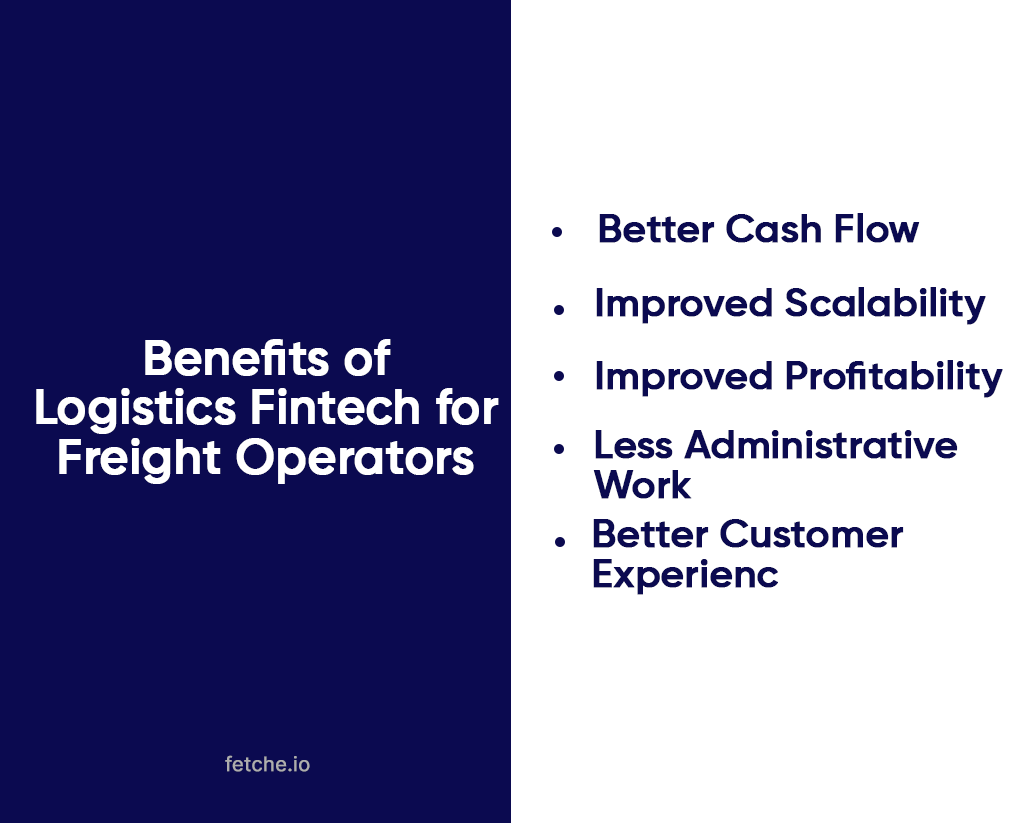
- Better Cash Flow: Accelerate collections and improve liquidity through faster invoicing and integrated payment workflows.
- Faster Payments: Reduce payment cycles with automated invoicing, embedded payments, and digital documentation.
- Lower Financing Costs: Reduce dependence on expensive factoring and short-term borrowing by improving working capital.
- Improved Profitability: Lower administrative costs and improve operational efficiency while protecting profit margins.
- Better Customer Experience: Offer faster, more transparent billing and payment processes that strengthen customer relationships.
- Less Administrative Work: Automate repetitive financial tasks, allowing teams to focus on higher-value activities.
- Stronger Financial Visibility: Access real-time financial insights that support smarter business decisions.
- Improved Scalability: Handle growing shipment volumes without proportionally increasing finance and administrative workloads.
Challenges to Adopting Logistics Fintech
While the benefits of logistics fintech are clear, many freight operators still face challenges when modernizing their financial processes. Most of these barriers stem from outdated systems rather than the technology itself.
- Legacy Accounting Systems: Older accounting software often lacks the connectivity required to support automated logistics workflows.
- Siloed Logistics Software: When transportation, finance, and operations operate on separate platforms, data becomes fragmented and difficult to manage.
- Manual Invoicing: Paper-based and manual invoicing processes increase processing time, errors, and payment delays.
- Change Management: Transitioning from familiar manual processes to digital systems requires employee training and organizational commitment.
- Data Quality: Inaccurate or incomplete operational data can reduce the effectiveness of automation and financial analytics.
The solution is not simply adding more financial tools. It is integrating logistics and finance into one connected ecosystem where operational events automatically trigger financial actions, creating a seamless flow of information across the business.
How Fetche Enables Smarter Freight Finance
Modern freight finance begins with operational visibility. When logistics operations, documentation, and financial workflows are connected, businesses can invoice faster, reduce payment delays, and improve cash flow without adding complexity. Fetche serves as the operational backbone that brings these functions together, helping logistics companies build faster and more efficient financial processes.
- Real-Time Invoicing
Automatically generate invoices as soon as shipment milestones or deliveries are completed, reducing billing delays.
- Digital Proof of Delivery
Capture and share electronic proof of delivery instantly to support faster invoice approval and payment processing.
- Accounting Integration
Connect logistics operations with accounting systems to streamline financial management and reduce manual data entry.
- Analytics and Insights
Monitor invoicing performance, payment cycles, and operational metrics through real-time dashboards.
- Workflow Automation
Automate routine financial processes such as invoice generation, document sharing, and payment follow-ups.
- Approval Workflows
Create structured approval processes that improve financial accuracy, transparency, and compliance.
- Operational Visibility
Gain a complete view of shipments, invoices, and financial performance from a single platform.
- Faster Billing
Reduce the time between delivery completion and customer invoicing, helping accelerate cash flow.
- Better Reconciliation
Automatically match invoices, payments, and operational records to minimize errors and administrative effort.
- Financial Reporting
Generate accurate financial reports that support cash flow management and informed business decisions.
By connecting logistics operations with financial workflows, businesses can reduce delays, improve working capital, and build more resilient freight operations.
The Future of Logistics Fintech Beyond 2026
The next phase of logistics fintech will move beyond automating financial processes to creating autonomous financial ecosystems. As AI, embedded finance, and real-time data become more sophisticated, financial decisions will increasingly be made within logistics platforms themselves, enabling businesses to operate with greater speed and confidence.
Key trends shaping the future include:
- Autonomous Finance – Financial workflows that execute automatically based on operational events.
- AI-Powered Working Capital – Intelligent systems that continuously optimize liquidity and cash flow.
- Embedded Lending – Instant access to financing directly within logistics platforms when required.
- Smart Payments – Automated payment routing and reconciliation with minimal manual intervention.
- Real-Time Settlement – Faster movement of funds between logistics partners, reducing payment delays.
- Open Banking Integration – Secure connectivity between logistics platforms and financial institutions for seamless transactions.
- Digital Supply Chains – Fully connected ecosystems where operational, financial, and commercial data move together in real time.
In 2026, the biggest financial challenge for freight operators is not access to capital, it’s access to their own cash. Long payment cycles, manual invoicing, and traditional freight factoring continue to lock working capital inside the business, slowing growth and reducing profitability. As customer expectations rise and operating costs increase, relying on outdated financial processes is no longer sustainable.
Logistics fintech is redefining how freight companies manage cash flow. Through embedded payments in logistics, dynamic freight financing, real-time invoicing for freight, and working capital automation, businesses can accelerate collections, reduce administrative overhead, and improve financial visibility without sacrificing margins. Rather than reacting to cash shortages, they can proactively manage liquidity using real-time operational data.
Fetche brings this transformation to life by connecting transportation, invoicing, digital proof of delivery, accounting, analytics, and financial workflows into one intelligent platform. With greater visibility, faster billing, and streamlined financial operations, logistics businesses can close the cash flow gap and build a stronger foundation for long-term growth.
Ready to modernize your freight finance operations? Discover how Fetche helps logistics companies automate invoicing, improve working capital, and build financially resilient operations.