
If you run a business in the Philippines and your logistics costs feel like they’re eating you alive — you’re not imagining it. You’re operating inside the most expensive logistics environment in Southeast Asia, and the numbers back that up.
Logistics costs in Philippines consume 27.5% of the country’s GDP — the highest figure among all ASEAN nations. And it doesn’t stop there. For businesses specifically, logistics-related expenses account for roughly 27% of sales revenues. Compare that to Thailand at 11%, and you start to see just how serious the gap is. Philippine companies are spending more than double what Thai competitors spend just to move goods from one point to another.
The frustrating part? A lot of this pain isn’t something you caused. But there’s still plenty within your control.
Why Logistics Costs in Philippines Are This High
Before jumping to solutions, it helps to understand where the cost is actually coming from — because “our country is an archipelago” only explains part of it.
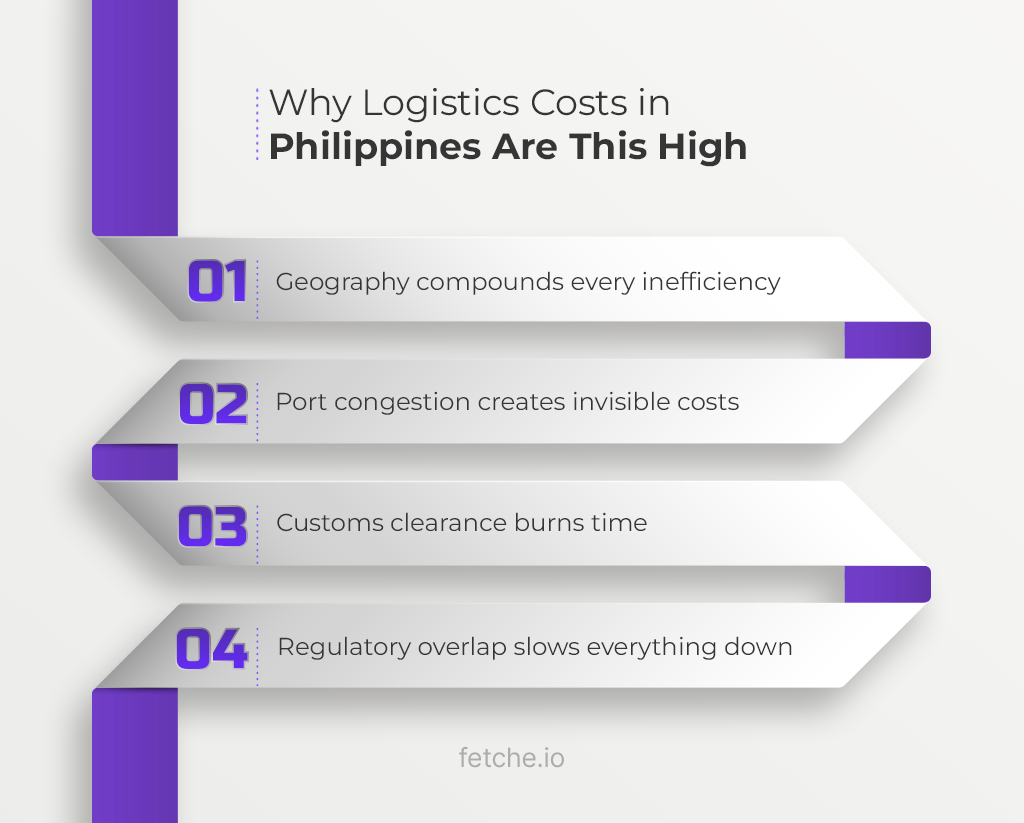
Geography compounds every inefficiency. Moving goods across 7,000+ islands means inter-island shipping is unavoidable for most supply chains. What makes it worse is that domestic maritime rates in the Philippines often come close to — or even exceed — international freight charges. A Mindanao farmer shipping produce to Manila can pay more for that domestic leg than an exporter shipping goods abroad.
Port congestion creates invisible costs. The Port of Manila handles roughly 70% of the country’s total container volume and routinely operates above its intended capacity — sometimes as high as 120%. That excess translates directly into delays, demurrage fees, and downstream disruptions that ripple through your entire supply chain.
Customs clearance burns time. Philippine import clearance averages eight to nine days. Thailand processes the same in one to five. Every additional day in customs is a day your inventory isn’t moving — and someone is paying for that idle time.
Regulatory overlap slows everything down. Multiple agencies, fragmented policies, and limited inter-agency coordination create friction at nearly every step of the logistics chain. Navigating that patchwork takes time, people, and often, unofficial costs.
Taken together, these structural factors create a baseline of inefficiency that’s hard to work around. But businesses that understand these root causes are the ones best positioned to minimize their impact at the company level.
What You Can Actually Control Right Now
The national-level fixes — port modernization, customs digitization, cabotage reform — will take years. You can’t wait on those. Here’s where companies are already making real progress:
1. Stop Flying Blind on Inventory
Overstocking and stockouts are quiet budget killers. Many Philippine businesses still rely on spreadsheets or siloed systems that give incomplete pictures of what’s actually in the warehouse. The result: you overorder to compensate for uncertainty, your carrying costs climb, and goods sometimes spoil or expire before they’re even dispatched — a particular problem for food and pharma chains spanning Luzon, Visayas, and Mindanao.
Real-time inventory visibility — knowing what you have, where it is, and when it needs to move — can dramatically reduce excess stock and emergency procurement costs. Businesses that shift to centralized inventory tracking typically find savings not in one big line item, but spread across dozens of smaller decisions made better, faster.
2. Fix Your Route Planning Before It Fixes Your Budget for You
Most companies doing inter-island or regional delivery are still planning routes the same way they did ten years ago — largely manual, largely reactive. The problem with reactive routing isn’t just fuel cost. It’s the combination of fuel, overtime, missed delivery windows, and the customer attrition that follows.
Route optimization — using actual delivery data, traffic patterns, and load constraints — consistently delivers 15–25% reductions in fuel and vehicle costs for businesses that implement it seriously. For a logistics operation with any meaningful delivery volume across Philippine geography, that’s a number worth pursuing.
3. Get Your Supply Chain Partners on the Same Page
One of the quieter contributors to high logistics costs in the Philippines is a lack of real-time coordination between suppliers, forwarders, and buyers. When each party operates with their own system and their own data, miscommunication becomes expensive. Cargo gets held, shipments arrive with incorrect documentation, lead times get padded with buffers that eat margin.
Supply chain visibility — the ability to track goods end-to-end and share that information across partners — shortens those buffers. It creates accountability. And in a geography as fragmented as the Philippines, that kind of coordination isn’t just nice to have; it’s a competitive edge.
4. Move Away from Manual Operations
ERP automation in Philippines remains underutilized relative to the country’s logistics complexity. Many businesses — particularly mid-sized manufacturers and distributors — still handle procurement, invoicing, and fulfillment through disconnected tools. That manual work introduces errors and slows turnaround at exactly the points where speed matters most.
The shift toward logistics management software in Philippines is accelerating, in part because digital tools have become more accessible and more Philippine-specific. Logistics automation doesn’t eliminate your workforce — it frees them from repetitive work so they can focus on decisions that actually require judgment.
The ASEAN Context Is Changing — And That’s Both a Warning and an Opportunity
Indonesia reduced its logistics costs from 24% to 14% of GDP by building a unified digital platform that connected customs, shipping, and warehousing data — and deploying AI for route optimization and inventory management. It took deliberate policy, but the private sector played a central role.
Thailand’s logistics costs sit at 11% of GDP — a number achieved through consistent infrastructure investment and multimodal connectivity, but also through widespread adoption of technology across supply chain efficiency operations.
The Philippines is now at an inflection point. Government initiatives like mandatory e-invoicing for customs (set to roll out from 2026), the Luzon Economic Corridor project, and the Build Better More infrastructure program signal that the macro environment will improve. But companies that wait for those tailwinds before fixing their internal operations will have already fallen behind competitors who started earlier.
Where Fetche Fits Into This
The challenges described above — fragmented inventory, inefficient routing, poor inter-island supply chain visibility, and manual processes — aren’t abstract. They show up on your P&L every month.
Fetche.io was built specifically to address these operational pain points for businesses running supply chains in the Philippine context. The platform brings together route optimization, real-time inventory management, and end-to-end supply chain visibility in one place — so logistics managers aren’t stitching together data from five different systems to get a picture of what’s actually happening.
For companies managing multi-island distribution, coordinating with multiple freight partners, or trying to reduce the cost of inventory held across warehouses in Luzon, Visayas, or Mindanao, Fetche provides the operational infrastructure to make smarter decisions, faster.
It’s not a silver bullet for 27.5% GDP-level cost structures. But it’s the kind of ground-level tool that makes a genuine difference — the kind that’s built for how Philippine logistics actually works, not how it works in markets with continuous road networks and predictable clearance times.
The Bottom Line
The Philippines carries the heaviest logistics cost burden in the ASEAN logistics comparison. Part of that is structural — geography, infrastructure, regulatory gaps — and those will take time to fix. But a significant share of what businesses spend on logistics today comes from operational inefficiency: poor route planning, disconnected inventory systems, and a lack of visibility across supply chain partners.
That part is fixable now. And in a market where your competitors are dealing with the same macro constraints, fixing your operations faster is the most durable advantage available to you.
If you’re ready to look at where your supply chain is leaking cost, Fetche.io is a good place to start.
FAQ
At 27.5% of GDP, the logistics cost in the Philippines is the highest in Southeast Asia — and that 27% GDP logistics cost isn’t just a macro number. Businesses feel it directly, with logistics expenses eating close to 27% of total sales revenue. That’s money that could be going into growth, not just moving goods from one island to another.
Most of the country’s container volume still funnels through one port — Manila — which was never built to handle what it’s processing today. Outside Metro Manila, port infrastructure is thin, domestic shipping is expensive, and road connectivity to key economic zones remains patchy. The logistics cost Philippines businesses carry reflects that reality every time a shipment moves.
They can — and honestly, they tend to move faster than large companies when they decide to fix things. Supply chain efficiency at this scale usually starts with one problem: nobody knows exactly what stock is where. Solving that single visibility gap cuts overstocking, reduces emergency orders, and removes a lot of the fire-fighting that burns time and budget every week.
Most businesses running on spreadsheets are making decisions with information that’s already hours or days old. Logistics management software in the Philippines changes that — live inventory data, actual route performance, real freight costs — so decisions are based on what’s happening now, not what someone last recorded. That alone closes a lot of the gap between what logistics should cost and what it actually does.
A logistics ERP for the Philippines has to work the way Philippine supply chains actually work — across islands, through multiple freight partners, with sea and road legs on the same shipment. Generic platforms weren’t built with that in mind. Businesses that try to adapt them usually end up maintaining manual workarounds anyway, which defeats the point of having a system at all.
Route planning is the fastest place to see a return. Logistics automation in the Philippines that starts with delivery routing — factoring in vessel schedules, road conditions, and load weight — cuts fuel costs and reduces the empty runs that quietly drain fleet budgets. It’s also contained enough to implement without overhauling everything else at the same time, which makes it a realistic first move for most operations.