
Oman’s logistics story is changing fast. New ports are expanding. Free zones are attracting global trade. Cross-border movement is increasing every year. This is not a slow transition. It is a planned shift. Under Oman Vision 2040 and reinforced by Oman SOLS 2040 technology roadmap, logistics is no longer a support function. It is a growth engine. But here’s the problem. Infrastructure is moving faster than operations. Many freight forwarders operating in Muscat, Sohar, and Salalah today are still running on spreadsheets, disconnected tools, manual coordination, and reactive decision-making. That gap is where businesses struggle. The problem isn’t that these businesses lack ambition. The problem is that their internal systems cannot keep pace with what Vision 2040 is about to demand of them. And that’s exactly why freight forwarding software in Oman is no longer optional. It has become a basic requirement to stay competitive.
What Vision 2040 Actually Means for Freight Forwarders
Freight forwarding used to be simple. Move cargo from point A to point B. Coordinate with carriers. Handle documentation. Close the job. That model doesn’t work anymore. Oman Vision 2040 logistics ultimately translates into:
- Multiple Transport Modes
- Multiple Vendors
- Cross-Border Compliance
- Real-Time Updates
- Client Expectations for Visibility
You are not just moving cargo. You are managing a complex, connected system. And manual systems cannot handle that level of complexity.
Changing Expectations for Logistics Companies Under Vision 2040
Oman Vision 2040 is not just about infrastructure. It is about efficiency. It is about speed. It is about global competitiveness. And that changes expectations for logistics companies.
- Faster Cross-Border Trade
As trade increases across the GCC, delays become unacceptable. Even small inefficiencies can:
- Disrupt supply chains
- Impact contracts
- Reduce reliability
Freight forwarding software ensures:
- Faster processing
- Accurate documentation
- Smoother movement
- Higher Shipment Volumes
More trade means more shipments. Manual systems cannot handle this.
Without automation:
- Teams get overwhelmed
- Errors increase
- Service quality drops
Software absorbs this growth.
- Increased Competition
As Oman grows as a logistics hub, more players enter the market. Local and global. The difference is no longer price. It is:
- Speed
- Visibility
- Reliability
Technology becomes the differentiator.
- Demand for Transparency
Enterprise clients expect:
- Real-Time Tracking
- Accurate Reporting
- Consistent Performance
Without software, meeting these expectations is difficult.
Where Freight Forwarders Are Losing Money Today
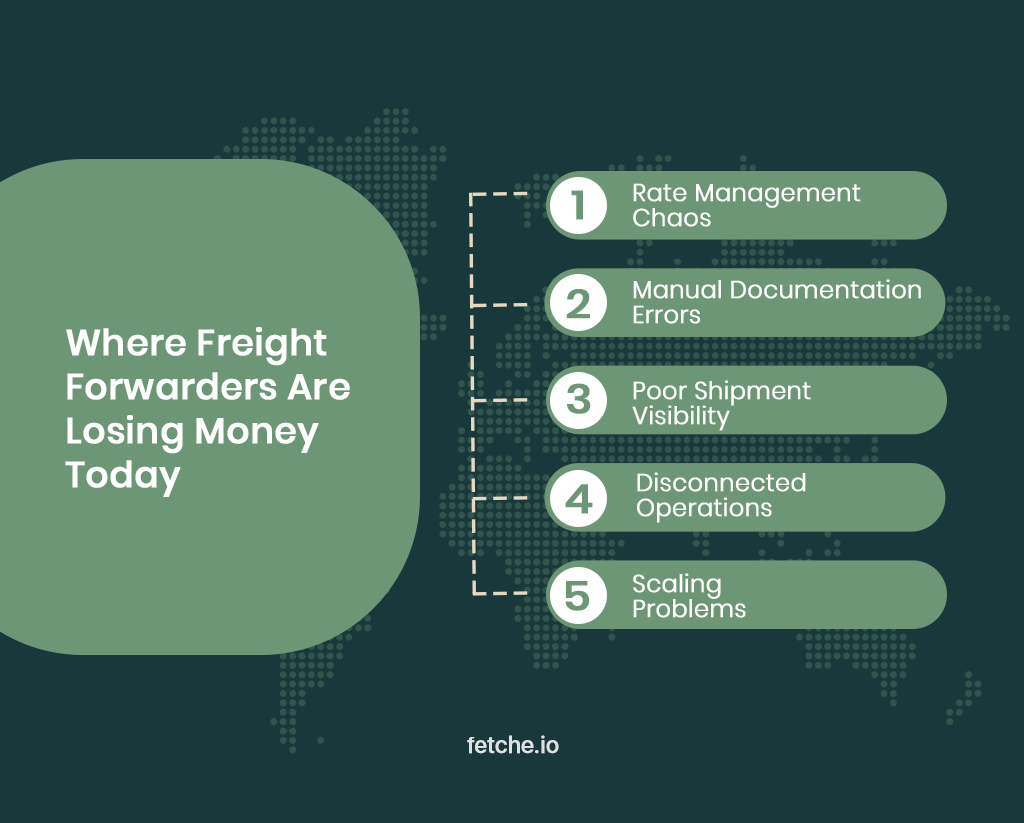
Most businesses don’t realize where the problem actually is. It’s not one big issue. It’s a series of small inefficiencies. And they add up. Let’s take a look at these inefficiencies:
- Rate Management Chaos
Carrier rates change constantly. Without a centralized system:
- Teams rely on old data
- Quotes are inconsistent
- Margins shrink without visibility
A shipment that looks profitable on paper often isn’t.
- Manual Documentation Errors
Every shipment needs:
- Invoices
- Bills of lading
- Packing lists
- Customs documents
When this is done manually:
- Errors happen
- Delays happen
- Penalties happen
Most of these issues are avoidable.
- Poor Shipment Visibility
Clients today expect updates. Not once a day. But in real time. Without proper systems:
- Teams spend hours responding to queries
- Customers stay uncertain
- Trust slowly drops
- Disconnected Operations
When freight teams, warehouse teams, and finance teams are all working on different systems, that leads to:
- Duplicated work
- Data mismatch
- Delayed billing
This is where operational friction builds.
- Scaling Problems
As shipment volume increases:
- Workload increases
- Errors increase
- Dependency on people increases
Hence, growth becomes difficult to manage. Not because demand is low. But because systems cannot handle scale.
How Freight Forwarding Software Changes Everything
Modern freight management system in Oman solves these problems at the root level. It does not just digitize operations. It connects them.
Let’s break this down.
- Centralized Rate Management
A freight system stores:
- Carrier rates
- Historical pricing
- Vendor performance
This allows teams to:
- Generate accurate quotes quickly
- Compare rates instantly
- Protect margins consistently
Decisions are no longer based on memory. They are based on data.
- Automated Documentation
Instead of creating documents manually, the system generates:
- Invoices
- Shipping documents
- Customs paperwork
This reduces:
- Manual effort
- Human errors
- Processing time
- Real-Time Shipment Tracking
Every shipment becomes visible. From booking to delivery.
Without contacting your team, clients can:
- Track cargo
- View status updates
- Access documents
This improves:
- Customer Experience
- Response Time
- Operational efficiency
- Unified Operations
Freight, warehouse, and finance work on the same system. This means:
- No data duplication
- No manual reconciliation
- Faster billing cycles
Everything is connected. Everything is visible.
- Scalable Workflows
Processes become automated. Tasks that took hours now take minutes. This allows businesses to handle more shipments without increasing headcount and without increasing complexity. That’s real scalability.
What the Industry Needs to See
The broader logistics sector in Oman is beginning to engage with technology, but the adoption of dedicated logistics ERP software in Oman still lags behind comparable markets in the UAE and Saudi Arabia. One of the reasons for this is a persistent skepticism that’s actually reasonable: operators have seen generic enterprise software fail to deliver on its promises before.
That skepticism deserves an honest response, and it’s one the industry hasn’t always provided clearly enough.
The distinction that matters is between software that includes a logistics module and software that was built logistics-first. A generic ERP can manage HR, payroll, and procurement – but it wasn’t designed around the operational reality of a freight forwarder managing multi-modal GCC shipments, integrating with customs authorities, and tracking fleet performance across Oman’s road network. The configuration complexity required to make a generic platform work for freight is significant, and the result is rarely a clean fit.
Platforms built specifically for GCC freight operations – with native Bayan integration, multi-modal workflow support, and real-time fleet dispatch – don’t require that configuration work because the operational logic is already embedded. That’s the distinction worth testing when evaluating the best freight forwarding software for Oman companies: not feature count, but operational fit out of the box.
The honest conversation also has to include measurable outcomes. Technology investment decisions in logistics aren’t made on the basis of interface aesthetics – they’re made on the basis of cost reduction, error rate reduction, and customer retention. Operators evaluating software should be asking vendors for concrete evidence: how much does customs documentation time drop? By how much does border delay frequency reduce? What does client churn look like before and after platform adoption? These are the questions that move a technology decision from a leap of faith to a calculated investment.
The Real Cost of Waiting
Technology adoption decisions in logistics often get deferred. There’s always a busy season, a staffing gap, an urgent shipment that has to take priority over an ERP evaluation. The deferral feels reasonable in the moment. Over time, it becomes expensive in ways that are hard to see clearly.
The businesses that invest in digital freight forwarding in Oman now are building something that compounds in their favour: cleaner data, faster documentation, stronger compliance records, and better client retention. When a major contract comes to tender – from an international manufacturer looking for a freight partner in Duqm, or a regional distributor expanding into Oman – the forwarder with an integrated platform and provable service standards is not competing on price alone. They’re competing on capability. That’s a different conversation, and a more winnable one.
The forwarder that waits will still be able to bid on that contract. But they’ll be doing it from a position of operational disadvantage, competing against businesses that have had months – or years – of building the infrastructure to service it well.
Vision 2040 is not a future event. It’s an active economic transformation, and the contracts it’s generating are being awarded today. The operational question for every freight forwarder in Oman is whether their systems are ready to win them.
What to Look for in Freight Forwarding Software in Oman
Not all systems are built the same. Here’s what actually matters.
- Multi-Modal Capability
Can the system manage a single shipment across sea, road, and air legs within one workflow – including carrier rate comparison, booking confirmation, and consolidated documentation? Switching between platforms for different transport modes is where the margin gets lost.
- Customs System Integration
Does the platform integrate natively with Oman’s Bayan customs system, or does it require manual export and re-entry? For a freight forwarding software with customs clearance in Oman, native integration is non-negotiable.
- GCC Regulatory Currency
Documentation requirements across the GCC change. Does the platform vendor maintain and update compliance templates as regulatory changes occur, or does that responsibility fall back on the operator?
- Scalability
Can the platform be configured to match current operational scale and expanded as volumes grow, without requiring a full re-implementation? Cloud-based deployment removes the infrastructure barrier, and modular configuration removes the complexity barrier.
- Proven Outcomes
Ask vendors for specific, verifiable evidence of operational improvement in comparable GCC deployments. Feature demonstrations are useful, but documented outcomes are the basis for a real investment decision.
Final Thoughts
Oman Vision 2040 is creating opportunities. But opportunity alone is not enough. You need the ability to handle it. The question is not whether freight forwarding software in Oman is necessary. At the pace Vision 2040 is moving, that question has already been answered. The question is which businesses will have built the operational foundation to compete for the contracts the transformation is generating.
The window for early-mover advantage in supply chain software in Oman is open. It will not stay open indefinitely. Freight forwarders who move now will be competing from a position of structural strength when the market accelerates. Those who wait will be catching up – and catching up, in a market moving at this pace, is a difficult position to be in.