
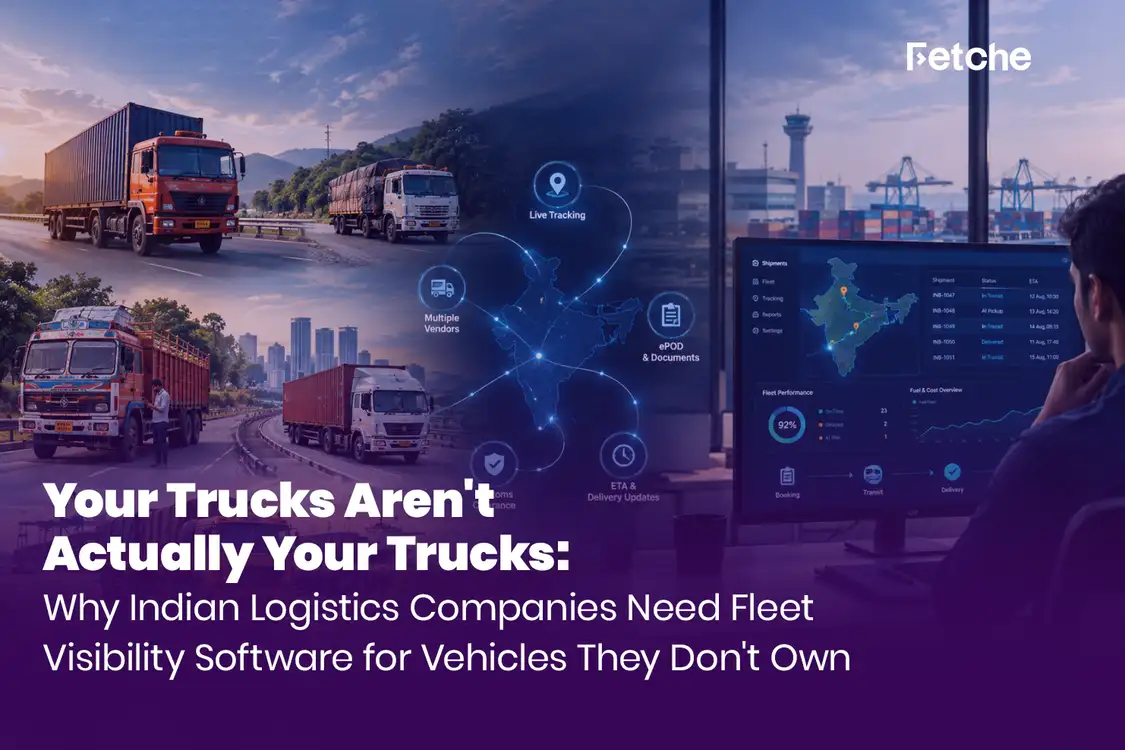
Ask most logistics operators in India how many trucks are in their fleet, and you’ll usually get two very different numbers. One is the fleet they own. The other, almost always the bigger one, is the fleet they use: market vehicles booked through brokers, attached trucks that show up for a season and disappear, subcontracted capacity pulled in to cover a spike in volume. That second number is where most of the freight actually moves. And it’s also where most operators have almost no real visibility at all.
This isn’t a management failure. It’s structural. India’s trucking industry runs on borrowed capacity, and the software most companies use was never designed to track a truck it doesn’t own. If your business is still trying to run “fleet visibility” the way a company with 100% owned vehicles would, you’re solving the wrong problem. What Indian logistics companies actually need is fleet visibility software for vehicles that will never appear on their own balance sheet.
The Uncomfortable Math of Indian Trucking Ownership
Any logistics management software in India that treats the fleet as a fixed, owned asset base is starting from the wrong assumption. Start with the ownership structure itself. Roughly 70-80% of India’s medium and heavy commercial vehicle fleet is owned by operators running five trucks or fewer. Large fleet owners, the kind who might run a standardized, company-branded fleet, account for a small sliver of total capacity. Everyone else is a small owner-operator plugged into the network through a broker, a transport union, or a direct relationship with a fleet aggregator.
This is why the “spot market” exists in nearly every major transport hub in the country. When a shipper needs a vehicle on short notice, the request rarely goes to an owned fleet — it goes out into a live market of independent truck owners, each with their own vehicle, driver, and schedule. Roughly a third to two-fifths of freight movement in India runs on some form of contractual arrangement; the rest is booked more or less on the fly, vehicle by vehicle, trip by trip.
For a logistics company, a 3PL, or a freight forwarder, this means the fleet that actually executes your promises to customers is a patchwork of vehicles you’ve booked, not vehicles you control. You can specify a truck type, a route, and a delivery window, but the vehicle itself, its maintenance history, its driver, and critically, its location, all belong to someone else.
The Tracking Device Isn’t Yours Either
Here’s the part that catches a lot of operators off guard: even the GPS hardware on these trucks usually isn’t something your company controls. Under India’s AIS-140 standard, every commercial vehicle is required to carry a certified Vehicle Location Tracking Device or VLTD (GPS- and NavIC-based hardware that reports position to a government backend) as a condition of the vehicle’s fitness certificate and permit. It’s a genuinely useful piece of regulation. But the VLTD is fitted to the vehicle, owned by the vehicle’s registered owner, and tied to that owner’s compliance obligations, not to whichever logistics company happens to be renting the truck’s capacity for a single trip.
In practice, this means the truck you’ve booked for a two-day haul is already being tracked but not by you, and not in a system you can query. Your visibility into that trip depends entirely on what the vehicle owner, the broker, or the driver chooses to share, usually over a phone call or a WhatsApp message. The device exists. The data exists. You just don’t have access to either.
This is the real gap behind the “your trucks aren’t your trucks” problem. It isn’t only that the asset is external. It’s that the entire tracking layer built around that asset is external too. Any fleet visibility approach that assumes hardware ownership simply doesn’t apply to a fleet you’re borrowing one trip at a time.
What This Blind Spot Actually Costs You
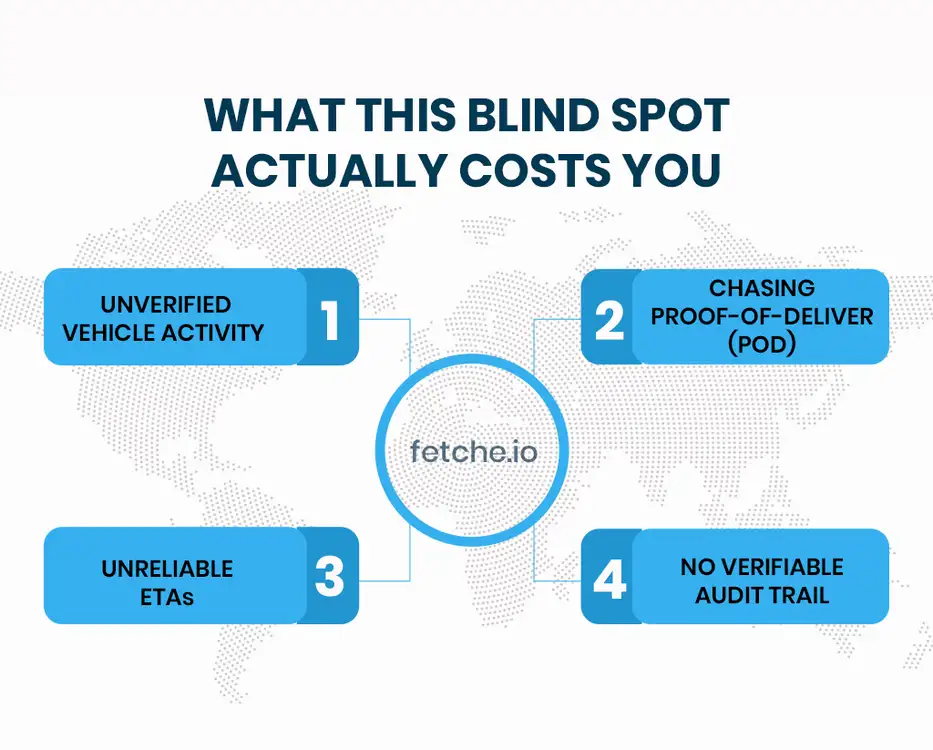
The consequences show up in fairly mundane, recurring ways rather than one dramatic failure.
- Detention charges become a negotiation instead of a fact, because nobody can independently verify when a vehicle actually arrived or was released at a dock.
- Proof-of-delivery turns into a chase — a phone call to the driver, a call to the broker if the driver doesn’t answer, and a delay before the customer gets a status update they were expecting in real time.
- ETAs are estimates built on habit and hope rather than live position data. And when something does go wrong — a diversion, a delay, a dispute over which vehicle actually carried a shipment — there’s no verifiable trail to fall back on.
None of this is unique to any one company. It’s the default state of operating with a majority non-owned fleet in a market where over a million trucks have only recently started getting pulled into any kind of organized, digital network. Indian trucks already average roughly 300 kilometers a day, well below the 500-800 km/day seen in more mature freight markets — and blind spots in vendor and subcontractor visibility are a meaningful part of why utilization stays low even as freight demand keeps climbing.
There’s also a quieter cost that compounds over time: you lose the ability to tell your reliable vendors from your unreliable ones. Without a consistent record of which brokers and market vehicles actually showed up on time, which drivers routinely delay checkpoint updates, and which subcontractors generate the most disputes, every renewal or rebooking decision goes back to memory and gut feel. In a market where you’re re-sourcing capacity constantly, that’s an expensive way to run vendor management.
Fleet Visibility Software for Vehicles You Don’t Own: What It Actually Needs to Do
The fix isn’t installing your own hardware in every truck you happen to book. That’s neither practical nor necessary. It’s rethinking what “fleet visibility” means when the fleet is fluid.
Visibility needs to be tied to the trip, not the asset. A vehicle you’ve booked for one movement doesn’t need to be “yours” for the tracking to work. It needs a system that captures location and status for the duration of that specific job, then closes out cleanly when the job ends. That’s a fundamentally different design problem than tracking an owned fleet.
Practically, this looks like a few things working together:
- Driver-app-based check-ins that don’t require the vehicle to have your company’s hardware installed. The driver logs pickup, transit checkpoints, and delivery from a phone.
- Trip-linked GPS sharing where location visibility is tied to an active booking or consignment rather than permanent access to someone else’s vehicle.
- Digitized proof-of-delivery and documentation replacing the phone-call-and-photo workflow with a timestamped record attached to the shipment.
- Vendor and subcontractor performance data like turnaround time, on-time percentage, and dispute frequency captured automatically across every booking, so you’re building a track record of the market vehicles and brokers you actually rely on, not just guessing which ones are reliable.
This is a software-layer solution to a hardware-layer problem, and it’s the only version of “fleet visibility” that actually fits how Indian logistics operates.
Choosing the Right ERP for Logistics in India
This is also why the software conversation for Indian logistics companies has shifted. A few years ago, this kind of software mostly meant digitizing paperwork — bookings, invoices, basic tracking for an owned fleet. Today, with e-commerce volumes climbing and freight demand expected to keep growing well into the next decade, the bar has moved. A good ERP for logistics in India now needs to handle mixed fleets by default: owned vehicles, attached vehicles, and one-off market bookings, all inside the same operational view.
When evaluating these platforms, a few questions matter more than the feature list: Does the platform assume every vehicle is yours, or can it track a booked trip regardless of who owns the truck? Does it connect tracking data directly to the transportation management and billing workflow, so a delayed vehicle automatically flags a detention charge instead of requiring someone to notice it manually? And does it give you performance data on the brokers and subcontractors you depend on, not just the vehicles you own outright?
Most of the well-known platforms in the market were built around one model of trucking — usually the organized, owned-fleet model common in more mature freight economies. That’s a mismatch for a country where the majority of capacity is fragmented and rented by the trip.
It’s also worth being clear-eyed about what software can and can’t fix on its own. No ERP will consolidate India’s fragmented truck ownership or replace the broker networks that make the spot market work — that structure isn’t going away. What the right platform can do is make the fragmentation manageable: giving you one place to see every booking regardless of who owns the vehicle, instead of stitching that picture together from a dozen phone calls a day.
Where a Platform Like Fetche Fits
This is the specific gap platforms positioned as top ERP software in India for logistics are increasingly being built to close. And it’s the gap Fetche’s platform is built to close for companies operating in exactly this kind of mixed-fleet environment. Its Track and Trace and Fleet Management modules are built to follow a shipment through its full journey whether the vehicle carrying it is owned, attached, or booked from the spot market for a single run while the Transportation Management System handles the booking, carrier assignment, and documentation around that trip, and Analytics turns the resulting data into a working scorecard of which vendors, brokers, and market vehicles are actually reliable over time. None of that requires owning the truck or its tracking hardware — it requires a system built with non-owned capacity as the default, not the exception.
Final Note
The fleet you’re moving freight on today is mostly borrowed, and it will keep being mostly borrowed — that’s the structure of Indian trucking, not a temporary phase. The operators who get ahead won’t be the ones who wait to own more trucks. They’ll be the ones who stop trying to run visibility like an owned-fleet company and start running it like what they actually are: a company that orchestrates other people’s vehicles and needs software built for exactly that.
Frequently Asked Questions
You track the trip, not the truck. Rather than installing your own hardware on every vehicle, logistics companies use driver-app check-ins, trip-linked GPS sharing, and digital proof-of-delivery tied to each booking. Visibility is granted for the duration of the job and tied to the shipment record, not permanent ownership of the vehicle.
Yes, though not through the vehicle’s own AIS-140 VLTD, which reports to the vehicle owner’s compliance system rather than to whoever booked the truck. Instead, logistics companies rely on trip-specific tracking — usually a driver’s mobile app or a temporary location-sharing link — layered on top of the government-mandated device that’s already on the vehicle.
Yes. The category has moved beyond software built purely for owned assets. Platforms designed for India’s fragmented trucking market now support hired, attached, and market vehicles as first-class citizens in the fleet view, alongside any vehicles a company owns outright.
Visibility over vendor-owned or subcontracted fleets typically comes through the booking and tracking workflow rather than direct access to the vendor’s vehicles. Each trip generates its own tracking, documentation, and performance data, which accumulates into a vendor scorecard over time showing which subcontractors consistently deliver on schedule and which don’t.
Very much so — arguably more than for companies with fully owned fleets. A TMS for third-party transporters in India manages carrier selection, rate negotiation, load assignment, and documentation across a constantly shifting pool of vendors, which is exactly the operating model most Indian logistics companies run on.
Real-time tracking for market vehicles is possible, but it works differently than tracking an owned fleet. Since these vehicles are booked on a per-trip basis, tracking is usually enabled for the length of that specific booking through a driver app or shared link, rather than through permanent hardware access.
Look for a platform that treats non-owned vehicles as the default operating model, not an edge case: trip-based tracking instead of asset-based tracking, digital proof-of-delivery, automatic detention and SLA flagging, and vendor performance analytics that build a reliability record across brokers and subcontractors over time.