
On 31 March 2026, the Dedicated Freight Corridor Corporation of India ran its final trial between Jawaharlal Nehru Port Terminal and Vaitarna, completing the Western Dedicated Freight Corridor. For the first time, India has two end-to-end freight rail corridors running trains at up to 100 km/h — roughly double the speed of the general network — with double-stack containers instead of single.
That’s the kind of project that eventually shows up in a GDP number. A joint DPIIT-NCAER study, the first systematic assessment of its kind, put India’s logistics cost at 7.97% of GDP in FY24, down from 8.84% the year before. A separate CII-Knight Frank report, using a broader industry methodology, puts FY26 closer to 10–10.7% still a steep fall from the 13–14% of GDP the country carried a decade ago. The two numbers disagree because they’re measuring different things, but the direction is the same, and so is the explanation: PM Gati Shakti, the freight corridors, Bharatmala’s highways, Sagarmala’s ports.
None of that is really in dispute. What gets discussed far less is who actually captures the saving. A rail corridor running at 100 km/h doesn’t automatically make a mid-market freight forwarder’s Delhi–Mumbai lane cheaper not unless something inside that company is watching the corridor, replanning the route, and updating the paperwork to match. Increasingly, that something is software, not steel.
Where the Improvement Is Actually Coming From
It’s worth being precise about where the macro number comes from, because it sets up what comes next.
The Eastern Dedicated Freight Corridor has been fully commissioned since 2023–24. The Western corridor 1,506 km from JNPT to Dadri — reached full completion this March, after DFCCIL’s trial run on the final JNPT–Vaitarna stretch. Together, the two corridors span roughly 2,843 km, with over 96% already commissioned, and traffic on the network has climbed accordingly: from an average of 247 trains a day in FY24 to 371 by February 2025, with a single-day record of 892 train interchanges set in January 2026. The Union Budget for 2026–27 added a third corridor to the pipeline, connecting Dankuni in West Bengal to Surat in Gujarat, with three more North-South, East Coast, and East-West currently at the detailed project report stage.
Layered on top of the rail build-out: PM Gati Shakti’s geospatial planning platform, which coordinates road, rail, port, and utility projects that used to be planned in isolation; Bharatmala’s national highway programme; and Sagarmala’s port modernisation, which has helped move India from 54th to 38th on the World Bank’s Logistics Performance Index between 2014 and 2023.
Running alongside the physical build-out is the National Logistics Policy, launched in September 2022 specifically to handle what Gati Shakti doesn’t: process reform, digitisation, and a shared data platform (ULIP) across agencies. Its own benchmark is a single-digit logistics cost as a share of GDP by 2030. Worth keeping in mind, because it’s essentially the same split this article makes at company level — physical infrastructure is one problem, and the software or process layer sitting on top of it is a separate one.
Whichever figure you anchor to, the country is spending meaningfully less of its GDP moving goods than it did ten years ago. That’s the backdrop. The open question is what happens once those goods reach a company that’s still running its fleet, its billing, and its customs paperwork more or less the way it did before any of this was built.
The Part Infrastructure Doesn’t Touch
This is where the national number and a specific company’s freight bill start to pull apart and it’s worth being concrete about why, because “inefficiency” as a word tends to hide more than it explains.
Start with trucks, since road still carries the bulk of Indian freight. An Indian truck averages 250–300 km a day. The same vehicle class covers 700–800 km a day in the US, and over 500 km in China. That gap isn’t mainly about road quality anymore — Bharatmala and the DFC have taken care of a lot of that. It’s about how loads get planned: which truck goes where, how much of the return leg runs empty, how long a vehicle sits idle at a checkpoint waiting on a document that could have been generated before it left the yard. Every 10% gain in fleet utilisation is estimated to cut long-haul freight rates by 6–7% — a bigger lever, at this point, than most further road-building, and one that has nothing to do with the road itself.
Ports tell a similar story. Despite FASTag and the government’s logistics data platform ULIP, Indian ports still average three to four days of dwell time against a global norm of one to two, and trucks lose six to eight hours per trip to manual interventions that better-instrumented ports have already automated. Detention and demurrage on that lost time run ₹20,000–40,000 per container — a cost a brand-new berth doesn’t erase if the paperwork behind it is still handled by hand.
And the gap isn’t spread evenly. That same DPIIT-NCAER study found small firms carry logistics costs equal to 17% of their output, against 7.6% for large enterprises. Big companies absorb inefficiency through scale and, often, dedicated in-house systems — Allcargo Gati’s 2025 migration of its ERP and control-tower operations to the cloud reportedly lifted operational efficiency by around 20%. Mid-market operators rarely have that same in-house capacity, which is exactly why a corridor completing on schedule matters less to their bottom line than whether their own systems can actually use it.
What a Logistics ERP Actually Closes
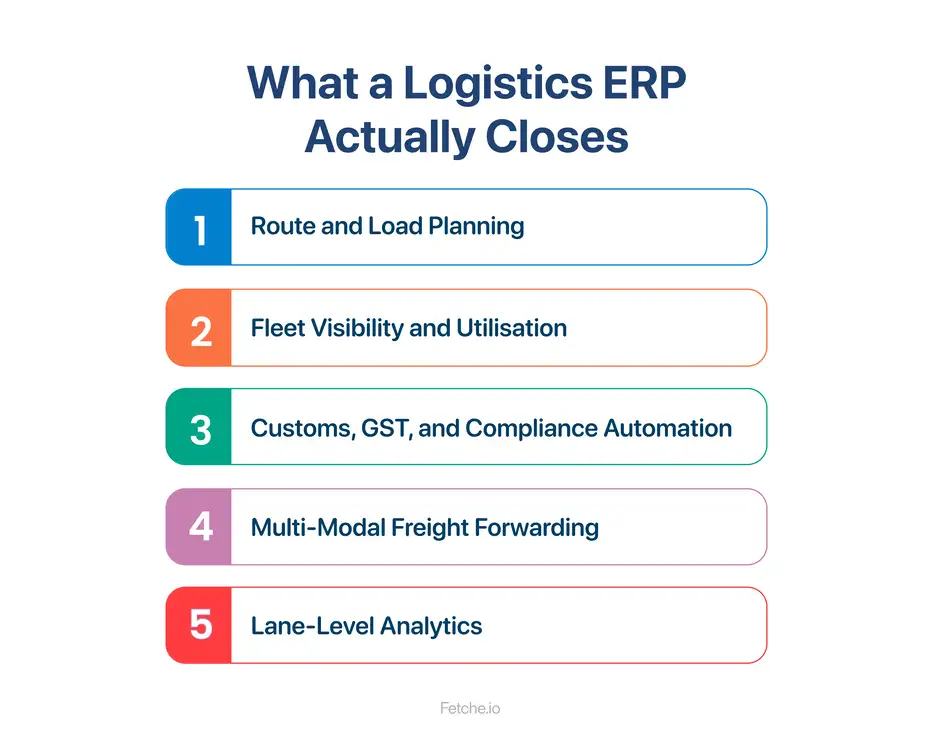
This is the layer that decides whether a macro improvement turns into a company-level saving, or just stays a line in next year’s Economic Survey — the supply chain management layer, in the broadest sense. It’s worth walking through what it does mechanically rather than filing it under “digital transformation” and moving on.
Route and Load Planning
A dispatcher working from a static spreadsheet can’t respond to a corridor that got faster last month. Route optimisation software that reads live traffic, capacity, and corridor data is what turns a faster rail link or a new highway stretch into an actual shorter transit time on a specific shipment, instead of a theoretical one.
Fleet Visibility and Utilisation
Fuel, GPS, and maintenance data usually live in three different places — a logbook, a driver’s phone, a service register. The moment that data sits in one system, discrepancies that were invisible before become visible: a gap between fuel purchased and fuel actually used, a vehicle spending more time idle than moving, a maintenance window that was quietly skipped. This is what real-time fleet tracking software is built to catch — the direct answer to the utilisation problem above, and where a lot of the “missing margin” in Indian fleet operations tends to hide.
Customs, GST, and Compliance Automation
GST e-invoicing, e-way bills, and the paperwork a shipment needs at a state border or a port are a direct contributor to that three-to-four-day port dwell time and those six-to-eight lost hours per trip — not because the requirements are unreasonable, but because filling them out by hand, more than once, in more than one format, is slow and error-prone. Customs clearance automation — in practice, e-way bill compliance software that generates documentation once and reuses it across the shipment’s life — removes the friction at the exact point it usually shows up: the checkpoint, not the highway. And with DPDP Rules now in force since November 2025 and enforcement phasing in through 2027, how a system handles driver, customer, and shipment data has become a compliance question in its own right, not just an operational one.
Multi-Modal Freight Forwarding
Rail is now faster and cheaper per tonne-km on the routes the DFC covers, yet road remains the default for a lot of Indian freight simply out of habit and limited visibility into the alternative. Multi-modal transportation software that plans road, rail, sea, and air from a single system is what actually lets a company route a shipment onto the corridor instead of defaulting to what’s familiar — and it’s the layer that matters most for 3PLs and freight forwarders juggling multiple carriers and modes on a client’s behalf.
Lane-Level Analytics
Total revenue on a route and actual profit on that route are different numbers once fuel, detention, and empty-running are counted against it — and in a lot of mid-market operations, finance only has visibility into the first one. Analytics that surfaces true lane-level margin — essentially a freight audit function built into the ERP rather than a separate exercise done after the fact — is what closes that particular blind spot.
What to Look for in the Top Logistics ERP in India
Given all of that, evaluating a top logistics ERP in India comes down to a short list of things that actually matter for a mid-market operator as opposed to a feature checklist built for a different market and localised afterward.
- Native GST and e-way bill generation a bolted-on compliance plugin tends to break exactly when a state changes a filing requirement, which happens often enough to be a real operating risk
- True multi-modal planning across road, the DFC network, sea, and air in one interface, not four systems stitched together after the fact
- Real-time GPS, FASTag, and IoT fleet integration that turns “we should have better visibility” into a dashboard a dispatcher actually checks every morning
- DPDP-aware data handling for driver, customer, and shipment data, given that rules are already in force and enforcement is ramping up through 2027
- Pricing and support built for mid-market scale, not a $150M-enterprise platform scaled down, with an implementation team that understands how documentation requirements vary by state
The operators who get the most out of a cloud-based logistics ERP in India are usually the ones who picked a platform sized and supported for exactly the scale they’re operating at not the biggest name on a shortlist.
Why the Timing Matters Right Now
There’s a reason this is a 2026 conversation and not a 2027 one. The Western DFC just went fully live. Analysts going into this year’s budget were pushing for exactly the same thing operators need internally: FASTag data, GPS movement, and e-way bill records unified into one real-time view, so that congestion, detention, and idle time show up as they happen rather than a week later in a reconciliation report. And India will reportedly need more than 200 multimodal logistics parks by 2047 infrastructure that, per industry estimates, can cut total logistics costs by 10–12% and improve turnaround by 20–25% for the operators plugged into it.
Every one of those gains assumes a company on the other end that can actually consume the data and act on it. A fleet still tracked mostly by phone calls and spreadsheets, with driver coordination running through a messaging app and accounting kept entirely separate, won’t be positioned to use any of it. As the infrastructure layer gets faster and better instrumented, the gap between operators with a real-time system and operators without one gets wider, not narrower because the bottleneck simply moves from the road to the back office.
The Bottom Line
India’s logistics costs are falling because the country spent a decade building the physical layer. What happens next, for any individual operator, depends on whether there’s logistics automation in place to actually capture it a software layer built around how Indian logistics companies operate, rather than adapted from somewhere else after the fact.
Fetche’s cloud-native platform spanning TMS, fleet management, customs clearance, freight forwarding, and analytics is built for exactly that: mid-market operators who need the corridor, the port, and the highway to actually show up as savings, not just as a statistic in next year’s Economic Survey.