
Something is changing quietly inside the best-run logistics operations in 2026. Shipment exceptions are being resolved before the operations team even sees them. Routes are being adjusted mid-journey without a dispatcher making a call. Customs documentation is being generated, checked, and submitted without a human touching a keyboard. And inventory positions are being rebalanced across warehouses based on demand signals that no analyst had time to read.
This is something better than automation. This is something structurally different. This is agentic AI in the supply chain. If you’ve been reading about AI in logistics and wondering what’s actually happening, this is the piece that explains it plainly.
What Is Agentic AI in Logistics?
Most AI systems in logistics today are assistive. They suggest better routes, predict delays, generate reports, etc. But they still rely on human decisions. Agentic AI is different. It does not just assist. It acts.
In short, agentic AI systems can detect problems, decide what needs to be done, and take action automatically. And they do all this without waiting for human output.
Agentic systems can set goals, plan sequences of actions to achieve them, use tools (APIs, databases, external systems), and adapt when conditions change. They operate in loops – act, observe, adjust – rather than in straight lines. For logistics, where conditions change constantly (weather, port congestion, carrier capacity, border delays, demand spikes), that loop is exactly what’s needed.
What is a Self-Healing Supply Chain?
A self-healing supply chain is exactly what it sounds like. It identifies disruptions. It fixes them. It keeps operations running. All in real time. Without manual intervention. And all this is possible because agentic AI is working inside a logistics automation software operation.
Let’s break that down with an example:
A shipment is delayed at a border.
Case 1 – Traditional system
- Alerts the operations team
- Team investigates
- Team contacts the carrier
- Team finds an alternative
Time lost – Several hours
Case 2 – Agentic AI system
- Detects delay instantly
- Evaluates alternative routes or carriers
- Rebooks shipment automatically
- Updates customer in real time
Time lost – Minimal
What Self-Healing Doesn’t Mean
It’s worth being direct about the limits, because overselling AI capability in logistics is a real problem that leads to disappointed implementations.
Self-healing agentic AI supply chains do not mean zero human involvement. They mean human involvement concentrated at the decision points where it adds the most value, like complex exceptions, relationship management, strategic planning, and situations that fall outside the parameters the agent was designed to handle. The agent absorbs volume, and humans handle judgment.
Agentic AI also does not fix bad data. An agent reasoning on inaccurate inventory records, outdated carrier rates, or inconsistent shipment data will produce confident wrong answers. The foundational requirement for agentic AI to work is data quality, which is itself an argument for consolidating operations onto a single platform before layering AI on top.
Moreover, implementation takes time. The businesses that are operating AI-capable logistics platforms effectively in 2026 started building the data infrastructure one or two years ago. That’s not a reason to delay; it’s a reason to start now rather than later.
Why AI in Logistics Is Moving Toward Autonomy
The push toward agentic AI is not just innovation for the sake of it. It is a response to real industry pressure.
Modern logistics is characterized by the following issues:
- Increasing supply chain complexity
- Rising customer expectations
- Volume growth
- Cost pressure
Thus, agentic AI is emerging because the pace and complexity of logistics have outgrown human response time. Modern supply chains generate constant streams of decisions, and handling each one manually creates lag. That lag is where costs rise, service levels drop, and opportunities are lost. While traditional AI helped teams make better decisions, it still depended on someone to act. Agentic AI removes that gap. It connects decision-making directly with execution, allowing systems to respond instantly as conditions change. In an environment where every minute impacts cost and reliability, autonomy is no longer an upgrade. It is becoming the only way to operate at scale.
Where Agentic AI Is Already Being Used in Logistics
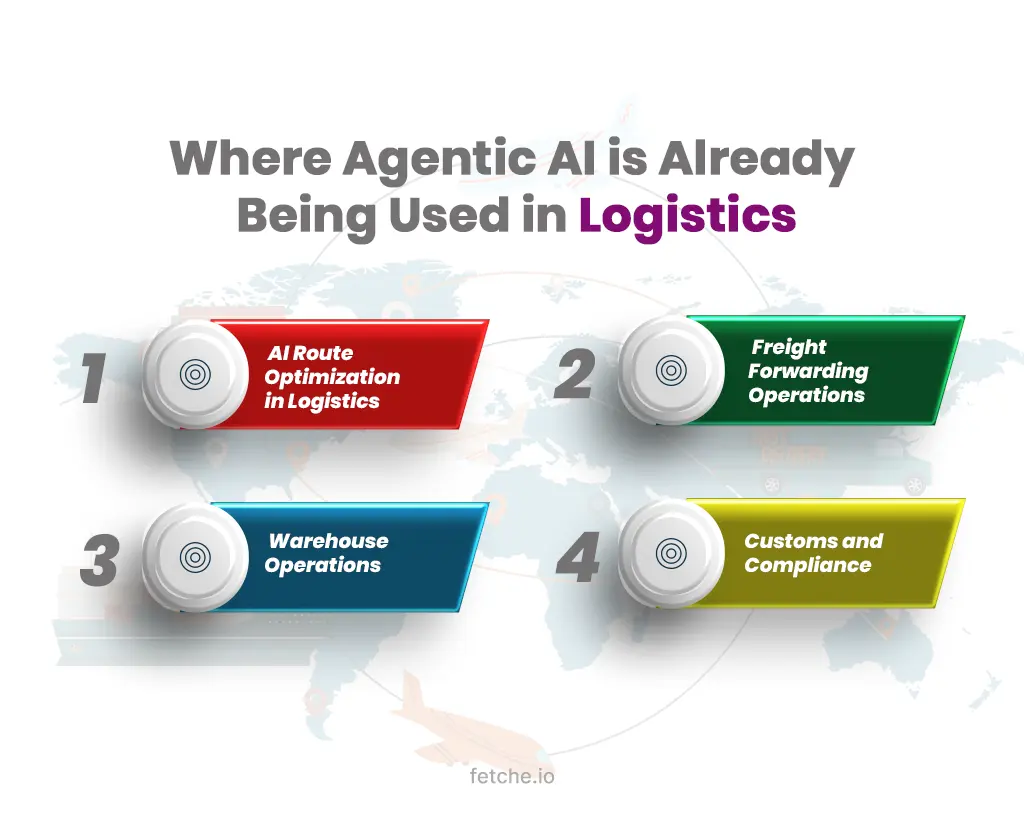
This is not a future concept. It is already being applied. Let’s take a look at some examples:
- AI Route Optimization in Logistics
Routes are no longer static. AI systems dynamically adjust based on traffic, fuel efficiency, and delivery priority. Agentic AI takes it further by automatically rerouting shipments without human approval.
- Freight Forwarding Operations
In modern AI in freight forwarding software:
- Rate comparisons happen automatically
- Bookings are optimized in real time
- Disruptions are handled without escalation
- Warehouse Operations
Agentic AI helps in:
- Inventory balancing
- Demand prediction
- Automated replenishment
This reduces stockouts and overstocking.
- Customs & Compliance
AI systems can:
- Validate documentation
- Detect missing data
- Ensure compliance
Agentic AI goes further by generating and correcting documents automatically.
What This Means for Logistics Businesses in the GCC
For freight forwarders, 3PLs, and transport operators across the GCC, the AI shift in logistics carries specific commercial implications.
Enterprise shippers, including manufacturers, distributors, and retailers, are beginning to include technology capability assessments in their vendor selection process. Can you provide real-time visibility using modern supply chain visibility software? Can you demonstrate a track record of proactive exception management? What happens to a shipment when something goes wrong at midnight? These questions are increasingly being asked, and the answers that win contracts are the ones that point to systems rather than people.
Why Most Logistics Businesses Are Not Ready Yet
Here’s the reality. Many companies want AI. But they are not ready for agentic AI. Here’s why:
- Fragmented Systems
Data is spread across:
- Spreadsheets
- Multiple tools
- Disconnected platforms
Agentic AI needs unified data.
- Lack of Real-Time Visibility
Without real-time tracking, AI cannot act effectively.
- Manual Workflows
If core operations are still manual, automation becomes difficult.
- Generic Software Limitations
Most generic ERP systems are not built for logistics complexity. They lack:
- Multi-modal workflows
- Real-time coordination
- Industry-specific logic
Building the Right Foundation
There’s a misconception worth addressing directly. AI in logistics is sometimes framed as a standalone capability — an AI tool you bolt onto your existing systems. In practice, agentic AI only delivers value when it operates on connected, clean, real-time data. That data lives in your ERP. Without it, AI agents have no operational surface to work on. This is why the ERP choice is now an AI infrastructure choice, not just an operations software choice. A modern AI logistics ERP is what allows agentic systems to access clean data, trigger actions, and operate across the entire supply chain.
Without ERP:
- AI cannot access clean data
- AI cannot trigger actions
- AI cannot scale
This is why platforms like Fetche.io — which connect TMS, WMS, freight management, and customs compliance in one environment — are increasingly being evaluated not just as logistics ERP but as the infrastructure layer for AI-driven operations.
Conclusion
Agentic AI is not a future concept waiting to mature. It is already reshaping how logistics operations run in 2026. Self-healing supply chains are a direct result of that shift. They do not eliminate complexity. They make it manageable. And most importantly, they do not remove humans from the system. They reposition them where they add the most value.
But agentic AI cannot work in isolation. Agentic AI needs connected systems, clean data, and real-time visibility. This means the businesses that benefit from AI in logistics are not just the ones experimenting with AI tools. They are the ones building the right operational foundation underneath it.
FAQ
An agentic AI system in logistics operates as a continuous decision-making loop. It reads live data from connected systems (shipment feeds, carrier APIs, customs platforms, warehouse sensors), reasons about changes or exceptions, takes action through the tools available to it, and verifies the outcome.
A self-healing supply chain is one where disruptions trigger automated corrective responses rather than manual intervention. When a shipment is delayed, an alternative is identified and actioned. When documentation has an error, it is caught and corrected before reaching the border. When inventory falls below the threshold, a transfer is initiated. The system doesn’t wait for a human to notice and act – it detects and responds in real time.
It’s operational. The AI capability, the integration infrastructure, and the logistics ERP platforms needed to deploy agentic AI in freight operations all exist today. Moreover, businesses in the GCC are already using AI-connected platforms for customs automation, route optimisation, and exception management.
Not necessarily, but the ERP is where agentic AI delivers most of its value. An agent connected to fragmented or siloed data can only optimize within those silos. A unified platform connecting freight, warehouse, customs, and client communication gives the agent a full operational surface to work on.