
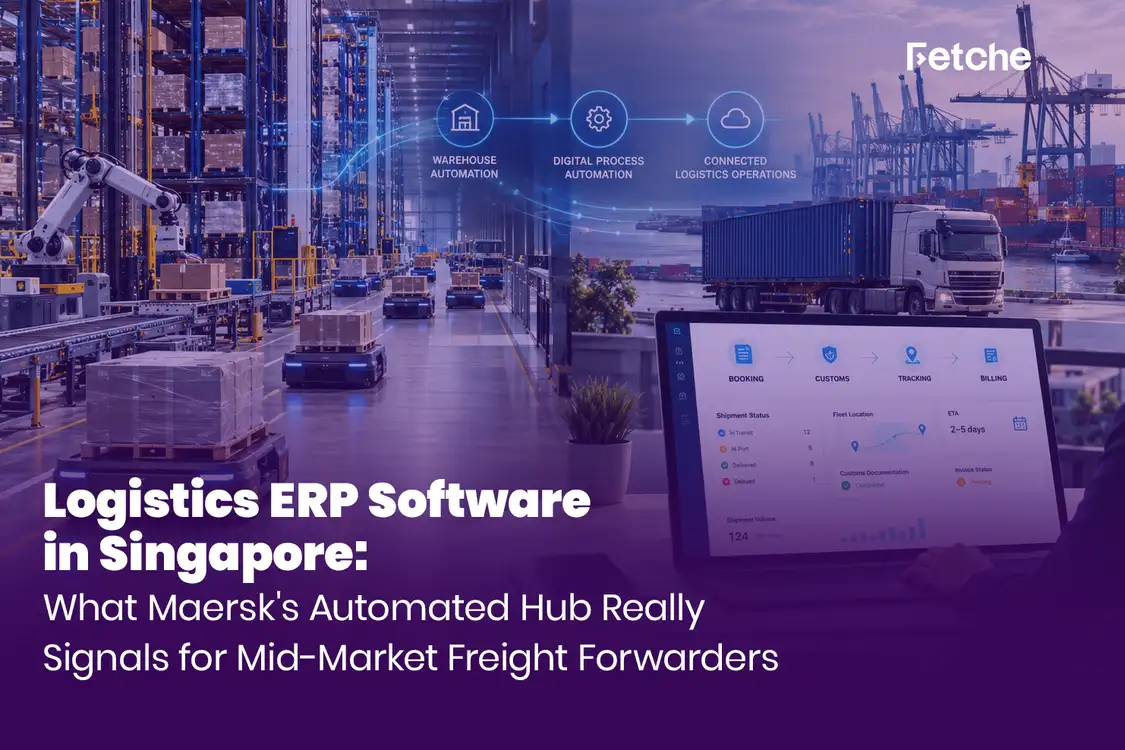
Maersk just switched on a 1.1-million-square-foot automated distribution centre in Singapore — World Gateway II, sitting close to Tuas Port and Changi Airport, built on a S$200 million-plus investment and backed by the Economic Development Board. The facility runs on robotics-driven storage, integrated warehouse and transport systems, and bonded storage with deferred GST handling. Once it’s running at full capacity, it’s expected to create around 500 new roles, most of them in automation and digital operations rather than manual warehouse work.
That’s a big number, and it’s tempting to read it as a story about Maersk. It isn’t, really. It’s a story about what Singapore’s logistics sector now treats as the baseline. When the world’s biggest carrier puts that kind of capital into automation, it resets what “efficient” looks like for everyone downstream — and every freight forwarder, 3PL, and fleet operator in that chain has to answer the same question: how do we compete on efficiency without a nine-figure infrastructure budget?
Automation at Maersk’s Scale vs. Automation Everyone Else Can Actually Reach
Most operators in Singapore aren’t going to build a robotics-driven warehouse, and that’s not a knock on them — it’s just not the right lever for a mid-market freight forwarder or 3PL running a few hundred shipments a week instead of a few hundred thousand. The gap that Maersk’s investment highlights isn’t warehouse square footage. It’s process automation: how fast a shipment actually moves from booking to customs clearance to final delivery, and how much of that path still runs through spreadsheets, email threads, and manual data entry.
This is where logistics ERP software in Singapore matters more to the mid-market than physical infrastructure ever will. A cloud-native ERP doesn’t need S$200 million or a million square feet — it needs a subscription and a team willing to move off disconnected tools. The automation Maersk poured into concrete and robotics, a mid-market operator can build into their booking, tracking, and customs workflows instead, at a fraction of the capital outlay.
Where the Friction Actually Sits for Mid-Market Freight Forwarders
Ask most freight forwarders in Singapore about their day-to-day, and the complaints are rarely about warehouse capacity. They’re about the same handful of friction points repeating every week: customs documentation re-keyed across two or three systems that don’t talk to each other, shipment and fleet status living in someone’s inbox instead of a live dashboard, and billing that gets reconciled by hand at month-end because the TMS and the accounting system were never actually connected.
Deferred GST and bonded storage — the exact features Maersk built into World Gateway II — matter here too, just at a different scale. A mid-market operator handling growing trade volume through Singapore still carries that compliance overhead, just without a dedicated compliance team to absorb it. That’s a software problem before it’s an infrastructure problem, solved by customs clearance software that automates classification and documentation instead of a bigger building doing the same job by brute force.
The same pattern shows up in fleet operations. A large carrier can justify a control tower with dedicated staff watching every container in real time. A mid-market operator with a leaner team can’t run that setup manually, but they don’t need to — a TMS that pulls GPS and load data automatically, flags delays before a customer calls to ask, and updates ETAs without someone manually checking a tracking portal gets most of the same outcome without the headcount. The point isn’t matching Maersk’s operations centre. It’s not needing one in the first place.
What the Best Freight Forwarding Software in Singapore Actually Needs to Do
If you’re evaluating the best freight forwarding software in Singapore for your operation, the Maersk news is a useful filter, not a template to copy. The question isn’t “can I automate at their scale” — it’s “does this system remove the manual steps that are actually slowing my business down today.” A few things worth checking before you commit to a platform:
Cloud-native architecture that scales with shipment volume instead of forcing new infrastructure spend every time the business grows. A TMS software module that gives real-time visibility into fleet location, load status, and delivery timelines instead of relying on driver check-in calls. Built-in customs clearance automation that handles HS code classification and documentation without a manual process bolted on the side. Analytics that actually surface where shipments are getting delayed, rather than a dashboard that just restates data you already had in a nicer font. And, just as important, a system that connects to the ports and carriers you already work with instead of asking your team to re-enter the same booking details into three different portals every week.
That last point gets skipped over a lot in vendor pitches, but it’s usually where the real time savings sit. An ERP that can’t talk to the systems a forwarder already depends on just moves the manual work somewhere else instead of removing it.
This is the layer Fetche is built around. Fetche’s Freight Forwarding ERP and Customs Clearance modules exist specifically to close the gap between what a mid-market operator can realistically implement this quarter and what mega-carrier automation delivers at an entirely different scale — automated documentation instead of manual re-entry, connected fleet visibility instead of scattered updates across three apps, and a system that carries a shipment from booking through to billing instead of leaving that connection to someone’s spreadsheet.
Why This Matters Beyond One Warehouse Opening
The EDB’s involvement in the Maersk project isn’t incidental. It reflects a broader push to position Singapore’s logistics sector around automation and digital operations, not just port throughput and container volume. That push doesn’t stop at the mega-carriers. It shapes what shippers and customers expect from every operator in the supply chain, including the mid-market freight forwarders and 3PLs who don’t have Maersk’s balance sheet but are competing for the same customers in the same market.
Operators who treat this as “not my scale, not my problem” are betting that customers won’t notice the difference in visibility, speed, or documentation accuracy. That bet gets harder to win every time a facility like World Gateway II raises the baseline a little further, because the shippers choosing between forwarders increasingly compare all of them against whatever “efficient” looks like right now — not against what was acceptable five years ago.
The Real Takeaway for Singapore’s Mid-Market Logistics Sector
Singapore isn’t asking every operator to build a robotics-driven warehouse. It’s asking every operator to run tighter, faster, and more transparently — and that’s a software problem before it’s ever an infrastructure one. Logistics ERP software in Singapore is how mid-market freight forwarders and 3PLs get the operational leverage that used to require Maersk-level capital: automated customs paperwork, connected fleet visibility, and a system that doesn’t fall over the moment volume grows past what a spreadsheet can handle.
The businesses that work this out now won’t be trying to compete with Maersk’s warehouse. They’ll be competing on the same efficiency terms it just reset — without needing to build one of their own to do it.