
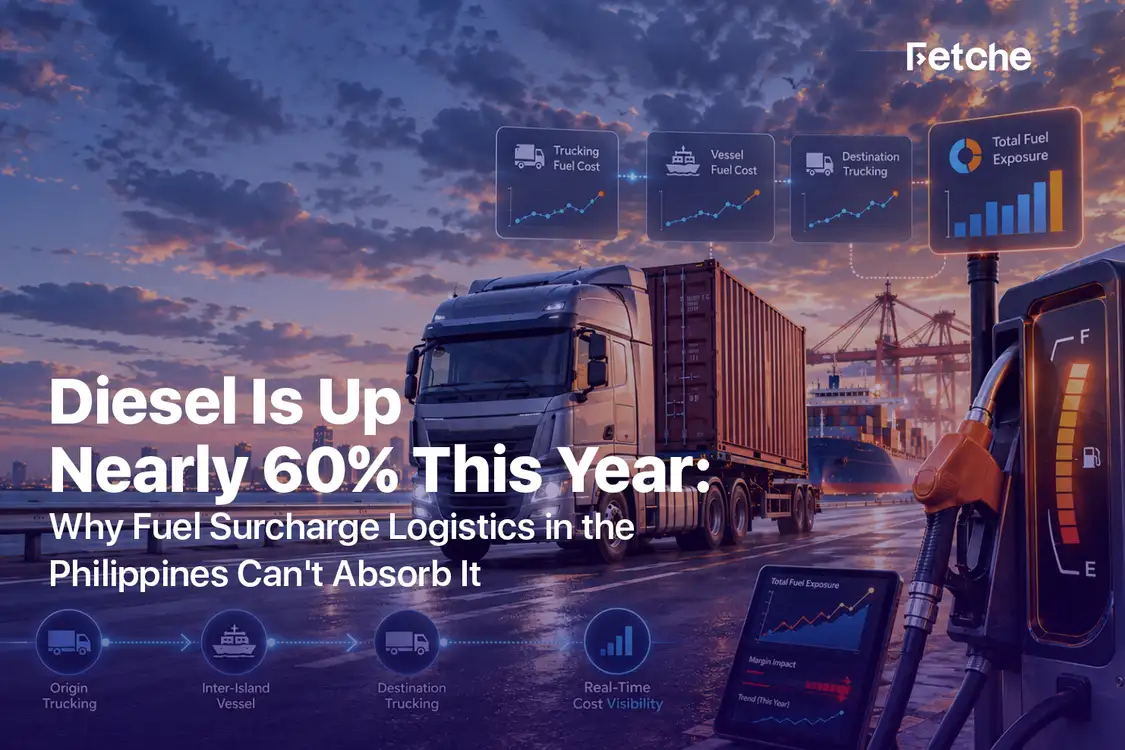
If you run freight in the Philippines, you’ve felt this year in your fuel line before you saw it in a headline. Diesel started 2026 hovering around ₱56-57 per liter. By late August, national averages were sitting in the ₱87-93 range, with a spike above ₱150 per liter in April at the height of the crisis. Depending on which week you benchmark against, that’s somewhere between 55% and 65% higher than where the year began. The cause is well documented: escalating conflict in the Middle East disrupted tanker traffic through the Strait of Hormuz, squeezed the specific crude grades Asian refineries need to produce diesel, and pushed the government to declare a state of national energy emergency in March. Since then, pump prices have moved in both directions with sharp hikes, partial rollbacks, and more hikes, but the trendline for the year is unmistakably up.
For most businesses, a fuel spike is a single budget-item problem. For fuel surcharge logistics in the Philippines, it’s structural. And the diesel price impact on logistics in the Philippines this year has exposed something more specific than “costs went up.” It’s exposed how little most fleets actually know about where those costs are coming from in real time.
How Rising Diesel Prices Affect Philippine Logistics
A single-leg trucking move in a country with continuous roads has one fuel exposure: the truck. An inter-island shipment in the Philippines rarely works that way. A typical Luzon-to-Mindanao movement might involve:
- A trucking leg to the port of origin
- A RoRo or feeder vessel crossing (with its own bunker fuel costs, which move with the same global pressures as diesel)
- A trucking leg from the destination port to final delivery
- Sometimes a second inter-island hop if the route isn’t direct
Each of those legs has its own fuel cost curve, its own surcharge structure, and often its own vendor. When diesel moves 60% in eight months, it doesn’t hit once but compounds across every leg of a multi-modal chain, which is exactly why inter-island shipping costs in the Philippines have become so hard to pin down with confidence this year. A forwarder quoting a move today, using a cost model built in January, isn’t just slightly off. They’re absorbing a stacked error across two or three separate fuel-sensitive legs at once.
Why Logistics Companies Can’t Absorb Fuel Price Hikes

Here’s where it gets expensive in ways that don’t show up until margin review. A few patterns we’ve seen play out across forwarders, 3PLs, and fleet operators this year:
- Vessel bunker adjustment lag
Shipping lines typically adjust bunker adjustment factors (BAF) on a delay relative to spot diesel and marine fuel movements. Forwarders locking in quotes based on last quarter’s bunker fuel surcharge in Philippines contracts are eating the gap themselves, especially on routes with less competitive vessel capacity where they can’t easily switch carriers mid-contract. This is one of the clearest examples of fuel surcharge logistics in Philippines operations lagging reality by a full pricing cycle.
- Idle time between legs
Port congestion, vessel schedule gaps, and customs processing all mean trucks and drivers sit. And in the Philippines, that idle time is frequently priced into trucking rates as a flat allowance set months ago. When diesel is 60% higher, the true cost of that idle window is 60% higher too, but the allowance in the rate card hasn’t moved.
- Route substitution blindness
Some inter-island lanes have two or three viable combinations of port pairs and vessel operators. When fuel costs shift the relative economics of those combinations, the cheapest route in January isn’t necessarily the cheapest route in August. Fleets without leg-by-leg cost visibility keep defaulting to habitual routing because they simply can’t see the shift, which quietly reshapes inter-island shipping costs in the Philippines lane by lane.
- Regional price variance
Fuel prices in provincial areas typically run ₱5 to ₱25 higher per liter than Metro Manila benchmarks. A costing model that uses a single national diesel average, instead of the actual price at the actual originating or destination province, is baking in a silent error on every quote for a Visayas or Mindanao-origin shipment.
None of these are new problems. They’re old blind spots that a 60% fuel swing has turned from minor variance into material margin erosion. And it’s why so many logistics companies are finding they simply can’t absorb fuel price hikes the way they used to, by rounding up the surcharge and hoping the math works out at settlement.
Fuel Surcharge Logistics in the Philippines: What “Visibility” Actually Means
The real issue isn’t that fuel went up. It’s that most fleets still price and report fuel exposure as one blended number per shipment, instead of seeing cost at the level of each individual leg (trucking, vessel, trucking). That gap is what fleet fuel cost visibility is meant to close, and it matters more this year than in a normal one, for three reasons:
- You can’t manage fuel exposure you can’t isolate
If a shipment’s cost is one number, you don’t know whether the margin pressure is coming from the vessel leg, the origin trucking leg, or the destination trucking leg. Leg-level fleet fuel cost visibility lets you pinpoint exactly where volatility is eating margin, and renegotiate or reroute that specific leg instead of the whole lane.
- Real-time leg costing beats month-end reconciliation
Forwarders finding out their true fuel-adjusted cost during invoice reconciliation are finding out too late to reprice the customer or adjust the route. The operators managing this year well are the ones who can see fuel-adjusted leg costs at booking time, not settlement time.
- Visibility compounds with route flexibility
Once you can see cost broken out by leg and by port pair, you can actually compare alternate routings on a like-for-like basis, which is nearly impossible when your only visibility is a single all-in number per shipment.
This is also where a lot of the credibility gap in Philippine freight forwarding shows up. Shippers increasingly ask forwarders to show their work — which leg costs what, why a rate moved, what the alternative routing would have cost. Operators who can answer that in real time are winning renewals. Operators who can only say “fuel went up” are losing them.
Managing Fuel Surcharges for Inter-Island Shipping
There’s a second-order effect worth naming here: shippers themselves have gotten more fuel-literate this year, out of necessity. When diesel moves 60% and pump prices make headlines weekly, procurement teams stop accepting “fuel surcharge” as an unquestioned line item and start asking for the breakdown.
That shift changes what managing fuel surcharges for inter-island shipping actually looks like in practice. It used to be enough to point to years in the market or a client roster. Increasingly, shippers want to see the mechanics like which leg of the route the surcharge applies to, how it was calculated, and why it changed from last quarter. Operators who can produce that breakdown on request are converting more renewal conversations. Operators who can only offer a single all-in rate are getting asked harder questions they can’t answer in the room.
This is, in a quieter way, a visibility problem wearing a sales problem’s clothes. The fleets holding onto margin and client trust this year aren’t necessarily the ones with the lowest costs, they’re the ones who can explain their costs, leg by leg, in a market where diesel price impact on logistics in the Philippines has made vague pricing a liability instead of an inconvenience.
Fuel Cost Optimization for Philippine Fleet Operators
Fuel cost optimization for Philippine fleet operators isn’t really a fuel problem to solve, it’s a data problem. The fleets managing this year best are the ones with systems that can actually answer, per leg and per shipment, what fuel is really costing them right now instead of what a rate card assumed back in January. That means:
- Real-time fuel cost tracking against actual consumption and route
- Analytics that flag which lanes, vehicles, or vessel partners are absorbing the most fuel volatility
- Bunker fuel surcharge in the Philippines tracked at the vessel-partner level
This is the kind of operational layer Fetche’s Fleet Management and Analytics modules are built around. It gives operators visibility into fuel cost at the level of the individual vehicle, leg, and lane, rather than a single blended number that only tells the full story after the fact. It’s less about a dashboard and more about whether the system can actually tell you, today, where your fuel dollars are going and why.
Final Thoughts – What Operators Should Actually Do Before Q4
If you’re managing fuel-exposed freight right now, a few things are worth doing before the next round of fuel adjustments lands:
- Audit your BAF lag
- Rebuild idle-time allowances using current diesel, not Q1 diesel
- Re-run your route comparisons
- Push for leg-level reporting from your logistics partners
None of this makes diesel cheaper. But it’s the difference between absorbing a 60% fuel swing as a diffuse, unmanageable cost and absorbing it as a series of specific, addressable line items – some of which you can actually do something about.
That’s the real shift this year is forcing. Fuel surcharge logistics in Philippines operations used to be manageable by feel — round up the surcharge, absorb the rest, move on. A 60% swing doesn’t leave room for that anymore. The fleets coming out of 2026 ahead won’t be the ones who found cheaper diesel. They’ll be the ones who finally built the visibility to know exactly what it was costing them all along.