
On 18 August, a container of jackfruit chips and Marayoor jaggery left Kerala’s Vizhinjam International Seaport for Valencia aboard the MSC MARIE LESLIE, flagged off by Chief Minister V D Satheesan at a ceremony most of the coverage will forget within a week. On paper, that’s a modest shipment of regional food products. Operationally, it marks the moment Vizhinjam stopped being a place where big ships hand boxes to smaller ones and became a port that Indian businesses can actually ship through.
That distinction is worth unpacking for anyone running export or import operations out of South India, because it changes more than the map suggests.
Transshipment and EXIM are not the same business
Since its first mother vessel docked in July 2024, Vizhinjam has crossed 2 million TEUs faster than any port in Indian history. Nearly all of that volume has been transshipment: containers arriving on a mega-vessel from one country, craned onto a smaller feeder ship, and sent on to their real origin or destination elsewhere. The cargo never entered the Indian economy in any commercial sense. Vizhinjam was a relay point, not a gateway.
Getting from transshipment-only to full EXIM status isn’t just a policy switch. It requires the port’s customs infrastructure, bonded areas, and inspection processes to be certified for cargo that’s actually entering or leaving the country, rather than just passing between two ships. That sign-off came this week from the Central Board of Indirect Taxes and Customs (CBIC).
Export-import (EXIM) operations are the different function that clearance unlocks. Containers stuffed by an actual Kerala exporter, or consigned to an actual Kerala importer, can now move through Vizhinjam’s own customs process instead of being trucked to Cochin, Tuticorin, or further away and shipped from there. For the port, that’s a new line of business. For every shipper in the region, it’s a new routing option that didn’t exist a week ago.
Why the 18-day cut holds up
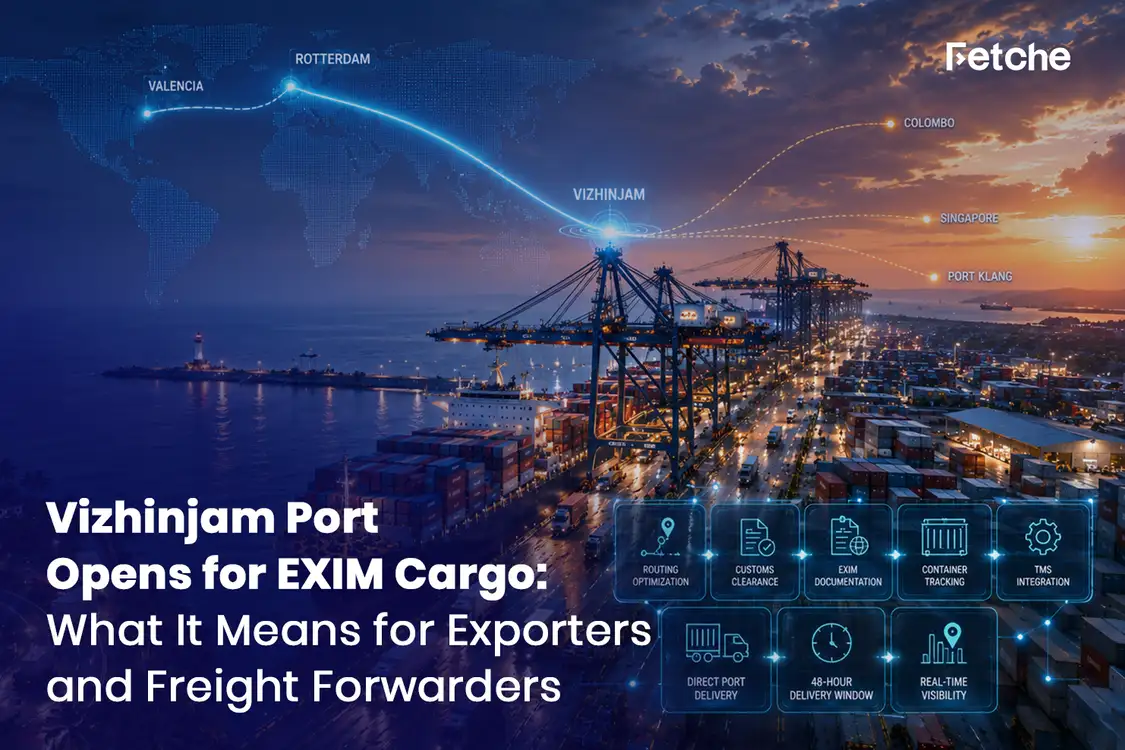
The headline figure — 22 days to Europe from Vizhinjam against roughly 40 days via the ports South Indian exporters currently use, and 35 days to the US — comes from geography, not a press release. Vizhinjam sits close to the East-West shipping corridor that carries most Asia-Europe container traffic, so vessels calling there skip the detour Indian cargo currently makes through Colombo, Singapore, or Port Klang. It also helps that Vizhinjam has a natural draft deep enough to berth the largest container ships afloat without extra dredging, and runs semi-automated yard operations that keep vessel turnaround quick, the kind of infrastructure detail that decides whether a carrier commits scheduled sailings to a new port instead of just testing it once.
That detour has a real cost at the national level. Roughly three-quarters of India’s transshipment cargo still moves through those three foreign hubs, and estimates put the resulting loss in port revenue and handling charges at over $200 million a year. Every container routed through Colombo instead of sailing direct from Vizhinjam adds feeder transit time and an extra handling cycle, and both eventually show up in a Kerala exporter’s landed cost in Valencia or Rotterdam.
MSC has committed two named services to the route: the Himalaya Express, covering Portugal, Valencia, Barcelona and Italy, and an India-Africa Service into southwestern Africa. Both give exporters a scheduled direct sailing instead of a routing that depends on transshipment capacity at someone else’s port.
The import side is still working around a missing CFS
Exports are the easier half of this launch. Imports come with a real constraint, worth understanding before you plan an inbound shipment through Vizhinjam.
The terminal doesn’t yet have a Container Freight Station attached to it — the off-port bonded facility where import containers are normally moved for examination and storage before delivery. Without one, the only way to bring cargo in is Direct Port Delivery (DPD), a CBIC scheme that lets eligible Full Container Load shipments clear customs at the terminal and go straight to the importer’s premises, skipping the CFS step entirely.
DPD isn’t open to everyone by default. It’s built for importers who already hold AEO accreditation, or who can show a track record of at least 25 FCL TEUs a year through a given port, which leaves out a lot of first-time or occasional importers until Adani Ports finishes the 100-acre CFS it has planned nearby. DPD cargo also has to clear the terminal and reach the importer’s premises within 48 hours of landing — a hard constraint if trucking and warehouse slotting aren’t arranged before the ship even berths.
Who gains first
Early bookings show where demand already sits: four containers from Thiruvananthapuram exporters so far, with more coming from Thoothukudi, Kochi and Kollam, meaning cargo is being redirected toward Vizhinjam from ports that used to be the default for the region. The sectors flagged as likely beneficiaries — spices, cashew, marine products, handloom, textiles, agricultural produce — are the small and medium exporter base that has spent years absorbing the cost of routing everything through Cochin or Tuticorin, then a foreign transshipment hub on top of that.
That’s also the segment least equipped to evaluate a new port option properly. A large exporter with a dedicated logistics desk can model whether a direct Vizhinjam sailing beats its existing routing on a shipment-by-shipment basis. A manufacturer booking four containers a month usually can’t, and defaults to whatever routing its forwarder already knows, which may not be Vizhinjam yet simply because the option is new. That gap between what’s technically available and what’s actually being used is exactly where a chunk of the early savings from Vizhinjam will quietly leak away, ribbon-cutting notwithstanding.
Where the software layer earns its keep
This is exactly the kind of shift a spreadsheet-and-email operation misses and a properly configured Freight Forwarding ERP in India catches. Choosing between Vizhinjam and an established gateway port isn’t a one-time decision; it changes shipment to shipment depending on destination, container volume, whether the importer on the other end holds AEO status, and how much slack exists in that 48-hour DPD window. That’s a routing optimisation problem, not a habit, and habit is what most exporters currently run on.
Customs adds another layer. A customs clearance automation module that already tracks AEO tier, DPD eligibility, and documentation status per shipment can flag in advance whether a container qualifies for Vizhinjam’s current import pathway or needs to wait for the CFS, instead of a forwarder finding out at the terminal gate. Paired with a TMS that can actually schedule trucking to hit a 48-hour delivery window from a port with limited landside infrastructure so far, that’s the difference between capturing the 18-day time saving and losing it back to a missed pickup slot.
None of this requires a large operation to benefit. It requires visibility into a set of variables that didn’t exist for South Indian shippers a week ago, and a system that updates routing decisions as Vizhinjam builds out the rest of its capability: the CFS, the planned rail link, and the climb to 3 million TEUs of annual capacity due by 2028. The port has already shown it can scale fast. Whether individual exporters capture the time and cost advantage now on the table depends less on Vizhinjam and more on whether their own logistics operation is set up to use it.