

In recent times, you’ve probably noticed the term “4PL” showing up in places it didn’t used to. It’s not just a rebrand. Something real is shifting in how mid-market logistics companies structure their operations, and most of the explainers out there stop at the org-chart definition without answering the question that actually matters to the people running these businesses: what does this shift demand from your systems?
That’s what we will try to answer here.
What is 4PL vs 3PL, actually?
A third-party logistics (3PL) provider executes specific, outsourced logistics functions — warehousing, freight forwarding, customs clearance, transportation, or last-mile delivery. You hand off a defined piece of the supply chain, and the 3PL runs it. The relationship is largely transactional.
A fourth-party logistics (4PL) provider sits a level above that. Instead of executing one function, a 4PL coordinates your entire logistics network, including the 3PLs, carriers, and warehouses you already work with, through a single governance layer. The 4PL doesn’t necessarily own trucks or warehouses. What it owns is the orchestration: visibility across every leg of the shipment, coordination between multiple vendors, and, critically, accountability for the outcome rather than just the task.
That accountability piece is the real difference between 3PL and 4PL providers, more than any specific service list. A 3PL is judged on whether it moved the freight correctly. A 4PL is judged on whether your supply chain, as a whole system, performed on time, on cost, and without you having to stitch together five different vendor reports to find out why it didn’t.
It’s also worth saying plainly: this isn’t always a permanent, binary choice. Plenty of companies run a hybrid model — 3PL relationships for specific lanes or warehousing, with a 4PL layer coordinating the whole picture above it. The decision isn’t “pick one forever.” It’s “what level of orchestration does your current complexity actually require?”
Why the Shift to 4PL is Accelerating in 2026
The 4PL conversation isn’t new. The model has existed in some form since the 1990s. What’s changed is the pace of adoption among companies that would have stuck with straightforward 3PL arrangements a few years ago. A few forces are converging at once:
- Supply chains got wider before they got smarter
- Market data backs up the trend
- Regulatory and trade complexity has increased
- Driver shortages
- Increased difficulty in scaling
None of this means every mid-market company needs a 4PL relationship tomorrow. It means the conditions that used to justify staying with a straightforward 3PL setup — simple network, few vendors, low cross-border complexity — are becoming less common, not more.
When to Switch from 3PL to 4PL
There’s no universal trigger point, but here are a few signals that tend to show up together when companies start seriously evaluating the move:
- Vendor sprawl is outpacing your team’s ability to manage it
- Visibility gaps are costing you money
- Cross-border complexity has crossed a threshold
- Your growth strategy depends on logistics being invisible to the customer
If none of these describe your operation yet, that’s a legitimate reason to stay with a 3PL model longer. The switch should follow complexity, not trend pieces.
The 4PL vs 3PL Cost Comparison
There isn’t a clean, universal number that says “4PL costs X% more” or “4PL saves you Y% on logistics spend.” The honest answer is that the cost structure is different, not simply higher or lower.
3PL pricing is straightforward, typically per shipment, per pallet, per warehouse square foot, or per mile. It’s easy to benchmark against a competitor’s quote because you’re comparing like-for-like execution costs.
4PL pricing typically includes a management or orchestration fee layered on top of the underlying execution costs (which still flow through to the 3PLs and carriers actually moving freight). On paper, that can look like it costs more. In practice, the value case for 4PL rests on cost avoidance that doesn’t show up on a per-shipment invoice: fewer expensive expedited shipments triggered by late exception detection, less duplicated freight audit work, better carrier rate negotiation from aggregated volume, and — often the largest line item — the internal headcount you don’t have to hire to manually coordinate five vendor relationships.
Whether that math works out in your favor depends heavily on your current network complexity. For a company with a simple, single-region network, a 4PL layer is often unnecessary overhead. For a company managing multi-country freight, multiple 3PLs, and inconsistent carrier data, the coordination cost of not having a 4PL layer is often higher than people assume, even if it’s harder to see on a monthly invoice.
The responsible way to evaluate this is a real cost comparison against your actual shipment volume and vendor count, not a generic industry percentage. Anyone offering you a clean universal number here is probably selling something.
What “4PL-Ready” Actually Means for Your Technology Stack
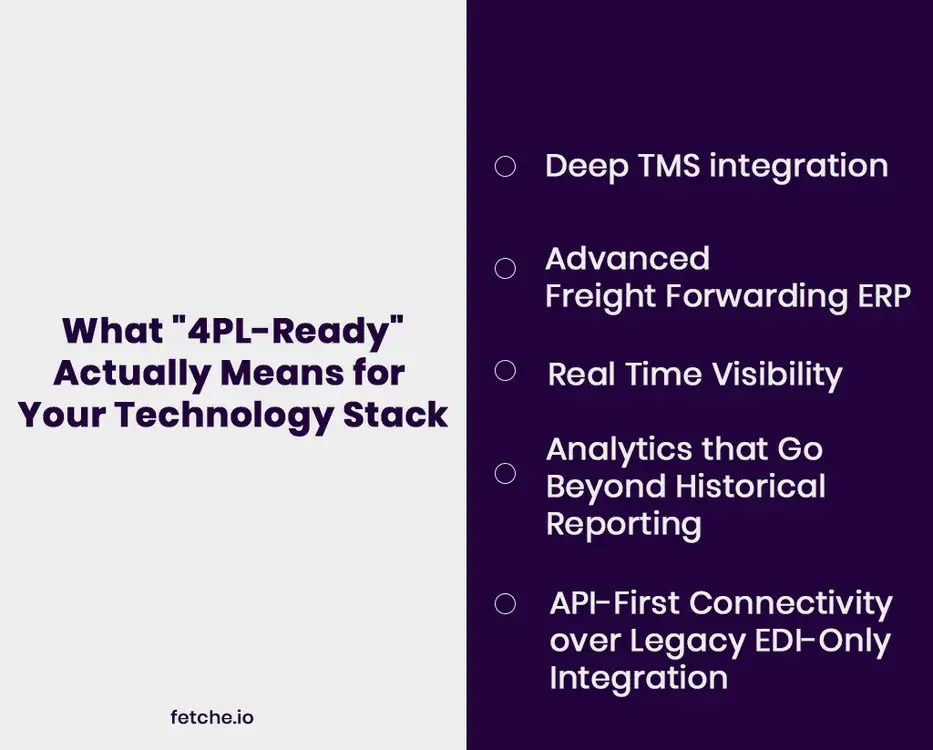
This is the part most 3PL vs 4PL comparisons skip entirely, and it’s the part that determines whether the model works at all.
A 4PL operating model is, functionally, a promise to give a client a single, accurate, real-time picture of a supply chain that runs across multiple vendors, modes, and geographies. That promise is only as good as the systems underneath it. You cannot orchestrate what you cannot see, and you cannot see clearly across a fragmented logistics technology stack held together with spreadsheets and email.
Here are a few 4PL logistics technology requirements that come up consistently when analysts break down what an operationally integrated 4PL stack actually needs:
- Deep TMS integration
There’s a real difference between a transportation management system that’s “technically connected” to your other systems and one that’s operationally integrated. The distinction shows up in the details: how much delay your operation can tolerate between a status change and a route decision, whether carrier selection reflects real-time capacity or stale data, and whether financial settlement happens automatically against carrier contract terms or requires weeks of manual reconciliation. A TMS that only connects at the surface level becomes an expensive data silo rather than an operational backbone — which defeats the entire point of moving to a coordination-first model.
- Freight Forwarding ERP that Unifies Operational & Financial Data
This means that customs documentation, shipment status, and billing aren’t living in three disconnected systems that someone has to manually reconcile at month-end. This matters more for freight forwarders and 3PLs stepping into a broader coordination role than almost anything else on this list, because the ERP is usually where the fragmentation is worst — one system for bookings, another for accounting, a third for compliance paperwork.
- Real-Time Visibility & Exception Management
Ideally, this could be through a control tower layer that sits above the individual carrier and warehouse systems. The industry is fairly aligned on this point: a control tower is only as good as the clean, structured data feeding it from the TMS and visibility layer underneath. Without that foundation, you’re paying for a dashboard, not a decision-making function.
- API-First Connectivity over Legacy EDI-Only Integration
The shift here has picked up noticeably through 2026 — EDI isn’t disappearing, but the growth is increasingly concentrated in API-augmented platforms rather than EDI-only setups, because API connections are faster to stand up with new trading partners and support the real-time data flows that orchestration actually depends on. If evaluating a TMS platform, it’s worth asking directly how much of its core functionality — rate shopping, tendering, tracking, invoicing — is actually exposed through modern APIs versus a handful of legacy endpoints.
- Analytics that Go Beyond Historical Reporting
Analytics should include lane performance, carrier reliability trends, and predictive exception flagging. This is the layer that turns “we have data” into “we make faster decisions than our competitors,” and it’s frequently the most underbuilt part of a mid-market logistics stack, because it’s the easiest piece to defer when budget gets tight.
This is, not coincidentally, close to how Fetche’s platform is structured — a TMS built for real-time shipment and carrier coordination, a freight forwarding ERP that keeps operational and financial data in one place instead of three, and analytics designed to surface lane and carrier performance instead of just producing static reports after the fact. None of that is a substitute for the operational discipline a 4PL model requires. It’s the infrastructure layer that makes the discipline possible. The label “4PL” describes an operating model. Whether that model actually functions depends entirely on whether the systems underneath it can hold a single, accurate picture across every vendor in the network.
The Best TMS Software for 4PL Providers: What to Actually Evaluate
If you’re in the market for a TMS specifically to support a 4PL or 4PL-adjacent operating model, a few evaluation criteria matter more than the standard feature checklist:
- Multi-carrier, multi-mode support.
- Depth of API coverage, not just its existence.
- Native integration with your ERP and WMS.
- Exception handling that’s proactive, not just visible.
- Analytics that support carrier and lane-level decisions.
FAQ
You should switch when vendor sprawl, cross-border complexity, or visibility gaps start creating real operational cost, not simply because 4PL is trending. Companies with simple, single-region networks often don’t need the added coordination layer yet.
Not necessarily, though the cost structure looks different. 4PL typically adds an orchestration fee on top of underlying execution costs, but the value case rests on cost avoidance — fewer expedited shipments, reduced manual coordination headcount, and better aggregated carrier rates — that doesn’t show up as a clean line-item discount.
Yes. Many logistics providers offer 3PL execution for specific lanes or functions while also providing 4PL-style orchestration for clients who need broader coordination. It’s increasingly common for the same company to operate both models simultaneously for different clients or business units.
No. Most 4PLs are non-asset-based. They don’t own the trucks, warehouses, or vessels moving the freight. Their value is in coordination, technology, and accountability across the vendors that do.
The biggest gap is usually integration depth. A 3PL can run effectively on a single-function system tied to its own operations. A 4PL needs a TMS, ERP, and analytics layer that can pull real-time data across multiple external vendors into one coherent, accurate picture, which is a harder integration problem than managing your own fleet or warehouse data.