
Singapore runs one of the busiest, most efficient supply chain hubs in the world. But “world-class port” doesn’t mean “easy operations.” Mid-market logistics companies and SMEs here are squeezed from every direction: warehouse space is tight, manpower is capped by quota rules, and customers expect same-day answers on shipments that are moving across three or four systems at once.
If you’re running a logistics or freight-forwarding business in Singapore, you’ve probably felt at least three of the challenges below this month. Here’s what’s actually driving them and where an ERP system fits into fixing them for good.
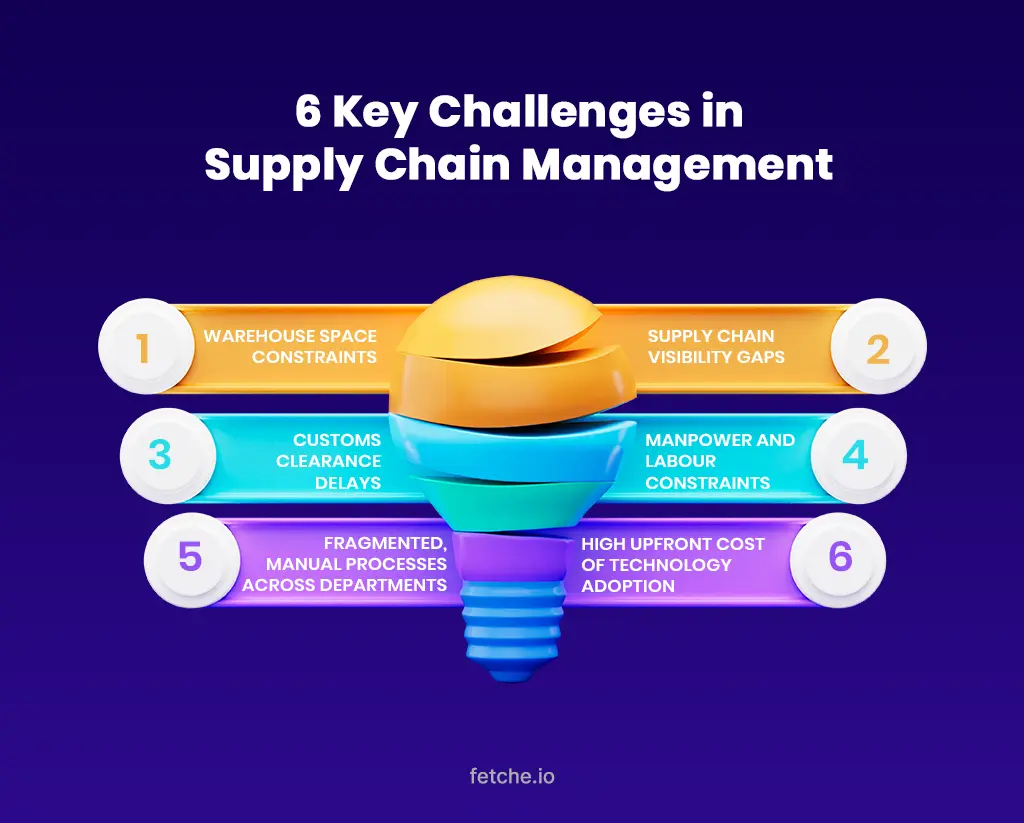
1. Warehouse Space Constraints
The challenge: Singapore’s industrial land is finite, and warehouse operators are feeling it. Warehouse vacancy climbed to roughly 11% by mid-2025 after several years of tight supply, even as occupancy across industrial space has stayed high JTC data puts overall occupancy near 88–89% through early 2026. Prime logistics rents have grown by close to 40% since 2020, and monthly warehouse rates in 2026 typically range from about S$1.00 to S$3.50 per square foot. A wave of new supply is coming through 2025–2027, but most of it targets larger, built-to-suit tenants not the SME operator trying to rent a flexible 5,000 sq ft unit near the port.
What this means day to day: SMEs are stuck paying premium rents for space they can’t fully optimise, because they don’t have visibility into what’s actually sitting on the shelves.
How ERP solves it: A logistics ERP with integrated warehouse management gives you real-time visibility into stock levels, bin locations, and turnover rates. Instead of leasing more square footage to “be safe,” you can:
- Track slow-moving vs. fast-moving SKUs and reallocate space accordingly
- Use slotting and cycle-count tools to cut wasted floor space
- Model consolidation scenarios before signing a new lease
This is the core of effective warehouse management Singapore operators need — not more space, but smarter use of the space they already have.
2. Supply Chain Visibility Gaps
The challenge: Many mid-market logistics firms in Singapore still run on a patchwork: spreadsheets for inventory, a separate system for trucking, WhatsApp for status updates, and email for customs documents. Each handoff is a place where information gets lost, delayed, or duplicated.
How ERP solves it: A single ERP platform connects procurement, warehousing, transport, and finance in one data layer. When a shipment status changes, everyone downstream — dispatch, finance, the customer-facing team — sees it immediately. This is one of the most common supply chain challenges Singapore businesses report solving once they move off disconnected spreadsheets: not because the ERP does anything magical, but because it removes the manual re-entry that causes errors in the first place.
3. Customs Clearance Delays
The challenge: Singapore’s port and customs processes are efficient by global standards, but customs clearance delays in Singapore still happen usually from incomplete documentation, HS code mismatches, or manual data entry errors between a freight forwarder’s system and TradeNet. A single wrong field can hold a container for hours or trigger a physical inspection.
How ERP solves it: ERP systems with trade compliance modules auto-populate customs declarations from existing shipment and product data, reducing the manual re-typing that causes rejections. Paperless trade infrastructure like SGTraDex which had already processed more than 35 million transactions by the end of 2024 is pushing the whole industry toward system-to-system data exchange rather than manual document handling. An ERP that can plug into these networks keeps your declarations accurate the first time, instead of after a resubmission.
4. Manpower and Labour Constraints
The challenge: Singapore caps the share of foreign workers a logistics operator can employ, and the sector is feeling the pinch. Transport job vacancies rose from roughly 2,800 to 3,800 within a single year, and wages have climbed alongside the shortage. You can’t out-hire your way through a tight labour market.
How ERP solves it: Automation doesn’t have to mean robotics on the warehouse floor (though some larger players are going there). For most SMEs, it means automating the low-value manual work: order entry, invoice matching, route planning, stock reconciliation. An ERP that automates these tasks lets a five-person ops team do what used to take eight without cutting service quality.
5. Fragmented, Manual Processes Across Departments
The challenge: Sales quotes a job in one tool, ops plans routes in another, finance invoices from a third and none of them talk to each other. This is the single biggest reason mid-market logistics firms in Singapore stay manual longer than they should: not resistance to technology, but the fear that implementing new software means months of disruption.
How ERP solves it: This is exactly the gap that modern logistics software for SME Singapore companies is built to close. A well-implemented ERP unifies sales, operations, warehousing, and finance into workflows that update each other automatically a quote becomes a job, a job becomes a shipment, a shipment becomes an invoice, without anyone re-keying data three times.
6. High Upfront Cost of Technology Adoption
The challenge: Many SME owners assume ERP means a six-figure implementation and a dedicated IT team they don’t have.
How ERP solves it: That assumption is outdated. Cloud-based systems have changed the economics entirely, and government support has made adoption easier — Enterprise Singapore’s Productivity Solutions Grant co-funds up to 50% of qualifying logistics technology costs, including cloud WMS and TMS tools. A cloud logistics ERP for SME Singapore businesses no longer requires servers, on-site IT staff, or a multi-year rollout. It’s subscription-based, deployed in weeks, and scales with your shipment volume rather than forcing you to pay for capacity you don’t use yet.
This shift matters because digital adoption in Singapore’s logistics sector is already high — 91% of transport & storage firms and 93% of wholesale trade firms have adopted at least one digital solution, per IMDA’s Digital Economy Report. The SMEs still running on spreadsheets aren’t behind because the tools are unavailable they’re behind because no one’s shown them a low-friction way in.
The Bottom Line
None of these challenges space, visibility, customs, manpower, fragmentation, cost — are unique to any one company. They’re structural to operating a logistics business in a small, high-cost, high-volume market like Singapore. What separates the operators who stay profitable from the ones who get squeezed is whether their systems are working with them or against them.
An ERP built specifically for logistics, not a generic accounting tool with a warehouse module bolted on addresses all six of these at once, because they’re all connected. Better visibility reduces customs errors. Better space utilisation reduces reliance on more headcount. Automated workflows free up your best people to actually solve problems instead of chasing paperwork.