
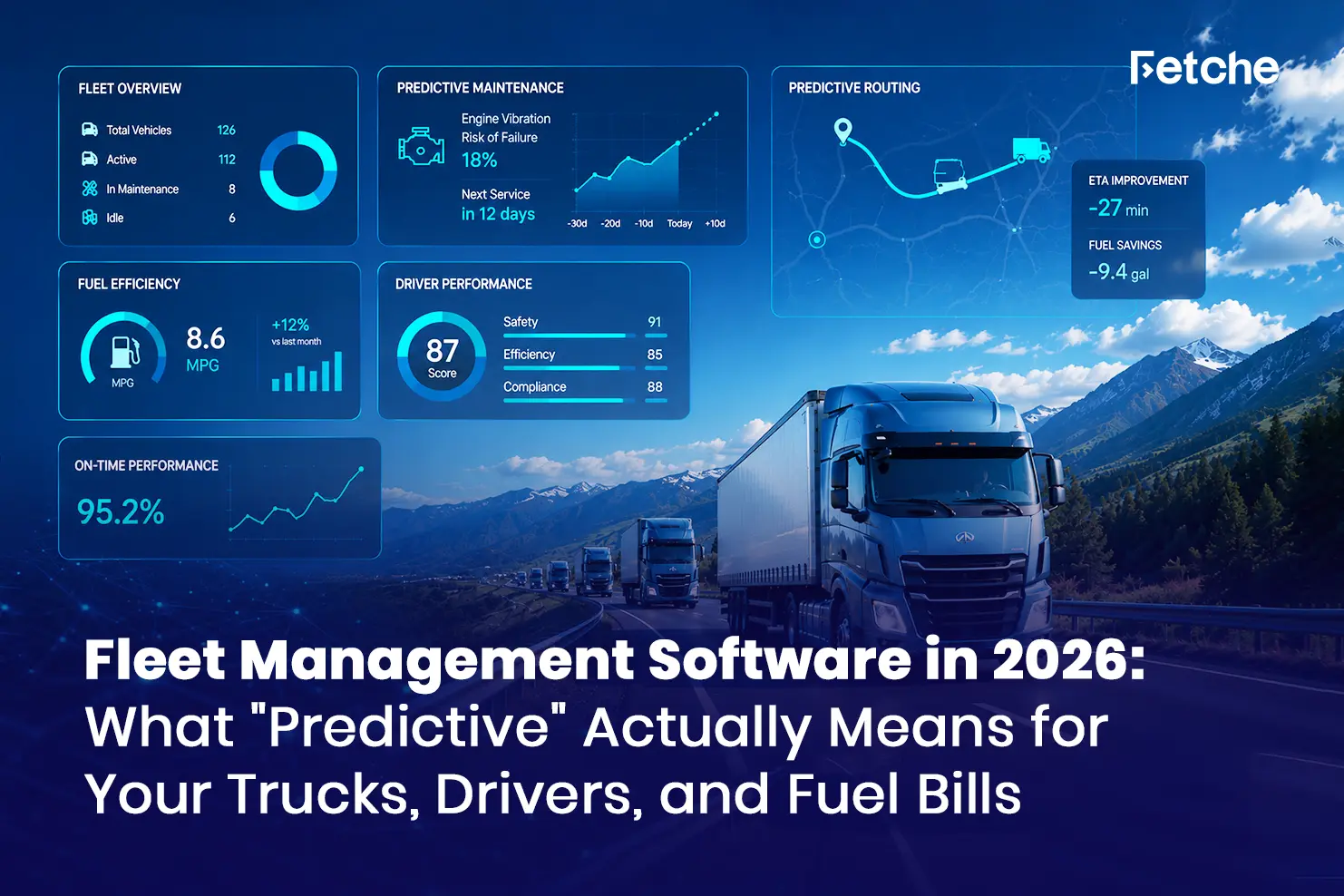
Every fleet software vendor in 2026 is selling “predictive.” Predictive maintenance. Predictive routing. Predictive fuel management. AI-powered everything. The brochures are impressive. The demos look clean. And then a fleet manager who’s been running 40 trucks for a decade asks the only question that matters: what does it actually do, and what does it save me?
That’s the question this piece answers. Because “predictive” is a real capability, not a buzzword.
What Fleet Management Software Actually Does
At its core, fleet management software connects the data that currently lives in separate places across a transport operation: vehicle location and movement, fuel consumption, driver behaviour, maintenance records, job dispatch, and delivery status.
A dispatcher checking route progress has to look at a different screen than the one showing fuel consumption. A maintenance manager tracking service intervals has no visibility into whether a vehicle is showing early signs of a problem. A finance director calculating cost-per-job is pulling data manually from three different sources at the end of the month.
Fleet management software collapses that fragmentation. Everything runs on shared data – trip data, vehicle diagnostics, driver scores, maintenance history – visible in one place, updated in real time. That’s the foundation. Everything else, including all the “predictive” capabilities, is built on top of it.
Without that foundation, predictive features don’t have enough to work with. Which is why the first question when evaluating any fleet platform isn’t “what does it predict?” It’s “what does it connect?”
What “Predictive” Means in Practice
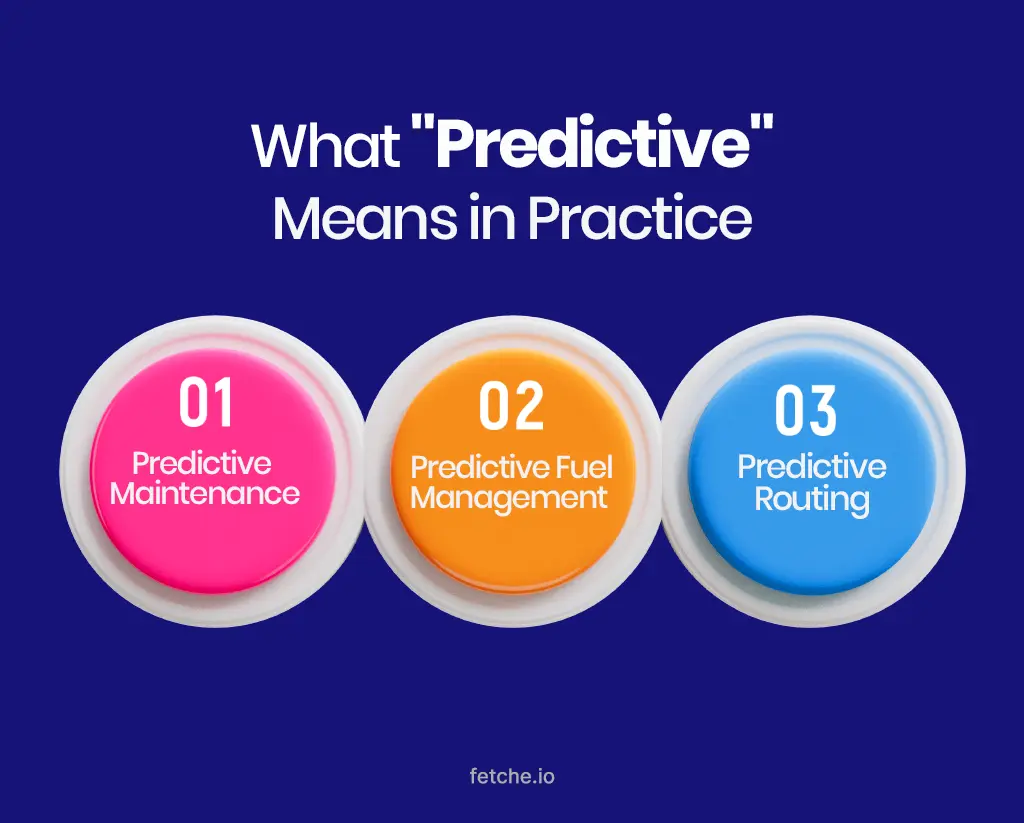
Once the data layer is in place, fleet management software can start doing something more sophisticated than reporting what happened. It can anticipate what’s about to happen and act on it. That’s what “predictive” means in a fleet context. This includes mainly three specific capabilities that each work through a specific mechanism and produce a specific outcome:
Predictive Maintenance
Let’s start with predictive maintenance. A modern commercial truck is a continuous stream of diagnostic data. Engine temperature. Oil pressure. Coolant levels. Battery voltage. Tyre pressure across all axles. Brake pad wear. Transmission fluid temperature. Fault codes from the onboard diagnostics system, pre-DTC anomalies that don’t yet register as a fault but are trending in the wrong direction.
A good number of vehicles manufactured in 2026 ship with embedded telematics, meaning rich diagnostic data streams directly from the factory, without installing aftermarket devices or taking trucks out of service. Predictive maintenance software reads that stream continuously and compares it against two things: the historical baseline for that specific vehicle (what does this engine normally look like at this temperature, load, and mileage?) and pattern data from fleets at scale (what does an alternator look like in the 30 days before it fails?).
The result is a shift from “something might be wrong” to “replace the alternator by Thursday.” That’s not an exaggeration. It’s a description of what component-level failure prediction actually produces when the model is trained on sufficient data.
The financial case for this specificity is straightforward. A planned workshop visit costs a fraction of what a single roadside breakdown costs you for the same component failure. In fact, fleets using predictive maintenance see 25–35% lower maintenance costs and 45–62% fewer unplanned breakdowns, with ROI typically achieved within 3–6 months.
Here’s the truth most vendors won’t tell you – ‘Most fleets should not go all-in on predictive for every vehicle’. The 2026 industry standard is a hybrid approach: preventive for standard assets, predictive for critical ones. The return on investment in predictive tooling is strongest on your highest-value, highest-utilisation vehicles – the ones where a roadside breakdown is most expensive.
| Predictive vs Preventive Maintenance of FleetPreventive – Truck A gets an oil change at 15,000 kilometres. The oil may be fine. The change happens anyway because that’s the schedule. Meanwhile, a bearing on Truck A is running at elevated temperature – a signal that would be visible in the diagnostic data, but nobody is watching it because the maintenance system only logs mileage intervals.Predictive – Truck A’s telematics data is monitored continuously. At 12,000 kilometres, the bearing temperature starts trending above its normal range under equivalent load conditions. The system flags it, generates a maintenance recommendation with a 30-day failure probability, and schedules an inspection during the truck’s next planned rest day. The bearing is replaced at standard cost, before it fails on a highway at 2 am.Predictive maintenance for trucks delivers 25-40% lower total maintenance costs, 30-50% reduction in unplanned downtime, and 20-40% equipment lifespan extension. For a mid-market fleet operator running 30 to 80 trucks, those are not marginal improvements. |
Predictive Fuel Management
Fuel typically represents 24-28% of total fleet operating costs. It’s the cost most fleet managers feel most acutely and the one they have the least visibility into at a granular level. This is why fleet fuel cost optimization is critical.
Most fuel waste is not at the pump. It happens between fill-ups, in ways that don’t appear in a fuel card statement. Three categories account for the majority:
- Idle burn
- Driver behaviour
- Route inefficiency
Taken together — idle reduction, behaviour change, and route optimisation — fleets that utilise data analytics report a 20% reduction in fuel costs compared to those relying on manual processes.
Predictive Routing
ETA accuracy is one of the most visible measures of a fleet operation’s credibility with clients. A forwarder or 3PL that consistently delivers within a narrow window of its stated ETA retains enterprise clients. One that delivers “sometime in the afternoon” loses them quietly, over time, to a competitor with better systems.
Traditional routing calculates the optimal path at the point of dispatch and doesn’t adjust. Traffic builds on a major highway two hours into a run — the driver knows, but the dispatch system doesn’t update, the client doesn’t know, and the ETA becomes a fiction.
Predictive routing reads live traffic data, weather conditions, and historical trip performance on each lane to generate an ETA that accounts for what typically happens on that route at that time of day. When conditions change mid-journey, the system recalculates and updates. The client’s ETA updates. The driver gets a revised route. The dispatcher doesn’t have to make five phone calls to find out what’s happening.
For fleet operators running the same routes week after week, the historical trip data compounds in value over time. The system learns that the Tuesday morning run consistently runs 18 minutes longer than estimated due to port traffic between 7 am and 9 am, and adjusts departure scheduling accordingly. That’s not a complex AI insight. It’s pattern recognition on your own operational data, applied automatically.
Where Analytics Fits Into All of This
Individual data streams like maintenance alerts, idle reports, driver scores, and route efficiency metrics are useful in isolation. The step-change in value happens when they’re connected.
AI fleet analytics pulls from TMS dispatch data, vehicle telematics, maintenance records, and fuel card transactions simultaneously to surface patterns that no individual report reveals. This can include a specific route that consistently generates high idle time and poor driver scores, suggesting a scheduling or dock management issue rather than a driver performance issue, or a driver whose scores drop on specific days, suggesting a fatigue or shift scheduling issue rather than a skills gap.
This is the difference between data that tells you what happened and analytics that tell you why and what to do differently.
How Fetche Brings This Together for Fleet Operators
Most of the capabilities described above require one thing to function effectively: connected, clean data in one place. Telematics data sitting in one system, maintenance records in another, dispatch data in a third, and fuel card transactions in a spreadsheet — that’s the configuration most mid-market fleet operators are running today, and it’s why their analytics capability is limited regardless of the quality of their individual tools.
Fetche’s fleet management module connects vehicle telematics, dispatch scheduling, driver performance data, and maintenance records within the same operational environment as the broader freight and logistics workflow. This matters for fleet operators who are also freight or 3PL businesses, because trip profitability becomes visible rather than calculated at month end from averages.
The analytics module surfaces that connected data as actionable insights like cost per kilometre by vehicle, AI driver behaviour monitoring for fleet safety, idle time trends by driver and route, maintenance cost trajectories, and ETA accuracy by lane. Not dashboards for the sake of dashboards, but the specific metrics that a fleet operations manager needs to have an intelligent conversation with a customer, a finance director, or a technician
FAQ
The vehicle’s onboard diagnostic system continuously generates data: engine temperature, oil pressure, brake wear, battery voltage, and hundreds of other signals. Fleet management software reads this data in real time, compares it against the historical baseline for that vehicle and against failure pattern data from comparable fleets, and generates component-level predictions — identifying which specific part is at risk, with a 30/60/90-day failure probability. A maintenance work order is generated and scheduled during planned downtime, before the failure occurs.
2. What’s the difference between predictive and preventive maintenance for a fleet?
Preventive maintenance services vehicles on a fixed schedule — time or mileage intervals — regardless of actual condition. Predictive maintenance services components when sensor data indicates they need attention, not before and not after. The result is fewer unnecessary service events, fewer missed failures, lower total maintenance cost, and significantly fewer roadside breakdowns.
The three largest controllable fuel costs are idle time, driver behaviour, and route inefficiency. Fleet analytics software quantifies each of these at the vehicle and driver level — showing exactly which trucks are idling excessively and at which locations, which drivers are generating the most fuel waste through aggressive driving, and which routes are running longer than optimised alternatives. Corrections are then targeted, evidence-based, and measurable.
It can, if it’s implemented as surveillance rather than coaching. Fleets that deploy it effectively share the data with drivers transparently, use it in constructive coaching conversations, and recognise top performers. The evidence consistently shows that drivers who understand how the data is used and see their own scores improve their behaviour voluntarily, particularly when coaching is specific (a GPS timestamp and a braking event) rather than general (“drive more carefully”).