
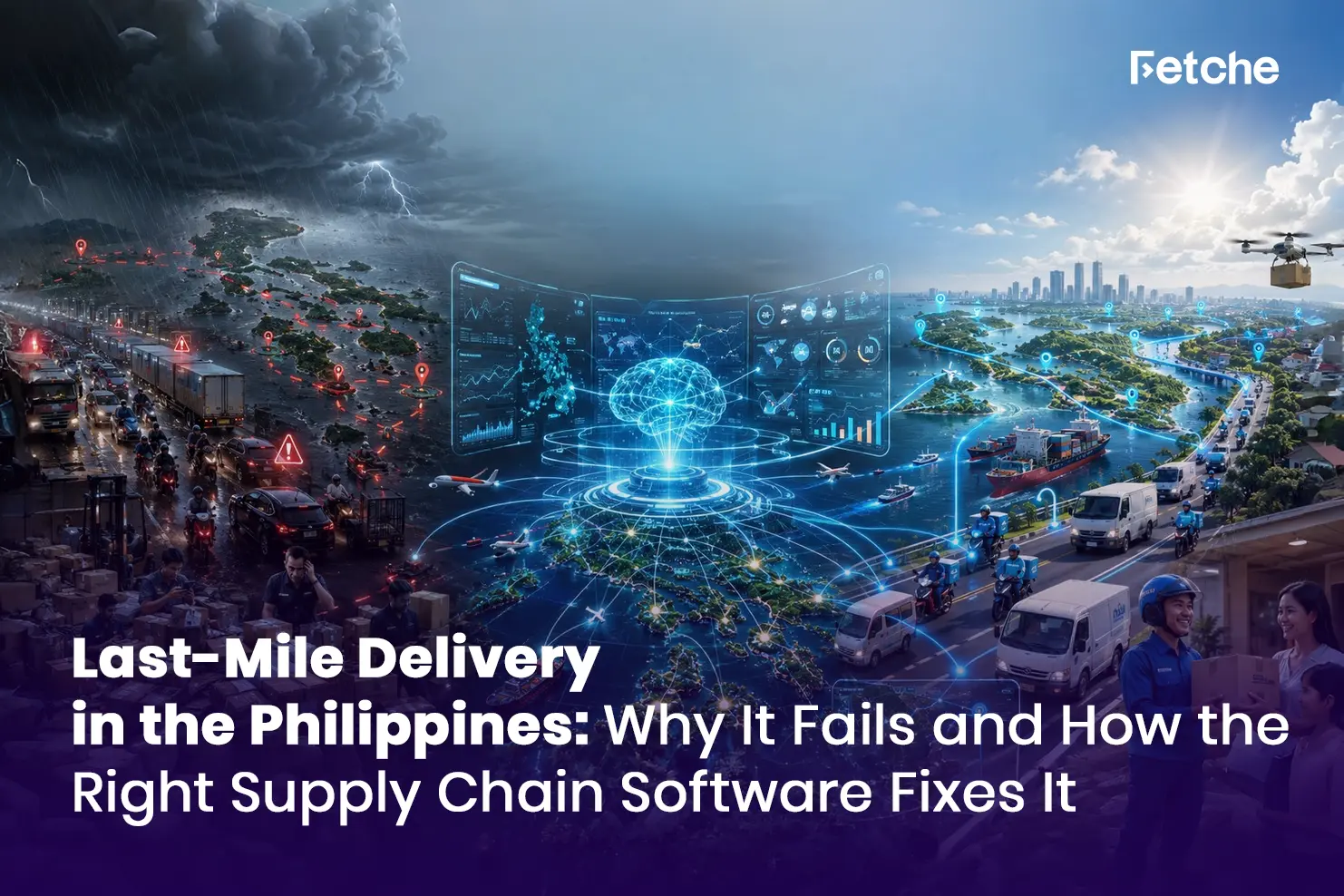
Imagine tracking a long-awaited package. You see it arrive at the local hub, just kilometers away from your doorstep. You get the text: “Your order is out for delivery today!” But then, the sun sets. The status changes to “Delivery failed: Address un-locatable” or “Customer unavailable” even though you were home all day.
In the Philippines, this is a daily frustration for millions of e-commerce shoppers and a costly nightmare for businesses. Last-mile delivery, the final leg of the supply chain where a product travels from a distribution hub to the customer’s doorstep, is notoriously the most expensive, inefficient, and problematic part of the logistics journey. But why does last-mile delivery in the Philippines fail so frequently, and how can businesses use supply chain software to turn this bottleneck into a competitive advantage? Let’s dive in.
Why Last-Mile Delivery Fails in the Philippines
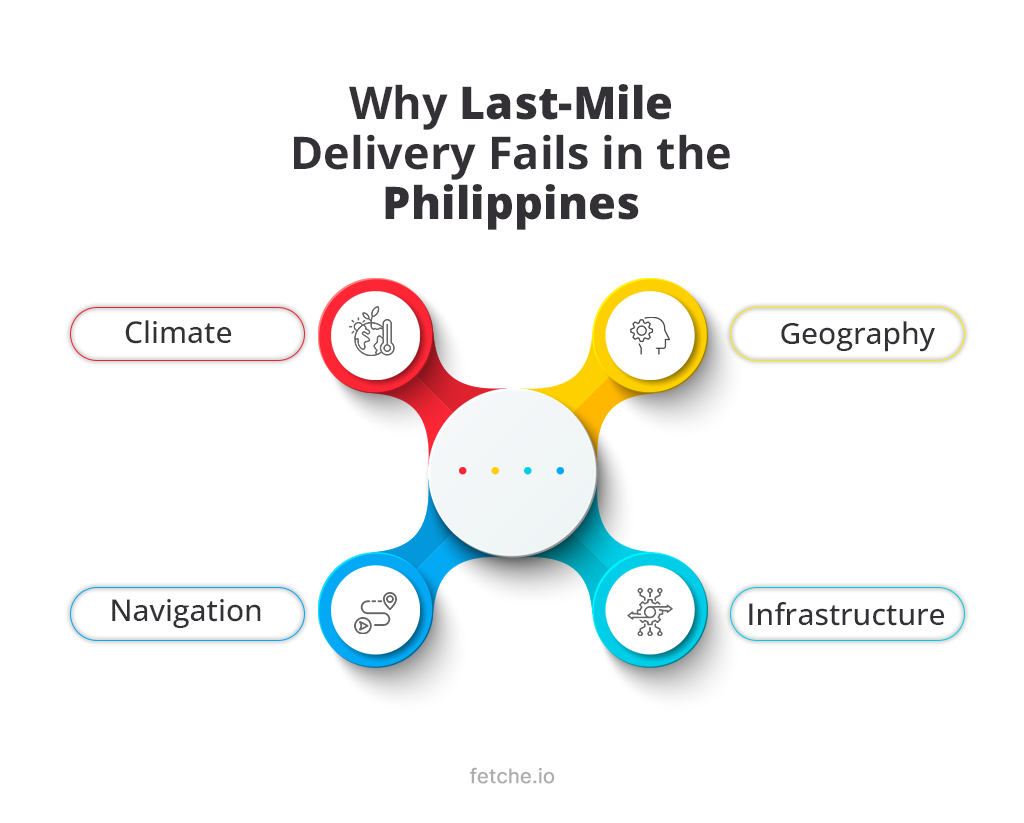
The Philippine archipelago presents a unique set of logistical hurdles. Unlike compact city-states or vast, well-connected landmasses, delivering goods here requires navigating a complex mix of geography, infrastructure gaps, and deeply ingrained consumer habits.
1. The Archipelago and Geopolitical Geography
With over 7,000 islands, inter-island logistics inherently complicates the supply chain network. A package traveling from a warehouse in Metro Manila to a customer in a remote barangay in Visayas or Mindanao must endure multiple touchpoints trucks, RORO (Roll-On/Roll-Off) vessels, airplanes, and tricycles. Port congestion and bureaucratic delays at major maritime gateways create unpredictable backlogs. When a vessel is delayed at the port, the downstream schedule collapses, leaving local hubs starved for inventory or suddenly overwhelmed with backlogged parcels.
2. Typhoon Disruptions & Climate Vulnerability
The Philippines is battered by an average of 20 typhoons per year. A single severe weather event can instantly sever critical transport arteries, cause landslides in mountainous provinces, or suspend sea travel entirely. Without dynamic operational agility, a typhoon hundreds of kilometers away can paralyze a Manila-based merchant’s entire fulfillment apparatus, causing a catastrophic spike in last-mile delivery costs due to stranded assets.
3. Inaccurate Addressing and Lack of Digital Maps
Unlike Western countries with standardized postal codes and highly accurate digital mapping, many areas in the Philippines rely on informal addresses.
Example: For an on-demand delivery driver using basic GPS, this lack of precise geocoding leads to wasted time, excessive fuel consumption, and ultimately, failed deliveries.
4. Severe Traffic Congestion and Poor Infrastructure
Metro Manila, Metro Cebu, and Metro Davao are notorious for grueling traffic. Urban gridlock significantly lowers the number of successful drops a driver can make per day, driving up last-mile delivery costs
5. High Dependency on Cash on Delivery (COD)
While digital wallets are rising, Cash on Delivery (COD) remains a dominant payment method in Philippine e-commerce. COD slows down the last mile significantly. Drivers must wait for customers to find cash, handle change, or worse deal with customers who refuse the package upon arrival, resulting in high Return to Origin (RTO) rates.
Eliminating Operational Silos Across Your Teams
The failure often happens hours or days prior, inside disjointed software applications. If your sales team, warehouse crew, and finance department use completely separate software platforms, your last mile is crippled before the truck is even loaded. Fetche stops this finger-pointing by functioning as an end-to-end Enterprise Resource Planning (ERP) platform, establishing a single source that unifies all internal departments:
- Warehouse to Road Synchronization (WMS + TMS): Instead of warehouse staff manually printing manifests and handing them off to a separate dispatch team, Fetche integrates your Warehouse Management System (WMS) directly with your Transportation Management System (TMS). As soon as an item is scanned and packaged at a provincial hub, the routing engine pre-allocates it to the optimal delivery vehicle sequence. There is zero double-data entry or delayed paperwork.
- Instant Financial Accountability: For most local companies, tracking Cash on Delivery (COD) means waiting for manual physical audits at the end of the shift. Because Fetche features integrated financial and accounting automation modules, a driver hitting “payment received” on their app instantly reflects on the central accounting dashboard. Accounts receivable teams gain immediate, line-item clarity on active cash flow moving across different islands or regions.
- Proactive Customer Support Management: Customer support teams often operate blindly, forcing them to call dispatch managers just to find out where a client’s parcel is. With Fetche, support agents have access to the exact same real-time operational map as the logistics team. If a typhoon delays a vessel or a port congestion backup holds up delivery, agents can proactively reach out to corporate clients with alternative timelines, protecting brand reputation before the customer ever has to ask.
Mitigating Philippine Delivery Failures: The Fetche Solution
Relying on manual planning and legacy systems is no longer viable in the Philippines. When the delivery environment is this hostile, legacy spreadsheets and fragmented systems are recipes for operational failure. Shippers and logistics operators don’t need another courier company; they need absolute control over their existing operations.
This is where Fetche comes in. Fetche functions not as a delivery service, but as the Logistics Enterprise Resource Planning (ERP) and operational intelligence layer built to withstand Philippine supply chain realities. It gives businesses centralized, real-time control over dispatch, routing, rider performance, and customer visibility.
Here is how Fetche solves the country’s biggest logistics pain points:
1. Smart Route Optimization to Beat Traffic
Modern route optimization software doesn’t just find the shortest path from point A to point B; it calculates the fastest path based on historical traffic data, time windows, and vehicle capacity.
- The Fix: Instead of drivers guessing their routes, the software automatically sequences deliveries to avoid known traffic hotspots during peak hours, drastically reducing delivery turnaround time.
2. Advanced Geocoding for Precise Dropping
To solve the “mango tree address” dilemma, sophisticated logistics platforms utilize AI-powered geocoding and machine learning.
- The Fix: The software converts ambiguous addresses into exact latitude and longitude coordinates. Furthermore, it learns from past successful deliveries. If a driver previously found the correct house, the system saves that exact digital footprint for future deliveries.
3. Real-Time Tracking and Automated Customer Alerts
When customers don’t know when their package will arrive, they leave the house, leading to failed COD attempts.
- The Fix: Supply chain software provides real-time visibility via automated SMS or Viber alerts with dynamic tracking links. Customers can see exactly where their rider is, ensuring they are home to pay for their COD orders, which directly reduces RTO rates.
4. Efficient Fleet Management and Driver Apps
Managing a mix of in-house riders and third-party logistics (3PL) providers can be chaotic without a centralized system.
- The Fix: A robust fleet management platform in Philippines equips drivers with a mobile app that handles electronic Proof of Delivery (ePOD), digital signatures, and instant cash reconciliation for COD. Managers can track driver performance, fuel consumption, and idle times from a single dashboard.
Case Study: The Software Difference in Action
Let’s look at a hypothetical comparison of a mid-sized e-commerce business in Manila:
| Metrics | Manual Logistics (Before Fetche) | Optimized Logistics (With Fetche) |
| Deliveries per Rider/Day | 15–20 drops | 35–40 drops |
| Failed Delivery/RTO Rate | 18% | Less than 4% |
| Fuel Expenses | High (due to backtracking) | Reduced by 25% via route optimization |
| Customer Satisfaction | Low (poor communication) | High (real-time tracking & predictability) |
The Path Forward for Philippine E-Commerce through Fetche
The booming e-commerce market in the Philippines shows no signs of slowing down. However, customer expectations are evolving rapidly. Shoppers no longer just want their items; they want them fast, transparently, and predictably. Fixing last-mile delivery in the Philippines isn’t about hiring more riders or buying more trucks; it’s about working smarter. By investing in the right supply chain software, local businesses can eliminate guesswork, bypass infrastructure limitations, drastically cut operational costs, and turn a notorious logistical headache into a seamless customer experience.
Fixing last-mile delivery in the Philippines isn’t a matter of throwing capital at the problem by hiring more riders or buying more trucks; it’s about working smarter through localized digital infrastructure. By anchoring operations with Fetche as the core supply chain software layer, local businesses can eliminate the guesswork of vague addresses, bypass severe infrastructure limitations, and drastically cut operational costs. Fetche transforms a notorious logistical headache into a seamless, high-performing customer experience, proving that the right software, not more assets, is the ultimate solution to the country’s unique supply chain challenges.