

Walk into the operations room of any mid-market 3PL in Europe right now and you will find the same tension. The team is good. The carriers are mostly reliable. The customers are demanding more than ever. And somewhere in the middle sits a TMS that was built for a different era — slower, simpler, and far less regulated than the one they are actually operating in.
This is not a technology problem in the abstract sense. It is a specific operational problem that shows up in missed SLAs, clunky carrier onboarding, sustainability reports nobody can produce, and integration headaches between systems that should have been talking to each other years ago.
The European 3PL market is on a strong growth trajectory valued at over $286 billion in 2025 and forecast to climb past $394 billion by 2031. But market growth does not automatically translate into profitability for every operator inside it. The ones pulling ahead share something in common: they stopped patching legacy TMS platforms and started replacing them.
What Is Actually Driving 3PLs to Switch Right Now
The decision to replace a legacy TMS rarely comes from a single event. It builds until the gap between what the platform can do and what the business needs becomes impossible to ignore. Several forces are making that gap very visible, very fast across Europe.
Regulation has fundamentally shifted the compliance floor. The Corporate Sustainability Reporting Directive has moved emissions accountability from a voluntary narrative to a structured legal obligation. For a mid-market 3PL, that means route-level carbon data, auditable freight emissions reporting, and documentation that can survive regulatory scrutiny. Most legacy TMS platforms were never built to capture this. Retrofitting it is technically possible but operationally messy emissions data ends up in a separate tool, reconciled manually, with a degree of uncertainty that any compliance officer will flag.
The driver shortage is making optimisation non-negotiable. According to IRU’s driver shortage data, there were 444,000 vacant truck driver positions in Europe in 2025, with projections suggesting this number could triple by 2026 if no structural changes are made. When every available driver hour is a scarce resource, the difference between a well-optimised route and a poorly assigned one is real capacity not just efficiency. A legacy TMS that requires dispatchers to manually assign loads is burning that capacity every single day.
Cross-border complexity has outgrown manual handling. Post-Brexit customs requirements, the Carbon Border Adjustment Mechanism, and evolving eFTI digital freight documentation rules have turned cross-border freight into a compliance exercise that runs alongside every shipment. Failure to integrate TMS and ERP systems with mandatory compliance platforms like ICS2 can result in fines of up to €5,000 per infringement exposure that compounds quickly at scale.
Vendor consolidation is narrowing the field. The acquisition of E2open by WiseTech Global for $2.1 billion and Descartes’ purchase of 3GTMS for $115 million represent the most aggressive wave of TMS vendor consolidation the industry has seen. When a platform gets absorbed into a larger enterprise product, mid-market operators tend to get deprioritised on the roadmap — pushing them to look for alternatives before their options shrink further.
Why 3PLs Are Switching from Legacy TMS: Four Operational Breaking Points
1. Carrier onboarding that takes weeks instead of days
The European carrier landscape is fragmented by design — major pan-European networks co-existing with hundreds of regional specialists. A legacy TMS handles tier-one carriers reasonably well and turns everyone else into a manual workaround. Modern platforms built on open carrier APIs make adding a new carrier a configuration task, not a development project. That distinction matters when commercial teams are moving faster than the system can keep up.
2. Visibility gaps that quietly erode customer retention
European shippers are no longer benchmarking their 3PL’s tracking capability against other 3PLs — they are comparing it to the consumer e-commerce experience. Order-level tracking, proactive exception alerts, status updates that do not require a phone call. When a legacy TMS cannot surface this, customer service teams absorb the gap manually. The cost is not just headcount. It is the contract renewal conversation where the customer has already decided.
3. TMS integration with ERP for logistics companies that breaks under pressure
In any mid-market 3PL, freight data needs to flow cleanly between the TMS, WMS, ERP, and billing systems. In a legacy TMS stack, these connections are typically custom-built, poorly documented, and fragile under any system update. The result is finance reconciling freight invoices manually, billing runs that depend on someone checking completion events by hand, and WMS triggers that break silently when either system is patched. The integration is always the last thing anyone looks at — until it fails at the worst possible moment.
4. Exception handling that relies on human memory
When a shipment goes off-track in a legacy TMS environment, detection depends on someone noticing. In a modern platform, exceptions are classified and escalated automatically — shifting the dispatcher’s cognitive load from detection to resolution, and getting ahead of the customer before they call.
How to Replace a Legacy TMS Without Disrupting Operations
How to replace a legacy TMS without disruption is the question that follows every honest assessment of a current system. The concern is legitimate — a poorly managed migration can damage carrier relationships, delay shipments, and create data reconciliation problems that take months to unwind.
The operators who navigate this well follow a consistent pattern. They run parallel operations on critical lanes for six to eight weeks rather than cutting over hard. They migrate carrier relationships through API first and retire EDI connections only once new integrations are proven. They involve operations managers — not just IT — in configuration, because the people who know where exceptions actually happen are the dispatchers. And they choose a modular rollout path: freight execution first, then freight audit and carrier analytics, then sustainability reporting.
The typical migration timeline for a mid-market European operator runs 16 to 26 weeks when properly scoped — with companies that rush the assessment phase often restarting the entire project six months later. Patience in planning is not delay. It is the difference between a migration that works and one that gets undone.
What Mid-Market 3PLs Are Actually Choosing Instead
The replacement landscape for transportation management systems in Europe has changed. The old binary — stay on a legacy TMS or spend 18 months implementing an enterprise platform — no longer reflects the actual options. Cloud TMS Europe deployments have matured to the point where mid-market operators with well-defined carrier networks can go live in weeks, not quarters.
Despite this, mid-sized European shippers deploy cloud-based TMS solutions at only 62% penetration — a significant lag behind North American adoption levels, and a real competitive opening for operators who move now.
The platforms gaining ground share a consistent profile: carrier-agnostic connectivity with open APIs, real-time order-level visibility surfaced through customer-facing portals, freight audit built into the execution layer rather than bolted on, and CSRD-aligned emissions reporting that does not require a separate data pipeline.
Why Fetche.io Is Built for the European Market
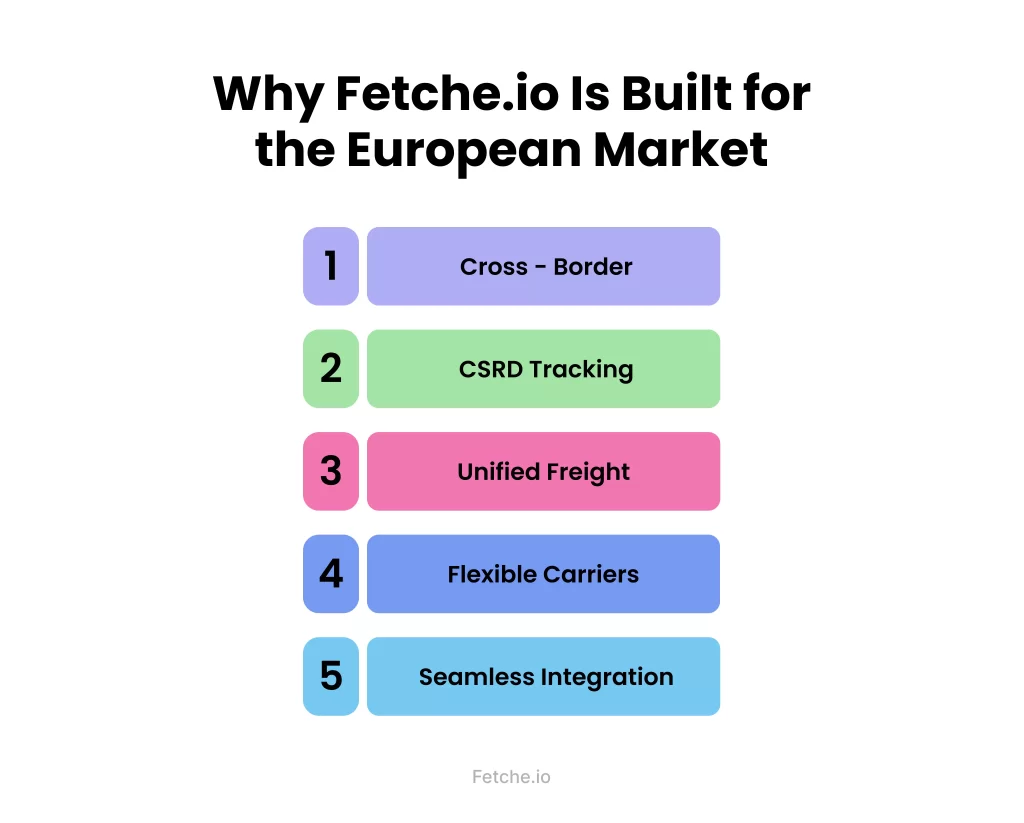
Most 3PL logistics software Europe vendors have European support. Fetche.io was built around European operating conditions — and the difference is practical, not cosmetic.
Cross-border compliance without the manual layer.
Managing a transportation management system for cross-border logistics Europe means navigating customs declarations, VAT treatments, commodity classifications, and liability frameworks that change at every border. Fetche.io builds customs documentation, HS code validation, and duty estimation directly into the freight execution workflow. For 3PLs managing UK-EU movements or Schengen boundary crossings, this removes a layer of manual processing that currently sits across every international shipment in most legacy environments.
CSRD emissions reporting at execution level.
Fetche.io captures fuel consumption, load factor, and carbon footprint data as a standard output of freight execution — not a separate reporting module. When an auditor asks for transport emissions segmented by carrier, lane, and reporting period, Fetche.io produces it directly. Most legacy TMS platforms produce a spreadsheet that someone still has to clean.
Multi-modal freight under a single execution layer.
European freight rarely moves by a single mode. Short-sea between Iberia and Northern Europe, rail through the Rhine-Alpine corridor, road across Central and Eastern Europe — Fetche.io manages road, sea, air, and rail within a single execution and visibility environment. The customer sees one tracking interface regardless of how many modes their shipment has touched.
Carrier flexibility that reflects how European logistics actually works.
Europe’s best carriers are often regional specialists. Fetche.io’s open carrier API framework means these relationships can be onboarded and managed alongside major pan-European networks — not maintained outside the system because the TMS software for 3PLs cannot handle them.
TMS integration with ERP for logistics companies — without the custom build.
One of the most persistent sources of operational friction in mid-market European 3PLs is the gap between the TMS and the rest of the business. Finance needs freight cost data to accrue correctly. The WMS needs dispatch triggers to fire on time. Customer billing depends on shipment completion events being captured and passed across cleanly. In a legacy stack, all of this relies on custom integrations that were built by someone who has since left, break silently when either system is updated, and take weeks to fix when they do. Fetche.io is built API-first. Connectivity to SAP, Oracle, Microsoft Dynamics, and other ERP platforms is a configuration exercise — not a development project. Freight cost data flows cleanly into finance. Dispatch triggers reach the WMS automatically. Customer billing reflects shipment completion without manual intervention. The integration works the way the business actually needs it to, and keeps working after system updates.
Mid-market scale without mid-market compromise. Enterprise TMS software is built for organisations with IT departments large enough to run them. Fetche.io is built for operators whose commercial and operations teams need to configure workflows, add carriers, and pull compliance reports without raising a ticket to IT. Implementation is measured in weeks. Pricing scales with volume. The platform grows with the business.
The Window for a Planned Migration Is Narrowing
There is a well-worn pattern in how European logistics businesses handle legacy TMS replacement. The problem gets identified. The project gets scoped. The scope gets complicated. The project gets deferred. And the cycle repeats — until something external forces the decision.
Right now three things are converging that make the deferred-decision approach genuinely costly. CSRD compliance timelines are not optional. eFTI digital freight documentation requirements take full effect in July 2027. And the driver shortage is turning every optimisation gap into a real capacity cost.
Mid-sized European shippers currently deploy cloud TMS Europe solutions at only 62% penetration — which means a significant share of the market is still running on systems that cannot meet today’s compliance, visibility, or carrier management requirements. The operators who move on their own terms will implement with proper planning time and parallel running. Those forced to move reactively — by a compliance audit, a customer ultimatum, or a vendor consolidation that deprioritises their support tier — will implement under pressure, at higher cost, and with less control.
Final Thought
The legacy TMS platforms that built European logistics over the last two decades were not failures. They were products of their time — designed for a regulatory environment that has since changed, a carrier integration landscape without APIs, and customer visibility expectations set in a pre-smartphone world.
That world is gone. The signs your TMS is holding back your 3PL are rarely dramatic — they accumulate quietly in dispatcher workarounds, customer service overhead, and compliance gaps that grow wider every quarter.
FAQ
Older systems often struggle with compliance, visibility, and automation. Modern platforms help logistics providers work faster and manage operations more efficiently.
They help manage customs documentation, compliance requirements, and shipment tracking across multiple countries from a single system.
Key features include carrier connectivity, real-time visibility, automation, reporting tools, and easy integration with existing systems.
It allows freight, finance, and billing data to flow automatically between systems, reducing manual work and improving accuracy.
Yes. Modern platforms provide real-time shipment updates and proactive alerts, helping customers stay informed throughout delivery.
A phased rollout, parallel testing, and gradual carrier onboarding can help ensure a smooth transition with minimal business impact.