
The logistics industry is under pressure like never before. Rising fuel costs, unpredictable demand, labor shortages, and increasing customer expectations for real-time visibility are pushing operations teams to rethink their strategies. This is where Artificial Intelligence in Logistics is becoming a competitive necessity.
In 2026, Artificial Intelligence is transforming how logistics companies plan routes, manage fleets, optimize warehouses, and forecast demand. From predictive analytics to smart automation, AI in logistics is driving measurable efficiency and profitability. For logistics managers and digital transformation leaders, understanding the future of adopting AI in the logistics industry is essential to staying ahead.
Let’s explore what’s changing and what it means for your business.
Why Artificial Intelligence in Logistics Is Accelerating in 2026
Three major factors drive the surge in AI adoption in logistics:
- Data Explosion– Logistics operations generate vast volumes of data from GPS systems, warehouse scanners, invoices, and customer portals. AI in supply chain systems can process this data in real time.
- Need for Automation– Manual documentation, route planning, and reconciliation are slow and error-prone. Logistics automation reduces delays and human errors.
- Demand for Visibility– Customers now expect live tracking, accurate ETAs, and proactive communication.
According to recent industry studies, companies implementing AI-driven systems report up to:
- 15–20% reduction in transportation costs
- 30% improvement in demand forecast accuracy
- 25% increase in warehouse productivity
AI in Logistics and Supply Chain: Market Dynamics Shaping 2026
The logistics sector with AI continues to grow significantly, contributing trillions to major economies, while increasing operational complexity drives the need for smarter systems.
Market Drivers
The biggest driver of AI adoption in logistics is the massive growth of real-time data from IoT devices, fleet systems, and warehouse sensors. AI in supply chain platforms converts this data into actionable insights for route optimization, demand forecasting, and cost reduction.
Businesses are under pressure to reduce fuel costs, improve delivery timelines, and enhance customer satisfaction. Logistics automation powered by AI helps achieve these goals with measurable impact.
Market Restraints
Despite its benefits, challenges remain. High initial investment and limited AI-skilled professionals can slow adoption, especially for small and mid-sized companies.
Market Opportunities
The rapid expansion of e-commerce creates strong demand for smart logistics solutions. AI improves last-mile delivery, warehouse efficiency, and inventory planning. Additionally, sustainability goals are pushing companies to use AI for route optimization and emission tracking.
Market Challenges
Data privacy, cybersecurity risks, and compatibility with legacy systems remain key concerns. Companies must adopt scalable, AI-enabled platforms to ensure seamless integration and long-term ROI.
Key AI Trends in Logistics 2026
1. Predictive Route Optimization
AI-powered Transportation Management Systems (TMS) analyze traffic, weather, fuel prices, driver availability, and delivery priorities in real time, instead of reacting to delays, AI predicts them.
For example, modern smart logistics platforms automatically re-route shipments to avoid congestion, reducing fuel waste and delivery time. In 2026, predictive routing will become standard rather than optional.
2. Intelligent Warehouse Automation
Warehouses are evolving into AI-driven ecosystems that enable:
- Demand forecasting for optimized inventory placement
- Automated picking route suggestions
- Real-time stock monitoring
- Labor allocation planning
Companies using AI in supply chain management report faster order processing and fewer stockouts. The future of logistics using Artificial Intelligence in their operations will include autonomous inventory audits using AI-powered vision systems and robotics.
3. AI-Driven Demand Forecasting
Traditional forecasting relied on historical data alone. Today, one of the most powerful AI use cases in logistics is predictive demand planning. By improving forecast accuracy, companies reduce overstocking, avoid emergency shipments, and optimize working capital.
AI models incorporate:
- Seasonal patterns
- Market trends
- Economic indicators
- Customer behavior
4. Smart Documentation & Compliance
Documentation remains one of the biggest bottlenecks in logistics operations. But with AI, tasks get automated. Invoice verification, freight documentation processing, compliance checks, and data entry from scanned documents will become automated.
AI-based OCR and machine learning tools can extract and validate information in seconds. This significantly reduces processing time and minimizes compliance risks.
Benefits of AI in Logistics: Real Business Impact
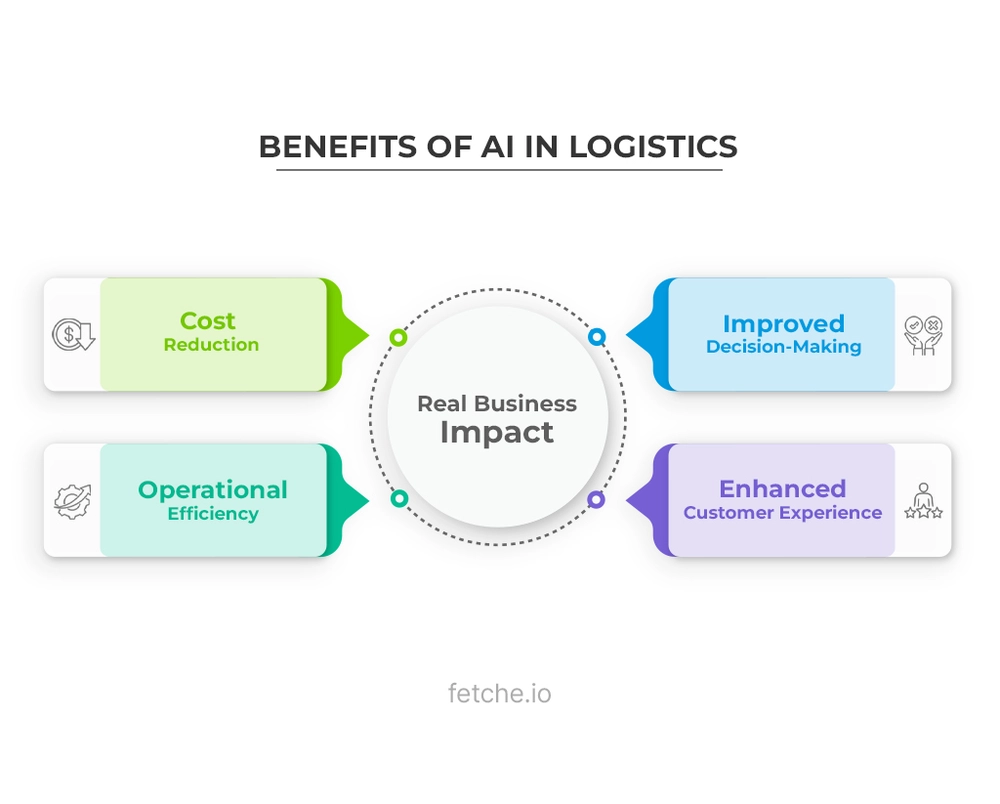
For logistics managers and freight forwarders, the benefits go beyond automation. They directly affect profitability and customer satisfaction.
- Cost Reduction: AI optimizes fuel usage, asset utilization, and inventory management.
- Operational Efficiency: AI eliminates repetitive manual tasks and reduces human errors.
- Improved Decision-Making: Advanced analytics provide real-time dashboards for smarter planning.
- Enhanced Customer Experience: Live tracking, accurate ETAs, and proactive alerts build trust and retention.
AI-powered analytics modules help logistics teams identify bottlenecks in transportation and warehouse operations. By integrating AI within ERP workflows, businesses gain a unified system that connects operations, accounting, fleet management, and analytics, leading to smarter decisions at every level.
Challenges of AI Adoption in Logistics
Despite its advantages, AI adoption in logistics comes with challenges:
1. Data Silos: Disconnected systems prevent AI from delivering accurate insights.
2. Integration Complexity: Legacy ERP systems may not support advanced AI tools.
3. Change Management: Employees may resist automation without proper training.
4. ROI Concerns: Decision-makers often question the return on investment.
The solution lies in choosing scalable platforms that integrate AI into existing workflows instead of replacing them entirely. Companies that adopt modular, ERP-integrated AI solutions experience smoother digital transformation.
AI in Supply Chain: From Automation to Intelligence
The shift from logistics automation to intelligent logistics systems marks the next phase of AI evolution. In 2026 and beyond, AI in supply chain operations will focus on:
- Autonomous decision support
- Real-time risk prediction
- Carbon footprint optimization
- Dynamic pricing models
Smart logistics is always about intelligence. Companies that leverage Artificial Intelligence in Logistics strategically will gain a competitive edge in speed, accuracy, and adaptability.
How to Prepare for the Future of AI in Logistics
- Audit your current logistics processes.
- Identify repetitive, data-heavy tasks suitable for AI automation.
- Invest in integrated ERP systems with built-in analytics.
- Prioritize scalable solutions that grow with your operations.
- Focus on measurable KPIs such as cost savings, turnaround time, and customer satisfaction.
The future of AI in logistics is not about replacing people, it’s about empowering teams with better tools.
Is Your Logistics Operation AI-Ready?
Artificial Intelligence in Logistics is redefining how businesses manage transportation, warehouses, documentation, and customer communication. As AI trends in logistics 2026 continue to evolve, companies that adopt intelligent systems early will outperform competitors in efficiency and service quality.
Will AI transform logistics? It already is. The real question is whether your organization is ready to leverage it strategically.
If you’re exploring scalable, AI-powered logistics management solutions, now is the time to switch to Fetche. Already operating services in these countries, Fetche has quickly become recognized as the Top Logistics software Philippines relies on, as well as the Best Logistics in Software in Singapore. Fetche’s end-to-end ERP solution is built to support AI-driven logistics automation, real-time tracking, predictive analytics, and intelligent decision-making, without disrupting your existing workflows. With scalable modules for transportation management, warehouse operations, fleet tracking, and analytics, Fetche helps logistics teams turn data into measurable performance improvements. Contact Fetche to schedule a demo and discover how integrated AI-driven modules can streamline your logistics operations.
Transform your logistics operations today by clicking here to Book Now and Schedule a Call with the Fetche team.
FAQ
Artificial Intelligence in Logistics refers to the use of machine learning, predictive analytics, and automation technologies to improve transportation, warehouse management, demand forecasting, and documentation processes. AI systems analyze large volumes of operational data in real time to optimize routes, reduce costs, enhance visibility, and support smarter decision-making across the supply chain.
AI reduces logistics costs by optimizing delivery routes, minimizing fuel consumption, improving asset utilization, and enhancing demand forecasting accuracy. Predictive algorithms help avoid empty miles, emergency shipments, and stock imbalances. Companies adopting AI-driven systems often experience measurable improvements in transportation efficiency and warehouse productivity.
Yes. AI-driven forecasting models go beyond historical data by incorporating seasonal trends, customer behavior patterns, economic signals, and market demand shifts. This leads to more accurate inventory planning, reduced stockouts, and improved working capital management. In competitive markets, intelligent forecasting is becoming a core component of Artificial Intelligence in Logistics strategies.
Modern AI tools integrate directly into ERP platforms to automate documentation, shipment tracking, billing reconciliation, and compliance checks. When embedded within the Best Freight Forwarding ERP Software, AI enables real-time analytics, predictive route optimization, and smarter resource allocation without disrupting existing workflows. This creates a unified ecosystem connecting operations, finance, and customer communication.
Absolutely. With rapid e-commerce growth and increasing demand for real-time shipment visibility, AI adoption is becoming essential. Businesses using advanced Logistics Software in Philippines markets are leveraging AI to improve last-mile delivery efficiency, warehouse automation, and cost control. Scalable ERP systems with built-in AI modules make adoption more accessible for both mid-sized and large logistics firms.
Key challenges include data silos, integration complexity with legacy systems, cybersecurity risks, and change management among employees. To overcome these barriers, companies should invest in scalable, ERP-integrated solutions, ensure clean and centralized data, and focus on measurable KPIs such as cost savings, turnaround time, and service quality improvements.