
Singapore’s supply chain resilience stands out in the world, and it continues to set the benchmark for 2026 and beyond. Singapore has built an ecosystem designed for efficiency, reliability, and long-term stability. Due to its world-class infrastructure for sea and air freight, including advanced ports and airports like Changi, its commitment to sustainability and digitalizing processes for greater efficiency, and its strategic geographic location, Singapore is a gold standard in modern logistics. This small country has so many advantages to offer to the logistics industry, international shipments, manufacturers, and e-commerce businesses. Even if consumer expectations rise high, Singapore is already equipped to lead the game of supply chain resilience.
Fetche the trusted logistics software among businesses in Singapore, is a reliable partner for businesses to utilize the country’s potential and adapt to the ever-evolving logistics industry, and it will help you remain ahead of the curve as Singapore does.
Singapore’s Strategic Position- The Foundation of Its Logistics Moat
Singapore’s supply chain resilience is not accidental, its geographical position plays a vital role in it. Situated at the crossroads of major east–west trade lanes, Singapore connects Asia to Europe, the Middle East, Africa, and Oceania. More importantly, it serves as the natural gateway to Southeast Asia’s fastest-growing economies, including Malaysia, Indonesia, Vietnam, and Thailand. This positioning enables businesses to centralize regional operations while maintaining rapid access to multiple markets.
This strategic location of Singapore reduces the country’s dependency on single corridors or trade routes and makes cargo movement easier in all ways. The ability of Singapore to combine geographic advantage with the flexibility of logistics operations is one of the reasons that makes the country the foundation of Asia’s most resilient supply chains heading into 2026.
Inside Singapore’s World-Class Logistics Ecosystem
Singapore’s supply chain resilience is powered by a tightly integrated logistics ecosystem where freight forwarding, air and sea transport, warehousing, and governance operate as one coordinated system. This alignment between public infrastructure and private logistics expertise is what allows Singapore to consistently outperform larger regional hubs.
Global-Scale Sea Freight Connectivity
- Singapore holds the 5th busiest port in the world.
- Over 200 shipping lines connect Singapore to 600+ ports worldwide.
- High-frequency sailings allow businesses to adapt schedules quickly.
- Advanced port operations enable fast vessel turnaround and cargo handling.
Air Freight Services Built for Speed and Reliability
- Singapore has world-class air freight services anchored by Changi Airport.
- Changi supports high-value, time-sensitive, and temperature-controlled shipments.
- Strong connectivity for electronics, pharma, and e-commerce cargo.
Advanced Warehouse Services in a High-Demand Market
- Warehouses optimized with automation and vertical storage to offset land constraints.
- Bonded and specialized facilities for regulated and high-value goods.
- Warehousing acts as an active distribution hub.
- Enables faster inventory flow in a high-cost market.
Government and Private Sector Collaboration
- Close collaboration between government bodies and private logistics players.
- Regulations promote efficiency, transparency, and ease of doing business.
- Continuous long-term investment in ports, airports, and trade systems.
Macro Forces Strengthening Singapore’s Supply Chain Resilience
- Supply chain re-shoring and diversification
Singapore has emerged as the preferred regional headquarters and consolidation hub for ASEAN operations as companies reduce reliance on single-source markets. - ASEAN’s growth as a strategic distribution base
Rapid manufacturing and consumer growth across Southeast Asia increased the need for a central coordination point, and thus Singapore became the center for regional supply chains. - E-commerce expansion across Southeast Asia
With Southeast Asia’s e-commerce market projected to exceed, brands rely on Singapore-based fulfillment for fast, cross-border deliveries. - Rising demand for specialized logistics
Singapore leads the region in cold chain infrastructure, hazardous goods handling, and high-value cargo security. - Sustainability and green logistics adoption
Singapore is proactively investing in green port initiatives, LNG- and methanol-ready berths, and carbon-efficient warehousing as part of green logistics and maintaining sustainability. - Technology-driven supply chain planning
The adoption of automation, data analytics, and digital logistics platforms improves visibility, forecasting, and responsiveness, strengthening resilience against disruptions.
Infrastructure Built to Stand Out
Singapore’s supply chain resilience is underpinned by infrastructure designed for continuity in cargo flow during disruption, sudden demand shifts, capacity constraints, and global trade volatility. Singapore has the world’s leading port and airport infrastructure that makes freight forwarding easier, efficient, and reliable.
World-Class Port Infrastructure That Keeps Sea Freight Moving
Despite regional congestion or global shipping disruptions, Singapore enables seamless sea freight forwarding with the world’s busiest and most advanced ports.
The ongoing expansion of Tuas Mega Port will make it the world’s largest fully automated terminal, positioning Singapore on top in sea freight forwarding. Deeper berths, massive container volume, automation, and efficiency make Singapore’s logistics infrastructure a world-class one.
Air Freight Infrastructure Designed for Time-Critical Cargo
Changi Airport holds a pivotal role in air freight services in Singapore. This airport is the most dependable air freight hub across Asia. With its exceptional operational efficiency, Changi Airport supports industries such as electronics, perishables, luxury goods, and high-value express shipments.
When other air hubs face bottlenecks or capacity shortages, Singapore’s air freight infrastructure is designed for time-critical cargo and high-value express shipments, enabling Singapore air freight service to stand out in Asia as well as the world’s logistics systems.
Seamless Multimodal Connectivity
The tight integration between sea, air, and land transport sets Singapore apart. Cargo can move quickly between ports, airports, and warehouses without friction, ensuring supply chains remain fluid.
Infrastructure That Enables Predictability
This combination of scale, automation, and connectivity reduces uncertainty for freight forwarders and shippers.
- Schedules remain predictable
- Alternatives are readily available
- Logistics operations can adapt quickly
They are the key traits of a truly resilient supply chain.
Digital Maturity: The Engine of Singapore’s Supply Chain Resilience
The Smart Nation Initiative by the Singapore government has a significant role in end-to-end supply chain digitalization. Through this initiative, logistics and trade have undergone rapid digitalization, thus transforming how cargo is documented, cleared, tracked, and optimized across the supply chain
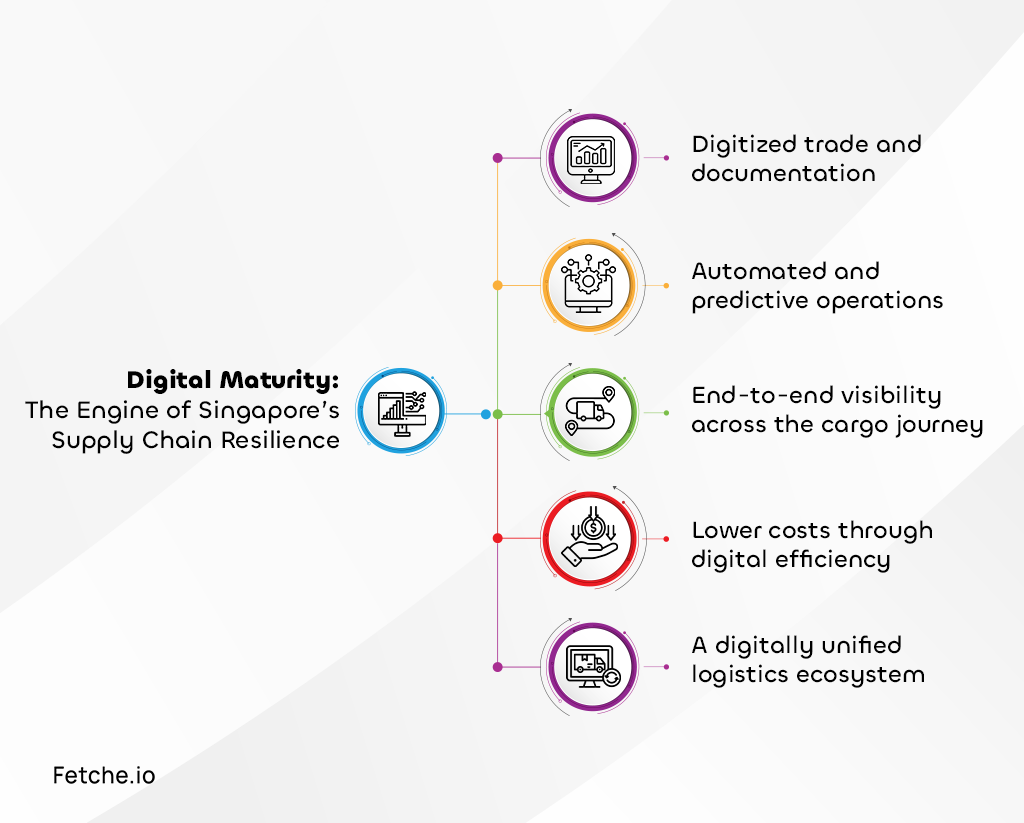
- Digitized trade and documentation
Electronic bills of lading and blockchain-based documentation reduce paperwork, errors, and approval delays.
- Automated and predictive operations
Automated customs and predictive analytics help anticipate disruptions and optimize routing before delays occur.
- End-to-end visibility across the cargo journey
Real-time visibility into shipments, inventory, and transport milestones across the supply chain.
- Lower costs through digital efficiency
Reduced manual work and administrative overhead lead to faster processing, fewer errors, and lower operating costs.
- A digitally unified logistics ecosystem
Connected digital systems across government bodies, ports, airports, and logistics partners enable seamless coordination and resilience during disruptions.
The Role of 3PL in Building Resilient Supply Chains
Businesses always rely on the 3PL (Third-Party Logistics) instead of handling everything in-house. So that transportation, warehousing, customs, and last-mile delivery become easier. The factors that let the logistics sector grow are:
- Automation in warehouses
- Robotics and AI in supply chain forecasting
- Real-time visibility platforms
- Expansion of last-mile capabilities
Advanced 3PL companies in Singapore combine strong physical infrastructure with digital tools for real-time tracking, inventory visibility, and performance monitoring. This allows businesses to respond faster, reduce risks, and maintain service levels even during uncertainty.
By acting as an extension of a company’s logistics team, 3PLs enable businesses to focus on growth while ensuring their supply chains remain resilient, cost-efficient, and future-ready, making them a pivotal pillar of supply chain resilience.
What Businesses Can Learn From Singapore’s Logistics Model
- Invest in infrastructure such as ports, airports, and warehouse services before disruption hits.
- Treat logistics as a strategic advantage or a growth enabler rather than considering it as a cost
- Adopt digital systems early, such as real-time visibility, automation, and data-driven planning.
- Must have seamless coordination between transport, warehousing, customs, and partners.
- Encourage public–private collaboration between policy, infrastructure, and private innovation.
How Fetche Helps Businesses Operate at Singapore’s Standard of Resilience
As a popular logistics ERP software in Singapore, Fetche enables businesses to operate by connecting every logistics function into one intelligent, real-time system.
- End-to-End Track and Trace
Real-time shipment and inventory tracking ensures complete visibility across freight movements, warehouse storage, and last-mile delivery.
- Smarter Warehouse Management
Before renting more warehouse services in Singapore, switch to Fetche’s Warehouse Management System for space utilization, inventory accuracy, and picking efficiency.
- Resilient Transportation & Freight Planning
With built-in Freight Management and TMS capabilities, businesses can plan routes, manage carriers, and adapt quickly when conditions change.
- Fleet and Driver Enablement
Fleet Management and the Driver Application ensure smooth execution on the ground, faster updates, and better last-mile performance.
- Analytics and Insights
Provide real-time performance metrics across operations.
- Financial Control and Cost Visibility
Integrated accounting and financials link logistics operations directly to costs and revenue.
As global trade faces increasing uncertainty in 2026 and beyond, Singapore continues to set the gold standard by combining speed, reliability, and adaptability across sea, air, warehousing, and third-party logistics operations. With Fetche, freight forwarders in Singapore, as well as others, can operate at an international standard of resilience. In a world where disruptions are inevitable, those who adopt integrated, intelligent logistics systems like Fetche will be the ones best positioned to compete, scale, and lead like Singapore.
FAQ
Singapore combines strategic location, world-class ports like Tuas and Changi Airport, strong 3PL networks, and advanced digital trade systems. This integrated ecosystem allows businesses to move cargo faster, switch routes easily, and maintain stability even during global disruptions, making it the benchmark for Supply Chain Resilience in Asia in 2026.
The country offers seamless multimodal connectivity between sea, air, and land transport, supported by automated ports, high-frequency sailings, and efficient air freight services. These capabilities ensure predictable schedules, quick turnaround, and minimal congestion, which are critical for resilient logistics operations.
Digital initiatives such as electronic documentation, real-time tracking, and predictive analytics improve visibility across the cargo journey. Businesses using modern platforms like Logistics Management Software in Singapore can reduce manual errors, respond faster to disruptions, and optimize inventory and transport planning.
3PL companies manage transportation, warehousing, customs, and last-mile delivery through automation and real-time platforms. By using tools such as Freight Forward Software Singapore, they help businesses scale operations, maintain service levels, and control costs during demand fluctuations.
Fetche’s Warehouse Management System in Singapore optimizes space utilization, picking accuracy, and inventory movement. Automation and real-time stock visibility reduce delays and errors, allowing companies to handle higher volumes without immediately investing in additional warehouse services.
reight forwarders can plan shipments, manage carriers, generate documentation, and track cargo in real time. Using a platform like Freight Forward Software Singapore enables faster coordination between customers, agents, and transport partners while improving service reliability.