
For every logistics firm, every festive season begins with a ray of new excitement, which, however, in no time turns chaotic. What starts with a lot of vigor and energy soon spirals into stress happening every year, yet feeling more intense each consecutive time.
Orders, as usual, flood in faster than most dashboards could refresh, and of course, customers expect next-day delivery as standard. As a result, couriers start hitting capacity limits, and most of the operations team become pretty much stuck juggling spreadsheets, WhatsApp messages, emails, and last-minute courier swaps just to keep things alive and moving.
By mid-December, “business as usual” feels like a distant memory, and chaos takes over the minds and operations.
Could the Festive Season 2025 be any better?
Looks like it may not be. Until you make some serious changes in the preceding procedures. Surging online orders, tight delivery timelines, labor shortages, and rising fuel costs very much turn the festive season into a major operational stress test. No worries, there are multiple ways to overcome this dilemma. Let’s discuss each in detail. This blog is a practical, honest guide that will help you to overcome festive season logistics challenges by using smarter systems, intelligent automation, and the right logistics management software—not longer hours and crossed fingers.
Why Festive Season 2025 Will Be Harder Than Previous Years
If Festive Season 2024 felt tough & miserable, Festive Season 2025 is set to raise the bar even higher. And therefore, relying on last year’s playbook is a bit of a risky move because, for one thing, the operating environment has fundamentally changed,
And for another, customer expectations have shifted dramatically, especially in the UK. Next-day delivery is no longer a premium option as it used to be in the good old days; it’s the baseline for any and every customer these days.
Same-day and timed-slot deliveries are becoming more and more common, especially in urban areas where customers are used to getting what they want in a day or less than that, placing enormous strain on last-mile delivery solutions that were never really designed for such intensity.
At the same time, courier capacity during peak weeks is tighter than ever. Carriers prioritize volume-heavy clients, labor availability fluctuates daily, and service consistency becomes unpredictable just when reliability needs to be intact.
And if you dare to add to this the growing complexity of multi-carrier operations, where businesses juggle regional specialists, national couriers, and contingency partners, it will result in a fragile system under constant and deepening pressure.
Perhaps most importantly, festive customers in 2025 are far less forgiving. Delays, missed delivery slots, or vague tracking updates aren’t seen as minor hiccups—they’re brand-damaging failures, which no company wants to endure during their normal working condition, let alone festive seasons.
In this environment, manual processes, disconnected tools, and reactive firefighting simply don’t scale.
The Real Festive Season Logistics Challenges UK Businesses Face
Let’s strip away the festive marketing gloss and talk about the unfiltered reality of festive logistics. These are the challenges UK delivery operations face every single peak season—only magnified during the Festive Season 2025.
- Unpredictable order spikes that break static delivery plans
Festive demand doesn’t rise gradually on a day-to-day basis; it shoots up in sharp, unpredictable waves driven by promotions, flash sales, influencer campaigns, and payday shopping all in no time. Needless to say, static route planning and fixed courier allocations may crumble like a broken glass vase under this volatility, forcing operations teams into constant replanning, manual overrides, and last-minute decisions that increase costs and error rates.
- Courier performance inconsistency during peak periods
Even your most trusted courier partners struggle during the festive rush. Missed collections, delayed linehauls, and service-level slippage become common, leaving businesses scrambling to reassign volume without real-time performance data or visibility into alternative option. - Last-mile delivery complexity is multiplying across the UK and surrounding regions.
Delivering into congested cities, suburban zones, and rural postcodes during the winter months introduces a totally new set of problems, in addition to the festive seasonal demand and complexities. Weather disruptions, traffic congestion, and regional carrier availability turn last-mile delivery into the most fragile—and expensive—part of the festive fulfillment chain.
- Lack of real-time operational visibility for decision-makers
Many managers still look forward to or only rely on delayed reports, siloed dashboards, or courier portals that never really get updated on time. By the time an issue is noticed well enough to initiate a discussion or take an action based on it, the delivery has already failed, customer complaints have escalated, it’s high time, and the opportunity to intervene has long passed the threshold. - Customer experience pressure, driven by tracking and communication gaps
Festive shoppers expect live tracking, proactive notifications, and transparency at every stage of delivery, as most of the products they purchase are strictly related to or wanted on the particular festive days or days preceding them. When updates are delayed or inaccurate, trust erodes quickly, greatly impacting repeat purchases and loyal customers even long after the festive lights come down.
Predictive Demand Planning in Festive Season 2025
One of the biggest shifts in Festive Season 2025 logistics is the move from reactive planning to predictive demand management. Instead of waiting for order volumes to slowly spike up and then trying to scramble to adjust routes, capacity, and courier allocation, many businesses have resolved to take the wiser route, that is, to make use of the historical data, seasonal patterns, and real-time signals to forecast demand before it materializes.
This approach allows operations teams to anticipate pressure points much more clearly across various regions, SKUs, and delivery time windows, reducing last-minute disruptions that typically plague the festive spirit.
Predictive demand planning becomes rather powerful when combined with a modern courier management system, as it enables early capacity discussions with carriers, smarter allocation of contingency partners, and more realistic delivery promises to customers, all without having to put a fraction of capital or energy into the process.
Rather than treating the festive rush as an unpredictable storm, it is high time that businesses begin to treat it as a forecastable event—complex, yes, but very much manageable with the right data-driven foundation.
Why Traditional Tools and Manual Workflows Fail During Festive Peaks
Spreadsheets, email chains, and phone-based courier coordination might feel familiar, but familiarity doesn’t equal scalability. During normal trading periods, these tools can just about hold things together. During festive peaks, they become bottlenecks.
Manual workflows slow decision-making precisely when speed is required the most. Data pretty much becomes outdated the moment it’s shared, not to mention teams’ duplicating effort across systems and valuable time being wasted chasing updates instead of addressing and solving the actual problems.
The festive rush exposes a hard truth: human-led coordination cannot keep pace with machine-speed demand.
That’s why automation, intelligence, and system-driven decision-making are non-negotiable, especially for festive seasons.
What Modern UK-Based Logistics Need to Survive The Festive Season 2025
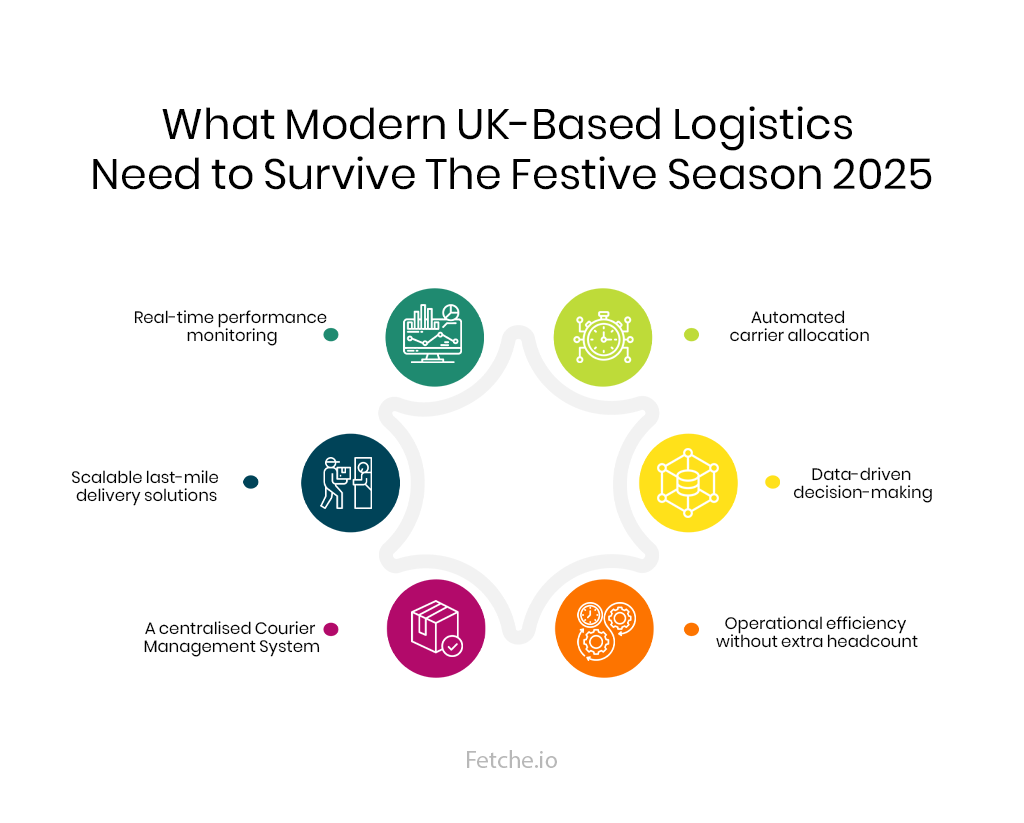
This is the turning point where survival shifts into strategy. To handle festive volumes without burning out teams or damaging customer trust, UK businesses need a fundamentally different operational approach.
- A centralised Courier Management System
One platform that connects all carriers, services, and regions into a single operational view, eliminating the chaos of juggling multiple portals and spreadsheets. - Scalable last-mile delivery solutions
Systems that flex with demand spikes, dynamically adjusting routes, capacity, and carrier allocation without requiring constant manual intervention. - Real-time performance monitoring
Live visibility across couriers, routes, depots, and delivery stages, allowing teams to identify risks early and act before failures occur. - Automated carrier allocation
Intelligent decision-making that assigns deliveries based on cost, capacity, geography, and SLA performance rather than habit or guesswork. - Data-driven decision-making
Access to actionable insights that support proactive planning instead of reactive firefighting. - Operational efficiency without extra headcount
Empowering existing teams to manage significantly higher volumes without longer hours or additional staff.
This is exactly why the right logistics management software changes everything.
Introducing Fetche: Built for Festive Season Logistics at Scale
Fetche is a purpose-built logistics management platform designed for high-pressure delivery environments like the festive seasons—when real-time visibility, tight control, and rapid execution are critical to keep up in order to grow the business.
Rather than treating courier management, last-mile visibility, and operational reporting as separate challenges like most logistics management software does, Fetche brings them together in one intelligent ecosystem. It basically enables businesses to orchestrate multiple carriers seamlessly, adapt to fluctuating volumes, and maintain control even when demand peaks unexpectedly, all operated and controlled under a single platform.
Fetche, Logistics Management Software acts as the central nervous system of your delivery operations. It connects data across carriers, depots, and routes, giving decision-makers a real-time, actionable view of what’s happening—and what needs attention—right then.
Therefore, unlike many other typical logistics software, Fetche becomes a strategic advantage, helping businesses turn festive complexity into controlled, scalable growth.
How Fetche Helps You Win the Festive Rush (Practical Use Cases)
Fetche’s value becomes clearest when festive pressure hits. Here’s how it directly supports delivery operations during peak season:
- Smarter courier allocation during peak demand
Fetche dynamically allocates volume across carriers based on real-time performance, capacity availability, and cost parameters, ensuring no single courier becomes a bottleneck. - Real-time visibility for proactive issue resolution
Operations teams gain instant insight into delays, exceptions, and SLA risks, allowing them to intervene before customer impact escalates. - Faster, confident decision-making
With all data centralized, Operations Managers and Transport Planners can make informed decisions in minutes, not hours, even during peak chaos. - Reduced dependency on manual coordination
Automation replaces repetitive tasks like reassigning deliveries, updating statuses, and chasing courier confirmations, freeing teams to focus on high-value problem-solving. - Improved customer delivery experience
Accurate tracking, proactive communication, and fewer missed deliveries ensure customer trust remains intact even at peak volume. - Cost control despite festive surcharges
By optimizing carrier usage and reducing inefficiencies, Fetche helps businesses manage rising festive costs without sacrificing service quality.
To sum up, Fetche gives operations teams the clarity and control they need to stay ahead when festive pressure peaks. By replacing guesswork and manual coordination with real-time intelligence, it helps deliveries stay fast, reliable, and cost-efficient even at the busiest times.
Strategic Cost Optimisation Without Customer Experience Trade-Offs
Festive Season 2025, like all other festive seasons, won’t fail to bring unavoidable cost pressures, from peak surcharges and fuel volatility to labor constraints and carrier premium pricing.
The challenge for UK businesses is thus not simply cutting costs but optimizing them without degrading the customer delivery experience.
Advanced logistics strategies now focus on balancing cost efficiency with service reliability by using data to make smarter trade-offs in real time.
This might mean dynamically switching carriers for non-urgent deliveries, adjusting delivery promise windows based on capacity availability, or consolidating routes where customer expectations allow flexibility. When powered by intelligent last-mile delivery solutions, cost optimization becomes a strategic exercise rather than a blunt cost-cutting measure.
The result is a delivery operation that remains profitable, competitive, and customer-centric—even at peak festive volume.
Prepare Early: Your Festive Season 2025 Action Plan
The biggest festive mistake is waiting until November to fix October’s problems. Preparing early is the difference between reactive survival and controlled success.
Now is the time to evaluate your current delivery operations, review courier performance data, and assess whether your systems can truly scale under festive pressure. Identify where visibility breaks down, where manual effort peaks, and where customer experience suffers most.
Implementing Fetche before the festive rush will allow your team to test, optimize, and gain confidence in their workflows long before volumes spike.
Final Thoughts
With the right systems in place, your delivery operations can move from reactive firefighting to proactive control.
By replacing manual processes with intelligent automation and centralized visibility, you won’t just survive the festive rush, but you will be able to turn it into a competitive advantage for your long-term growth and visibility, unlike any other such opportunity.
If you’re ready to move from festive overwhelm to operational confidence, Fetche is the logistics management software that helps you master peak season delivery, not fear it.
FAQ
The main priority is maintaining reliability and speed, as customer expectations for next-day delivery have become the baseline standard for the Festive Season 2025. Businesses must evolve from reactive firefighting to proactive control to meet these demands.
Companies typically face unpredictable order spikes that disrupt static plans, courier performance inconsistencies, and the growing complexity of last-mile delivery in congested urban or remote rural areas during the winter months.
A dedicated platform like Fetche acts as a central nervous system, connecting all carriers and services into one view. This Logistics Management Software enables real-time performance monitoring and automated carrier allocation to ensure no single courier becomes a bottleneck.
Traditional tools like spreadsheets and emails fail to scale when order volumes shoot up in sharp, unpredictable waves. Manual coordination is often too slow to address real-time disruptions, which can lead to brand-damaging delivery failures.
Yes, by optimizing carrier usage based on real-time capacity and cost parameters, these systems help businesses manage rising surcharges and fuel costs without sacrificing the quality of the customer delivery experience.
The key is to use the peak period as a strategic advantage. By mastering UK delivery operations through predictive demand planning and intelligent automation, businesses can build customer trust that lasts long after the holiday lights come down.