
Jurong and Changi are premium industrial hubs in Singapore, especially for their proximity to ports, airports, and key transport routes. But industrial rental rates in Singapore are among the highest in Asia, and warehouse layouts in these zones are often tight and expensive to scale. When space feels limited, many businesses assume they need to rent more. In reality, the problem is usually not space, it’s visibility. Overflow inventory, poor slotting, congested picking lanes, and inefficient layouts often hide unused capacity. This leads to a critical question many logistics managers are asking today: Can software replace space?
The real answer is that efficient warehouse management software replaces the need to rent more space through better stock visibility and space utilization. Software like Fetche eases the process of finding underutilized spaces in warehouses and lets the team use those spaces wisely, thus avoiding the necessity of renting more space.
The Hidden Warehouse Problem: Space Exists, But You Can’t See It
Managing inventory in high-cost industrial areas like Jurong and Changi is quite expensive. What if your warehouse in such areas is full and there is no more space for more products? You will definitely rent another space. More than bringing benefits through this, it becomes a liability to you. Renting more space means spending more, which is an additional expense. But many warehouse operators become blind to the fact that there are more spaces in the warehouse, which go unnoticed because of improper space management. It is a hidden problem that most warehouses face- space exists, but you cannot see it, only because of manual warehouse management that hides the real capacity and full potential of the current storehouse. Empty bins and unused vertical racking go unnoticed, and overstock happens due to inaccurate inventory data. Besides, slow-moving inventory blocks high-demand areas.
How Space Becomes Invisible
- Manual inventory tracking hides available space and stock.
- Inaccurate inventory data leads to overstocking.
- Empty bins and unused vertical racking go unnoticed without digital visibility.
- Improper slotting places slow-moving items in high-demand areas.
- No real-time stock visibility makes space utilization hard to measure
- Congested aisles and poor picking flow create the illusion of a full warehouse.
- Lack of space analytics prevents identifying underutilized zones
All these problems result in congested aisles, poor picking flow, and a false “space shortage.” So businesses need to rent additional warehouses and thus increase operating costs. These extra costs are unnecessary and can be avoided with proper warehouse optimization in Singapore.
Why Renting More Warehouse Space in Jurong & Changi is a Costly Mistake
Renting more warehouse space in Jurong and Changi is a costly mistake because these are some of Singapore’s most premium industrial zones, where high rental rates quickly inflate fixed operating costs without addressing the root problem. In most cases, space shortages are caused not by a lack of square footage, but by poor inventory visibility, inefficient racking, bad slotting decisions, and congested picking areas that leave usable space hidden or underutilized. Expanding into additional space also brings higher labor requirements, duplicate equipment, increased transportation between facilities, and greater operational complexity, especially for 3PL warehouse solutions. Instead of fixing the problems and freeing up spaces, renting more space often multiplies them. Here comes the importance of technology-led warehouse optimization, a far more cost-effective and sustainable solution than physical expansion.
The Hidden Costs of Expanding Warehouse Space
- High rental costs in Jurong and Changi significantly increase fixed overheads.
- More labor and equipment are needed to run multiple or larger facilities.
- Higher transport costs arise from moving inventory between locations.
- Poor inventory visibility remains unsolved, even with extra space.
- Inefficient racking and slotting continue to waste valuable capacity.
- Operational complexity increases, especially for 3PL warehouse solutions.
How a Warehouse Management System Helps Save Space
- Eliminates phantom stock with real-time inventory visibility
- Creates space in prime zones through smart slotting of fast movers
- Uses every bin efficiently with automated putaway
- Unlocks unused vertical space through optimized racking
- Reduces buffer stock with accurate FIFO/FEFO tracking
- Clears congested aisles by improving inventory turnover
- Cuts unnecessary movement using zone and wave picking
- Reveals hidden capacity with centralized space and inventory data
This is where warehouse optimization in Singapore becomes measurable and repeatable.
How Fetche Solves Warehouse Space Challenges in Singapore
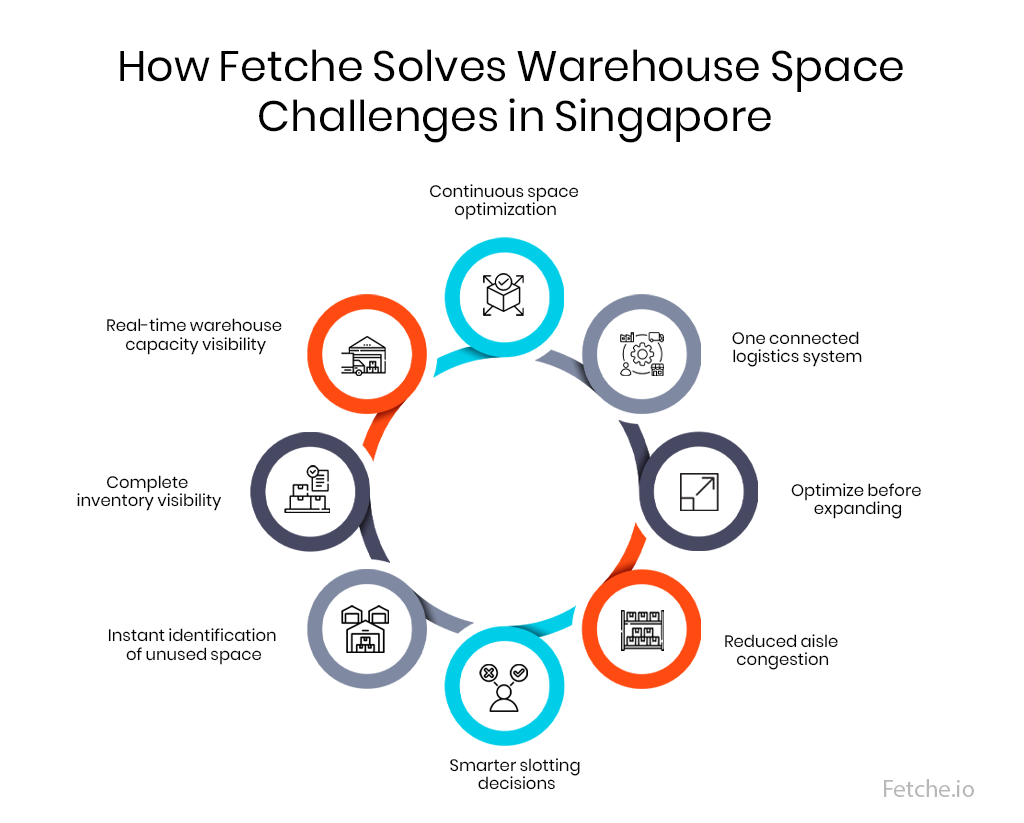
In high-cost industrial hubs like Jurong and Changi, warehouse space is limited and expensive. Often, the real issue isn’t the lack of space, it’s the lack of visibility into existing capacity. Fetche.io, a Warehouse Management System, helps warehouses uncover hidden space, improve utilization, and avoid unnecessary expansion by making every square foot visible and actionable.
With Fetche, warehouses can:
- Real-time warehouse capacity visibility: Fetche shows exact space availability across bins, racks, and zones in real time. This helps teams understand true warehouse capacity instead of relying on assumptions.
- Complete inventory visibility: Every item is tracked live, showing what is stored, where it is located, and how long it has been there. This eliminates guesswork and prevents misplaced or forgotten stock.
- Instant identification of unused space: Empty bins and unused vertical racking are highlighted automatically. Hidden and underutilized areas become visible and ready for use.
- Smarter slotting decisions: Fast-moving and slow-moving items are placed in the right locations. This improves picking efficiency and frees up high-demand storage areas.
- Reduced aisle congestion: Overstocked pick faces and blocked aisles are minimized through better space allocation. Warehouse movement becomes faster and more organized.
- Optimize before expanding: Fetche helps maximize existing warehouse space before considering new rentals. This avoids unnecessary costs in high-rent areas like Jurong and Changi.
- One connected logistics system: Inventory, warehouse, and transport operations work together on a single platform. This ensures smooth coordination and better space planning.
- Continuous space optimization: Warehouse optimization becomes an ongoing process, not a one-time effort. Data-driven insights help maintain efficiency as inventory changes.
Warehouse Expansion vs. Warehouse Optimization: A Simple Cost Comparison
You can run a warehouse in Jurong and Changi either in a smart way or a hard way. In this fast-moving world, adopting software for organizing warehouse racking and slotting is necessary and makes the work smarter, easier, and smoother with fewer errors. As the best logistics ERP software in Singapore, Fetche helps with warehouse optimization that can save costs and unwanted expenses created by warehouse expansion. Here is a comparison table reflecting how Fetche helps prevent unnecessary costs by saving more space.
| Cost & ImpactArea | Warehouse Expansion(Renting More Space) | Warehouse Optimization(Using Fetche WMS) |
| Industrial Rent | High rental rates in Jurong & Changi with long-term lease commitments | No extra rent by maximizing existing warehouse capacity |
| Upfront Investment | Security deposits, fit-out, racking, utilities | Software implementation at a fraction of rental cost |
| Labor Costs | More staff are needed to manage multiple locations | The same team becomes more productive with automation |
| Equipment Costs | Duplicate forklifts, scanners, racks, IT setup | Better utilization of existing equipment |
| Space Utilization | Inefficient layouts are often repeated in new space | Smart slotting, vertical racking, automated putaway |
| Inventory Visibility | Limited visibility across locations | Real-time stock and space visibility |
| Operational Complexity | More coordination, higher error risk | Centralized control from one system |
| Transportation Costs | Inter-warehouse transfers increase fuel and time | Reduced internal movement and handling |
| Time to Scale | Months to acquire and operationalize new space | Faster optimization with immediate impact |
| Flexibility | Fixed cost, hard to scale down | Scalable and adaptable as demand changes |
| Risk | Locked into high-cost leases | Low-risk, software-led optimization |
| Long-Term ROI | Cost-heavy with slow returns | Faster ROI through efficiency and cost savings |
In high-cost industrial areas like Jurong and Changi, expanding warehouse space increases expenses, while optimizing existing space through a warehouse management system in Singapore, like Fetche, delivers measurable savings and long-term efficiency. Not only for large enterprises, but Fetche is also the best WMS for small companies in Jurong.
When Should You Invest in a Warehouse Management System?
Every logistics hub needs an efficient warehouse management system, especially when they face the following scenarios:
- Warehouse feels full, but there’s no clear visibility into where space is being wasted
- Inventory records don’t match physical stock on the floor
- Empty bins and vertical racking go unnoticed due to manual tracking
- Slow-moving inventory blocks fast-moving SKUs
- Picking teams spend too much time searching, walking, or correcting errors
- Safety stock keeps increasing to compensate for inaccurate data
- When considering renting more warehouse space to handle growth
- Industrial rental rates in Singapore are rising faster than your margins
- Manual putaway and slotting lead to poor space utilization
- Managing multiple SKUs, clients, or 3PL operations is becoming complex
- Real-time inventory and capacity insights are missing from daily decisions
- Growth is planned, but warehouse expansion is not financially viable
If you are facing these challenges in your logistics space, it is clear evidence that you need a warehouse management system, and that is why Fetche is here to be adopted as a true logistics companion and inventory management system.
Fetche for SMEs & 3PLs in Jurong and Changi
Instead of expanding warehouse space and taking on higher rents, Fetche helps businesses unlock the full potential and hidden capacity within their existing facilities through smarter warehouse management and real-time visibility.
Fetche is ideal for:
- SME logistics companies managing limited warehouse space
- 3PL warehouse solutions handling multiple clients and SKUs
- Freight forwarders operating in premium industrial areas
Fetche is designed for:
- Smaller warehouses under high rental pressure
- Growing operations that need scalable systems, not bigger buildings
- Businesses looking for a smarter alternative to leasing additional space
With Fetche, SMEs and 3PLs gain accurate inventory visibility, optimized slotting, and better space utilization, making it one of the best warehouse management systems in Singapore.
Space is a challenge for warehouses, especially in areas with high rental costs like Jurong and Changi in Singapore. But you can transform these challenges into opportunities where space gets saved through better management using warehouse management software like Fetche. Switch to Fteche today to maximize your warehouse space.
FAQ
By using a Warehouse Management System in Singapore, you can maximize your current footprint through better visibility, avoiding the need for expensive additional leases.
Implementing the Best Logistics ERP Software in Singapore is more affordable than physical expansion, as it optimizes your existing space and improves labor productivity.
A Warehouse Management System in Singapore identifies underutilized vertical racking and empty bins that are often missed during manual inventory tracking.
Fetche is considered the Best Logistics ERP Software in Singapore because it offers real-time capacity insights, helping smaller operators manage complex inventories in tight spaces.
Poor visibility and manual tracking create the illusion of a full warehouse; a Warehouse Management System in Singapore fixes this by providing accurate, real-time data.
Yes, the Best Logistics ERP Software in Singapore uses smart slotting to place fast-moving items in prime zones, clearing aisle congestion and speeding up operations.