
If keeping inventory aligned in a single warehouse is difficult, multiply that responsibility across five, ten, or twenty locations, and you’re dealing with multiple demand patterns, fluctuating lead times, shifting priorities, etc.
And still, logistics companies are expected to synchronize it all seamlessly to keep their customers happy.
Is it even possible?
Not unless you have alignment, network-wide visibility, interconnected planning, automation, and a unified ERP backbone.
Let’s discuss!
What Is Multi-Location Inventory Management in Modern Supply Chains?
Multi-location inventory management is basically the process of controlling and coordinating stock across several touchpoints, including warehouses, regional distribution centers, cross-docking hubs, and even retail outlets.
Instead of treating each site as an independent storage unit, the entire network is considered or managed as one connected ecosystem.
Besides, modern organizations need inventory that is:
- Visible everywhere
- Synchronized across systems
- Optimized based on real, location-level demand
And this level of Inventory Optimization is impossible with spreadsheets alone. It calls for unified data models, central planning engines, intelligent replenishment rules, and automated execution through ERP and WMS systems. Many companies today achieve this through ERP for inventory management, ensuring every warehouse follows standard processes and consistent planning logic.
Inventory optimization using ERP software is the digital nerve center of modern inventory optimization today.
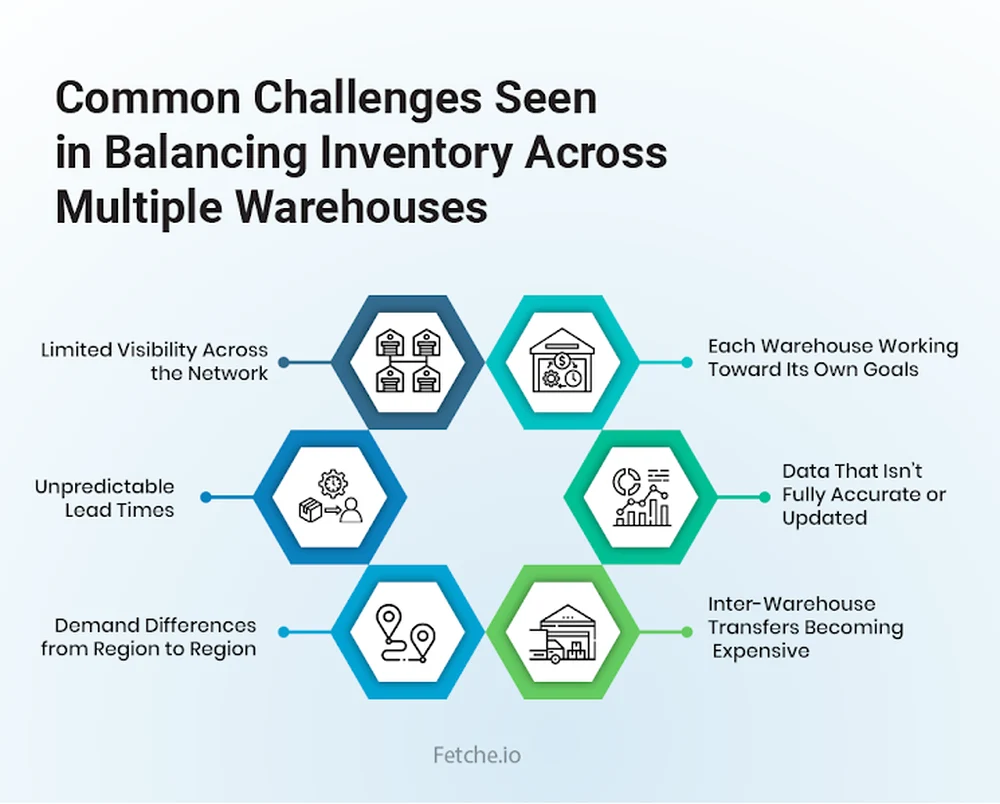
Common Challenges Seen in Balancing Inventory Across Multiple Warehouses
It may sound efficient on paper, but the process of managing inventory across several locations at a time is not something that would run as smoothly as we assume, as each warehouse behaves differently.
They may usually have their own demand patterns, lead times, storage limits, and operational priorities depending upon the region, its residents, and their preferences. When all of these began pulling in various directions, keeping the entire network synchronized is not really possible.
Below are the most common issues logistics teams run into on a day-to-day basis:
1. Limited Visibility Across the Network
If warehouses use different systems or update stock manually, real-time visibility becomes nearly impossible. This results in duplicated inventory, unnoticed shortages, and planning decisions that depend on incomplete information.
2. Demand Differences from Region to Region
No SKU performs the same everywhere. A product that sells out quickly in one region may sit untouched in another. Without accurate, location-wise forecasting, inventory ends up in the wrong place at the wrong time.
3. Unpredictable Lead Times
Delays from suppliers, transport bottlenecks, customs clearance, or local disruptions make replenishment cycles inconsistent. Teams are left choosing between carrying extra buffer stock or dealing with unexpected stockouts.
4. Each Warehouse Working Toward Its Own Goals
Warehouses often optimize for local needs—like maximizing their own service levels or keeping storage neatly balanced. But what works best for one site may not benefit the entire network, creating misalignment and inefficiencies.
5. Inter-Warehouse Transfers Becoming Expensive
Shifting inventory between locations is sometimes necessary, but it’s far from ideal. Transfers increase transportation costs, require more coordination, and add room for errors or product damage.
6. Data That Isn’t Fully Accurate or Updated
Inconsistent cycle counts, delayed updates, or mismatched units of measure can seriously disrupt planning. When the data is off, even the best systems and forecasts struggle to perform well.
Why Multi-Location Inventory Optimization is Essential: Strategic Benefits
A strong inventory optimization strategy doesn’t just “fix stock issues.” When done properly, it elevates the entire supply chain. The advantages go far beyond saving money — they improve service, efficiency, and decision-making across the whole network.
Here’s what an optimized multi-location inventory setup really delivers:
1. Lower Overall Inventory Without Increasing Risk
Rather than keeping extra safety stock in every warehouse, multi-echelon planning places buffers exactly where they add the most value. The result? Less excess inventory, but better availability.
2. Higher Service Levels and Faster Order Fulfillment
When inventory is placed intelligently across the network, products reach customers faster — with fewer missed orders and fewer “out of stock” moments. This directly boosts customer satisfaction and retention.
3. Reduced Transport and Emergency Freight Costs
A balanced network means fewer last-minute stock transfers, less express shipping, and fewer firefighting scenarios. Transportation decisions become planned, not reactive.
4. Better Use of Working Capital
When you carry only the stock you genuinely need, capital gets freed up. That money can then go into expansion, technology upgrades, or capacity improvements instead of sitting on warehouse shelves.
5. More Efficient Warehouses
Cleaner, right-sized inventory means better slotting, smoother operations, and improved picking accuracy. Teams spend less time reorganizing and more time fulfilling orders.
6. Stronger Supplier Relationships
With accurate demand signals and consistent replenishment patterns, suppliers can plan better, too. This improves collaboration, reliability, and negotiation power.
The Role of ERP, Supply Chain Planning (SCP) & Advanced Analytics
Inventory optimization using ERP software is the digital nerve center of modern inventory optimization today.
Here’s why ERP/SCP is critical:
- Unified Data Model: Every warehouse speaks the same language — SKU codes, units, bins, lead times, and cycle counts remain standardized.
- Real-time Stock Updates: Any transaction — inbound, outbound, return, transfer — syncs instantly, eliminating blind spots.
- Integrated Forecasting and Replenishment: Automated rules ensure stock movements follow consistent logic instead of manual overrides.
- Scenario Planning: Supply chain planners can test the impact of promotions, disruptions, or capacity changes.
Exception-Based Management: Instead of managing everything manually, planners focus only on deviations.
This is, in fact, the foundation behind true warehouse stock control, allowing every warehouse to operate consistently with fewer manual errors.
Real-Time Inventory Visibility: The Non-Negotiable Foundation of Optimization
No matter how advanced your forecasting, automation, or ERP system may be, nothing works without accurate, real-time visibility.
Here’s what strong real-time visibility includes:
- Accurate Stock-on-Hand Data
Every decision starts with knowing exactly what is available at each site. Real-time updates prevent duplicated orders, avoid blind spots, and ensure the inventory picture is always correct.
- Live Tracking of Inbound Shipments and ETAs
Visibility into supplier dispatches, production loads, and incoming shipments helps teams plan replenishment more confidently. When ETAs update automatically, you can adjust allocations, delay transfers, or prevent unnecessary emergency orders.
- End-to-End Visibility of In-Transit Inventory
Inventory on the move is still inventory — and often, it’s the most ignored. Tracking stock across transport lanes helps reduce the need for transfers, improves planning accuracy, and prevents safety stock from being inflated.
Why do you need Location-Specific Demand Forecasting?
One single national forecast might look good on some dashboard, but it hardly ever reflects what is really going on at ground level.
Each region, sometimes each warehouse, has its own way of working. What sells fast in Dubai may not sell in Delhi, and seasonal patterns completely vary from city to city, which is why location-based forecasting is important in order to capture regional buying habits, local seasonal trends, channel-specific variations, and warehouse-level SKU behavior intact.
Multi-Echelon Inventory Optimization (MEIO): The Smarter Way to Balance Stock
MEIO is now the industry standard for best practices in inventory optimization in logistics. It has become the gold standard for managing inventory in multi-location, multi-channel supply chains. Rather than treating each warehouse independently, MEIO optimizes inventory across the entire hierarchy — from suppliers to central warehouses, regional DCs, and even stores.
Here’s why MEIO is a game-changer:
- It evaluates demand variability collectively, not in isolation.
- It places safety stock where it actually adds value, not everywhere.
- It prevents duplication of buffers across nodes, reducing waste.
- It aligns service levels and carrying costs, delivering cost-effective availability.
Inventory Segmentation (ABC/XYZ): Prioritizing According to Importance
Treating all SKUs equally is one of the fastest paths to poor inventory performance. Inventory segmentation provides clarity on what deserves tighter control and what can follow more relaxed policies.
ABC segmentation prioritizes SKUs by value and velocity:
- A Items: High value, high impact, require strict planning and monitoring
- B Items: Moderate importance, balanced focus
- C Items: Low-value or bulk SKUs, often managed with simpler rules.
XYZ segmentation focuses on demand predictability:
- X: Consistent and predictable demand
- Y: Moderate variability
- Z: Highly uncertain or volatile demand
Combined ABC/XYZ profiling helps define:
- Stocking norms
- Replenishment frequencies
- Safety stock levels
- Review cycles
Reverse Logistics & Return Inventory Control
Returns are often the most neglected part of inventory planning — especially in multi-location networks. Without a clear process, return stock becomes “invisible,” inflating true inventory levels and distorting decisions.
Effective reverse logistics requires:
- Fast inspection, grading, and disposition to avoid pileups
- Routing rules that direct returns to the most appropriate location
- Defined pathways for resale, repair, refurbishment, or disposal
- Instant updates to inventory availability across the ERP/WMS
- Root-cause analysis to identify issues in quality or fulfillment
Final Thoughts
Balancing inventory across multiple warehouses is not something you achieve overnight for once and then forget. It’s a continuous capability — mainly powered by technology, accurate data, strong processes, and consistent governance.
When you are able to bring together:
- Real-time network visibility,
- MEIO-driven optimization,
- AI/ML-driven forecasting,
- ERP-backed replenishment discipline,
- Clear segmentation and return management,
You are able to create an ecosystem where inventory flows intelligently. Thus, we safely point out that the supply chain leaders who invest in this inventory optimization today will be the ones who operate with agility and outmaneuver uncertainty in the future.