
The eAWB, or Electronic Air Waybill, is an essential digital document used in air cargo that contains the contract of carriage between the shipper, freight forwarder, and airline. It is the electronic form of traditional paper airway bills that is going to change the ways of air cargo management through digitalization. eAWB was introduced in 2010 by IATA, and since 2019, the e-AWB in air cargo has been the standard default document. It gradually becomes the default carriage contract in air freight and replaces traditional paper AWBs with a secure, digital alternative that simplifies documentation, accelerates customs clearance, and strengthens compliance with global trade standards.
Let’s explore details about eAWB and how it is going to transform the future of air cargo.
What is eAWB: An Overview
The Electronic Air Waybill, or eAWB, is an important digital air freight document that contains the contract between the forwarder or shipper and the airline or carrier. Formerly, to include shipment details such as consignor, consignee, cargo contents, and routing in one place, paper air waybills were used. eAWB, or Electronic Air Waybill, is the digital equivalent of these traditional paper air waybills. It has become central to cargo supply chain optimization.
eAWB is an initiative by the IATA with the goal to reduce paperwork, errors, and labor, and to digitalize and accelerate the processes in air freight shipment. This digital document includes all the necessary details related to the shipment, including customs papers, commercial documents, transportation documents, etc. Digital documentation in air cargo with Electronic Air Waybill (eAWB) is a game-changer for air freight services, which makes processes faster, more accurate, and far more reliable.
Why eAWB Matters in Modern Logistics
As paper documents slow down the process and make errors, and tracking shipments harder, paper AWB is inefficient for keeping the air freight details. Besides, the logistics industry is getting advanced day by day, so it needs more advanced systems to accelerate the operations. This is where the Electronic Air Waybill becomes crucial.
eAWB makes air cargo operations smoother and more efficient with speed, accuracy, transparency, and compliance. With eAWB freight forwarding software, logistics companies can make their entire process smart and efficient.
- Speed: eAWB makes clearing customs faster and cuts down delays caused by paperwork bottlenecks.
- Accuracy: Reduces errors as information is transmitted digitally and consistently.
- Transparency: eAWB allows shippers, freight forwarders, airlines, and customs authorities to view real-time updates.
- Compliance: eAWB ensures seamless alignment with customs clearance digitalization, and cross-border trade compliance.
The method of handling information changes and becomes more efficient with eAWB, which paper air waybills could not bring. Paper documents can be misplaced, missed, or damaged. Electronic air waybills are a solution for modern logistics, which can store, transmit, and manage shipment data electronically through air cargo management software or freight forwarding ERP software.
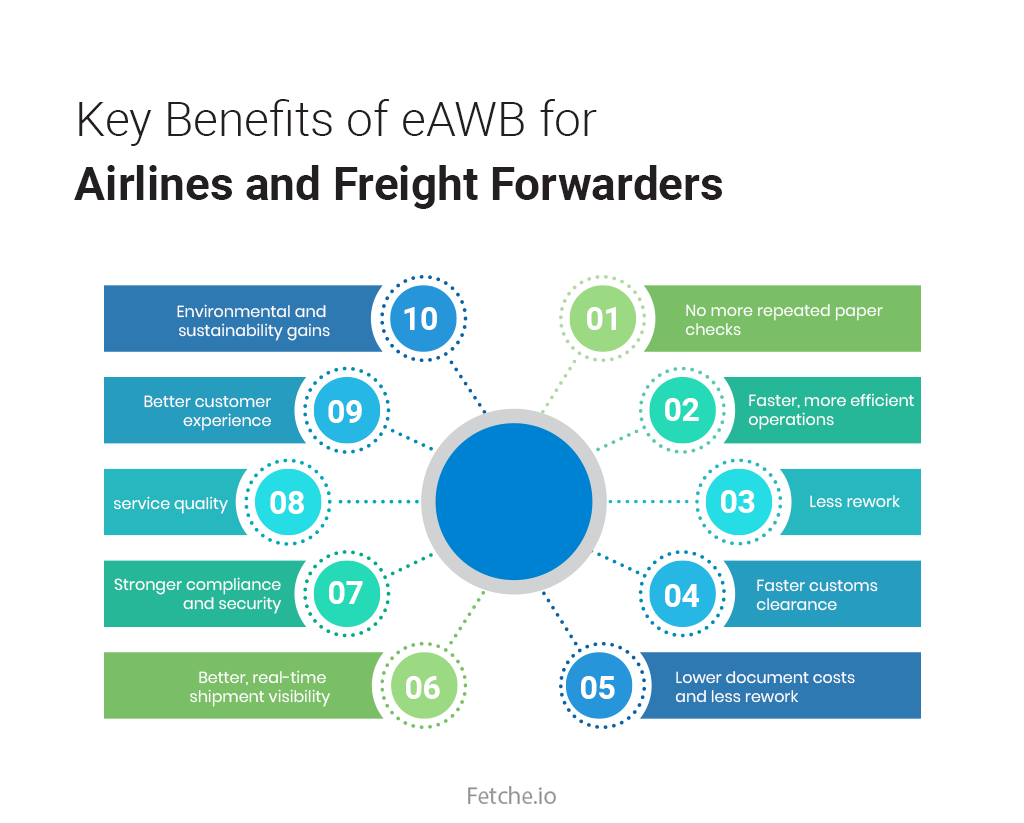
Key Benefits of eAWB for Airlines and Freight Forwarders
The benefits of the Electronic Air Waybill are numerous in air cargo management for both airlines and freight forwarders. Air cargo digitalization is crucial nowadays, and eAWB eases the process. The IATA eAWB initiative has brought many advantages to the air freight documentation process across operations, cost, compliance, customer service, and strategy. Here are the key benefits of eAWB.
- No more manual paper checking again and again: As shipment data is exchanged electronically, check-in, handovers, and processing at terminals move much faster. This reduced ground time, bottlenecks, and waiting lines. Also, it brings improved data quality and reliability.
- Faster, more efficient operations: Pre-submitted eAWB data helps other staff to start work before the aircraft arrives.
- Lower document costs and less rework: Reduces document costs by removing printing, couriering, and manual filing.
- Less rework: As eAWB reduces data-entry mistakes, it leads to less rework and shorter dwell times and thus reduces labor and detention costs.
- Faster customs clearance and fewer surprises: eAWB supports pre-arrival data submission and standardized records, which smooth customs processing.
- Better, real-time shipment visibility: eAWB can be integrated with cargo systems so that you will get up-to-date shipment information.
- Stronger compliance and security: eAWBs are easier to audit, trace, and secure and are useful for customs compliance, AEO programs, and forensic reviews.
- Better customer experience and service quality: Faster processing, accurate ETAs, and automatic status updates reduce customer inquiries and increase trust.
- Environmental and sustainability gains: Removing paper across millions of shipments reduces waste, storage needs, and carbon associated with document handling.
Benefits that are especially impactful by role
| For Airlines | For Freight Forwarders |
| Improved aircraft utilization (shorter ground time) | Faster booking-to-delivery cycles and fewer manual corrections |
| Fewer misloads and incorrect handling instructions | Improved quoting accuracy and faster client onboarding |
| Cleaner revenue reconciliation and billing | Stronger customer retention from reliable, transparent service |
For both airlines and freight forwarders, the electronic AWB is a practical step that brings paperless cargo operations. It also supports Authorized Economic Operators Standards.
How eAWB Supports AEO (Authorized Economic Operator) Standards
The AEO, or Authorized Economic Operator, program involves a partnership between customs authorities and traders to ensure supply chain security and facilitate legitimate trade. The AEO ensures that global supply chains are secure and compliant with international trade regulations. Electronic Air Waybill enables air freight services to achieve AEO certification, which is a hard-earned credential for them. By replacing paper-based processes with digital documentation, eAWB provides the reliability and transparency needed for AEO compliance.
Here are the key ways in which eAWB strengthens AEO compliance:
- Compliance with customs regulations, as eAWB aligns with the IATA eAWB initiative and global customs clearance digitalization.
- Record-keeping and transparency are made simple with eAWB, because shipment records are stored digitally in air cargo management software or freight forwarding ERP systems.
- Financial solvency and accountability will be gained as electronic documentation minimizes disputes with carriers or clients by ensuring accurate billing and cleaner revenue reconciliation.
- Offering cargo and supply chain security by preventing tampering or loss of documents by keeping all data in encrypted systems
- eAWB allows special cargo handling instructions to be transmitted clearly and without error, ensuring compliance with safety requirements.
- With eAWB, companies can integrate automated validation checks that flag missing or incorrect data instantly, improving internal compliance controls and reducing costly mistakes.
- Reduces reliance on manual, error-prone processes, as staff get training through a unified platform.
- Real-time visibility enabled by eAWB helps logistics teams detect route deviations, delays, or compliance issues early, strengthening proactive risk management practices.
- eAWB removes the bottlenecks of paper-based systems and supports faster, standardized cross-border trade, a key pillar of AEO certification.
AEO compliance in logistics is very crucial in proving your operations are compliant, secure, and reliable. eAWB supports air cargo logistics companies meeting AEO standards.
Challenges in Adopting eAWB
Even though eAWB brings huge benefits, some hurdles still slow down its global adoption:
- Resistance to Change– Many logistics companies are still comfortable with paper-based processes.
- System Integration– Connecting eAWB with older freight forwarding ERP systems can be tricky.
- Training Gaps– Staff may have difficulty using new digital freight forwarding solutions and tools.
- Regulatory Differences– Electronic documentation in air cargo management is not accepted by all countries.
How to Overcome These Challenges
- Change Management– Give proper guidance to teams and stakeholders about the usage of eAWB to improve efficiency and compliance.
- Adopt the Right Software– Use modern eAWB-enabled freight forwarding ERP software that integrates easily with existing systems.
- Training Programs– Provide training and enrichment programs for staff to enable them to use digital tools wisely.
- Choose Digital-Ready Partners– Work with carriers, airports, and customs authorities that already support eAWB processes.
The Future of Air Cargo with eAWB
As the whole world adapts to digital trends, so does air cargo. The future of air freight will rely on technology and will become digital. The eAWB, or Electronic Air Waybill, boosts this change. Many of the airlines and air cargo services have already chosen eAWB instead of messing around with traditional paper air waybills. Airlines, freight forwarders, IATA-accredited cargo agents, and e-commerce businesses currently use Air Waybills (AWBs) for international air cargo shipments, where data is shared instantly and securely. In the future, most of the cargo services will shift to eAWB without doubt.
Here are the changes we can expect with eAWB in air cargo:
- Full paperless operations across trade lanes
- All parties will receive the same up-to-date shipment information
- AI & IoT integration for predictive logistics
- Pre-arrival processing and automated risk assessment
- Eliminating duplicate entries and the need for secondary data providers
- Sustainability and cost efficiency with fewer paper processes, fewer detention fees
- Global Standardization as more countries adopt digital-first policies
The future of air freight is digital, and the Electronic Air Waybill (eAWB) is the foundation of this transformation. The rise of eAWB marks a milestone in the ongoing global air freight digital transformation, where digital tools replace outdated paper-driven workflows. It strengthens cross-border trade compliance by standardizing documentation and aligning with customs requirements worldwide.
With Fetche, you can simplify eAWB adoption through an all-in-one freight forwarding ERP software that integrates digital documentation, real-time shipment visibility, and compliance management.