
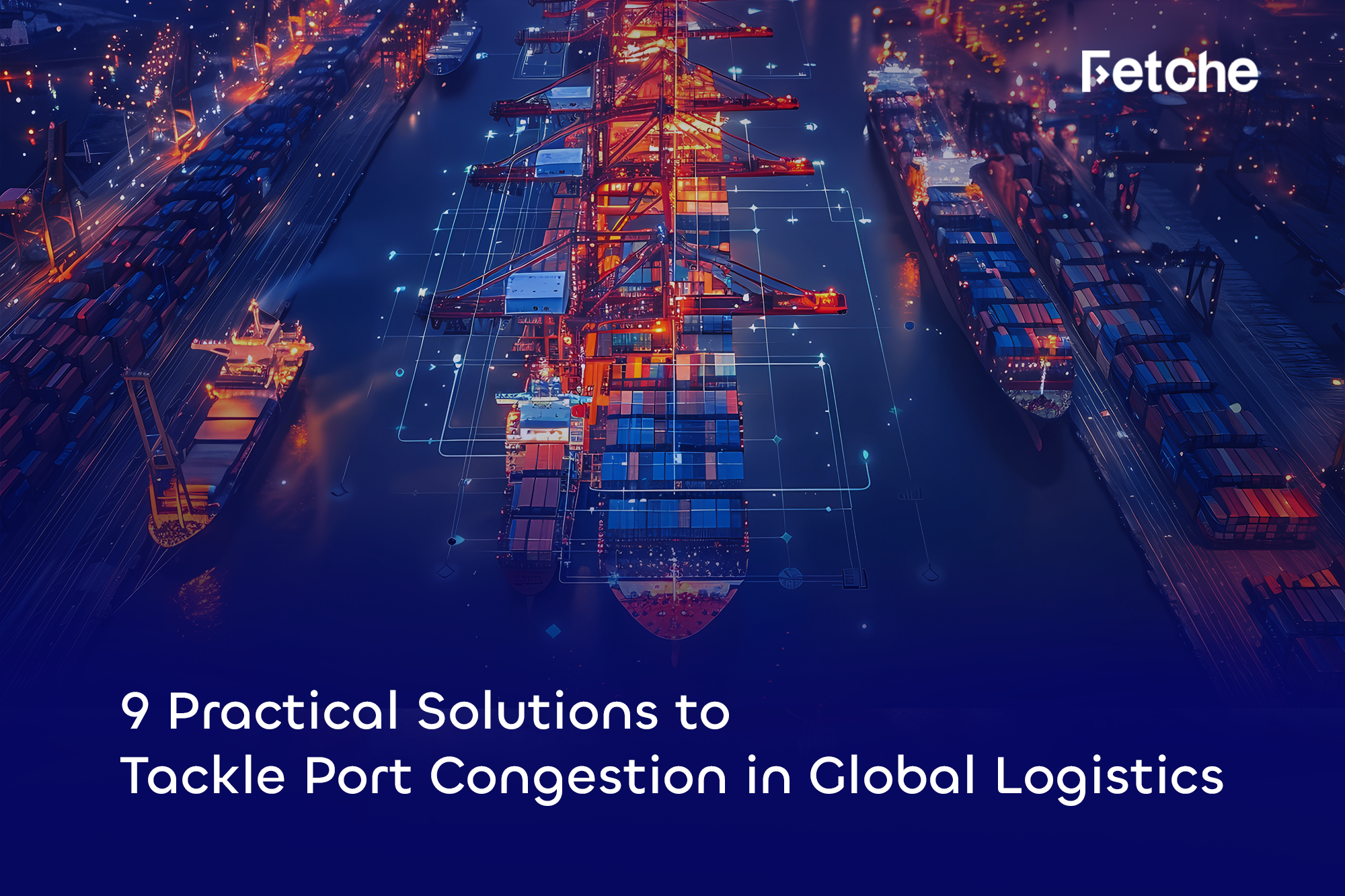
If you are a part of the logistics industry, chances are that you have already dealt with port congestion. After all, it is a global trade logistics challenge that affects shippers, freight forwarders, and businesses alike. It results in shipping delays, schedule breakdowns, and massive supply chain disruptions.
Unpredictable and uncontrollable as it sounds, port congestion can be tackled. The solution is better planning and technology. But before we get to the solution, we need to understand what causes port congestion. Only the problem can present you with the solution. So, this blog will break it down problem by problem and match each one with a practical solution.
What is Port Congestion?
You can think of port congestion like a traffic jam. It happens when ships and containers cannot move in or out of a port smoothly. Vessels wait at anchorage, containers pile up at terminals, and workers are unable to manage the load. You might have also seen this situation referred to as container terminal congestion.
Negative Effects on Businesses
Maritime logistics challenges like congestion adversely affect businesses. It often has a ripple effect that hits both revenue and customer trust. Here are some of the main effects of port congestion:
- Shipping Delays
Late shipments frustrate customers and harm brand reputation.
- Higher Costs
Demurrage, detention, and storage charges pile up, eating into profits.
- Inventory Shortages
Retailers face empty shelves and manufacturers face production halts.
- Ripple Effects in Supply Chains
One port delay creates a domino effect, causing freight forwarding challenges across continents.
- Reduced Competitiveness
Delays cause your customers to turn to competitors.
Major Causes of Port Congestion
Port congestion is often the result of multiple interconnested issues. We can generalise these and say that most port congestion occurs when the port capacity is unable to keep up with the demand.
Core Cause of Congestion – Port capacity is unable to keep up with demand. |
This can happen due to a couple of reasons:
- Sudden trade spikes
- Inefficient port operations
- Labor shortages
- Inefficient yard and container management
- Customs delays
- Equipment breakdowns
Resolving Port Congestion
Port congestion is a serious issue, but it can be resolved. The answer lies in a mix of technology and infrastructure upgrades. One apt example is the Vizhinjam Port in India, which is a high-capacity, semi-automated port. It is a testament to how the right combination of innovation and planning can ease bottlenecks.
With that in mind, let’s break down the causes of port congestion and how businesses can resolve them:
1. Problem – Rising Trade Volumes
At the rate at which global trade is growing at the moment, port infrastructure cannot keep up. Ships are getting bigger, and trade volumes are spiking. This is leading to global port congestion.
Solution – Invest in port efficiency solutions. Port authorities need to expand infrastructure. Meanwhile, businesses can choose less congested ports and spread shipments across multiple terminals. Smart port solutions like automated cranes and AI-driven scheduling can also go a long way in managing capacity more efficiently.
2. Problem – Inefficient Port Operations
In many ports, you’ll still see clipboards, manual logs, and fax machines handling cargo movements. These outdated and slow systems lead to shipping delays. Without digitization, large volumes cannot be processed.
Solution – The answer is automation. Digitization can be achieved through logistics management software for ports. This way, customs clearance, container management, and scheduling can be automated. This will improve speed and accuracy. Additionally, digital freight solutions can be incorporated to gain better visibility into shipments and reduce delays.
3. Problem – Labor Shortages & Strikes
Labor is the backbone of port operations. Therefore, any shortage of workers or an unexpected labor strike can quickly lead to port congestion. Without enough workers, vessels will have to wait longer, and cargo will eventually pile up.
Solution – The only solution is to try and manage the workforce effectively. Where possible, balance manual work with automation to reduce dependency on human labor during peak times. You can also:
- Use predictive analytics to forecast labor demand
- Use collaborative tools to improve communication between port workers and management
4. Problem – Inefficient Yard & Container Management
Sometimes containers are stacked in ways that make retrieval difficult. A container needed today might be buried under stacks of others. This inefficient system causes cargo delays at ports and slows the supply chain.
Solution – Adopt warehouse and freight integration systems. This will help:
- Track container location in real time
- Reduce time spent searching containers
- Cut down yard congestion
- Optimize space
- Improve turnaround time
5. Problem – Customs & Regulatory Delays
This is one of the biggest shipping industry bottlenecks. Manual documentation, verification delays, and changing regulations across countries will cause unexpected delays.
Solution – Use import/export documentation software. This will:
- Automate compliance
- Reduce errors
- Speed up approvals
- Make it easy to share customs documents
6. Problem – Equipment Breakdowns
Port operations are heavily dependent on equipment. This includes cranes, trucks, and handling systems. If these break down, everything stops. Freight forwarding challenges grow when vessels cannot be unloaded on time.
Solution – Adopt predictive maintenance. You can also:
- Use IoT sensors to track equipment performance
- Invest in backup equipment
7. Problem – Poor Coordination
A lot of elements come together in port operations. There are shippers, carriers, freight forwarders, customs, and terminal operators in this equation. Wherever there are multiple elements at play, there is also a need for smooth coordination. So, without proper coordination, any number of logistics congestion solutions will fail to deliver results.
Solution – Use collaborative platforms like logistics management software for ports. This will give you the following advantages:
- It will bring all stakeholders in one place
- It will offer shared dashboards and communication tools
- It will enhance visibility for everyone involved
- It will support decision-making
8. Problem – Underutilization of Technology
There are more than a handful of port management tools available today. And yet, many ports and logistics providers are guilty of underutilizing technology.
Solution – Adopt tools and software that can enhance port operations. Here are some examples to get you started:
- AI solutions to optimize vessel berthing
- Machine learning tools to improve truck scheduling
- Data analytics platforms to streamline cargo flow
9. Problem – External Disruptions
Apart from the problems we discussed until now, there are also a handful of external disruptions that can adversely affect your port operations. This includes storms, pandemics, and even geopolitical tensions. The peculiarity of these disruptions is that they are unpredictable and beyond anyone’s control. This makes these disruptions the hardest to tackle.
Solution – A resilient supply chain is the only solution. If you can make your supply chain resilient, you can overcome any disaster. This is how you can go about building resilience into your supply chain:
- Use a multi-carrier shipping integration system
- Create contingency plans for emergencies
- Use real-time shipment tracking platforms to help you stay prepared

FAQ
1. How to avoid port congestion?
By planning in advance, diversifying routes, improving documentation, and adopting digital tools like logistics management software for ports.
2. What is port congestion?
Port congestion happens when ships and containers cannot move in or out of a port smoothly. It leads to:
- Shipping delays
- Higher costs
- Inventory shortages
- Container pile-ups
3. How can the congestion problem at the seaport be solved?
You can solve congestion problems at seaports by:
- Upgrading infrastructure
- Adopting smart port solutions
- Using freight forwarding software.
4. How to calculate port congestion?
It is usually measured by vessel wait times, average container dwell times, and berth utilization rates. Digital tools now offer real-time congestion tracking.
Conculsion
Port congestion shouldn’t bring your operations to a halt. As we discussed, every problem comes with a solution. Whether the issue is rising trade volumes, inefficient port operation, labor shortages, or inefficient yard management, the solution is always within reach. However, as global trade expands and pressure on ports mounts, the onus of implementing these solutions lies on logistics providers. The business that understands this will move faster, deliver on time, and keep customers happy even in adverse conditions.