

The trade of goods has been as ancient as human contact itself. It could be traced back to the days of the barter system, wherein goods were transferred hand-to-hand from village to village at times of need. With civilizations expanding and borders dissolving, seaborne cargo took the place of the barter system and, in no time, became the backbone of global exchange, transporting spices, silk, and tales across seas. Throughout centuries, this service of delivery has evolved, shaped by war, climate, innovation, and coercion.
In this blog, we’ll unpack some of the most relevant modern delivery models, analyze their pros and cons, and explore which ones are winning customer hearts—and why. So if you’re someone who finds the intersection of technology, behavior, and supply chain fascinating, keep reading.
A Sneak Peek into the Evolution of Cargo Delivery Models
Cargo delivery has always been the pulse of business. But what transpires in getting goods from sender to receiver has changed dramatically—from dirty postal counters to intelligent locker systems and now, completely optimized doorstep delivery. Before the digital era, cargo delivery was centralized. Parcels were sent out from country or regional post offices and picked up at the local post office by receivers, sometimes days or weeks apart. Firms and consumers alike had to depend on those government-operated networks or private courier outlets that were inflexible, invisible, or inconvenient. With the commencement of private logistics providers, particularly during the 1990s and early years of the 2000s, the PUDO model became more popular. Products were dropped off at specified third-party sites—such as convenience stores and gas stations—where consumers could retrieve them.
The actual change, however, came about only with the growth of e-commerce. As shopping online boomed, logistics players wanted to capture last-mile deliveries. That’s when click-and-collect was invented—customers shopped online but picked up from shops or lockers. Amazon Lockers, InPost, and other locker parcel schemes came into the picture. As cities became more urban and customers increasingly had less time, even lockers were becoming a hassle. Individuals didn’t want to “go somewhere” to pick up their deliveries—they wanted their orders delivered to them.
Why Pickup Points Were Once the Preferred Model
When home pickup cargo service wasn’t an option yet, pickup points (also referred to as PUDOs—Pick-Up and Drop-Off points) were celebrated as the most effective solution for addressing last-mile delivery in volume. This was well received by customers as well as distributors alike due to the following reasons:
- Pickup points reduce failure rates by removing the need for tight customer coordination.
- Delivery vehicles of courier partners would take optimized routes, delivering dozens (scores) of packages at a single location rather than finding narrow lanes to individual doorways.
- Since customers would pick up within regular retail hours, the logistics providers could make definitive arrangements for resource deployment, manning, and drop schedules.
- By delivering to hub points, the logistics firms reap enormous per-unit cost savings.
- Pickup points were ideal for high-density city centers where parking limits, gated communities, or security protocols rendered door-to-door service impractical.
- Customers were also able to bring goods back directly to the collection point without having to organize collections or suffer courier delays.
Why Pickup Logistics Didn’t Scale with Modern Expectations
Here are a few key challenges that made pickup point models obsolete:
- Customer Inconvenience
- Not Suitable for Fragile Cargo
- Collection Delays
- Festive Season Congestion
- Insufficient Infrastructure in Tier-2/3 Cities
- Low Personalization
- Limited Support Hours
What Is Home Delivery in Modern Logistics?
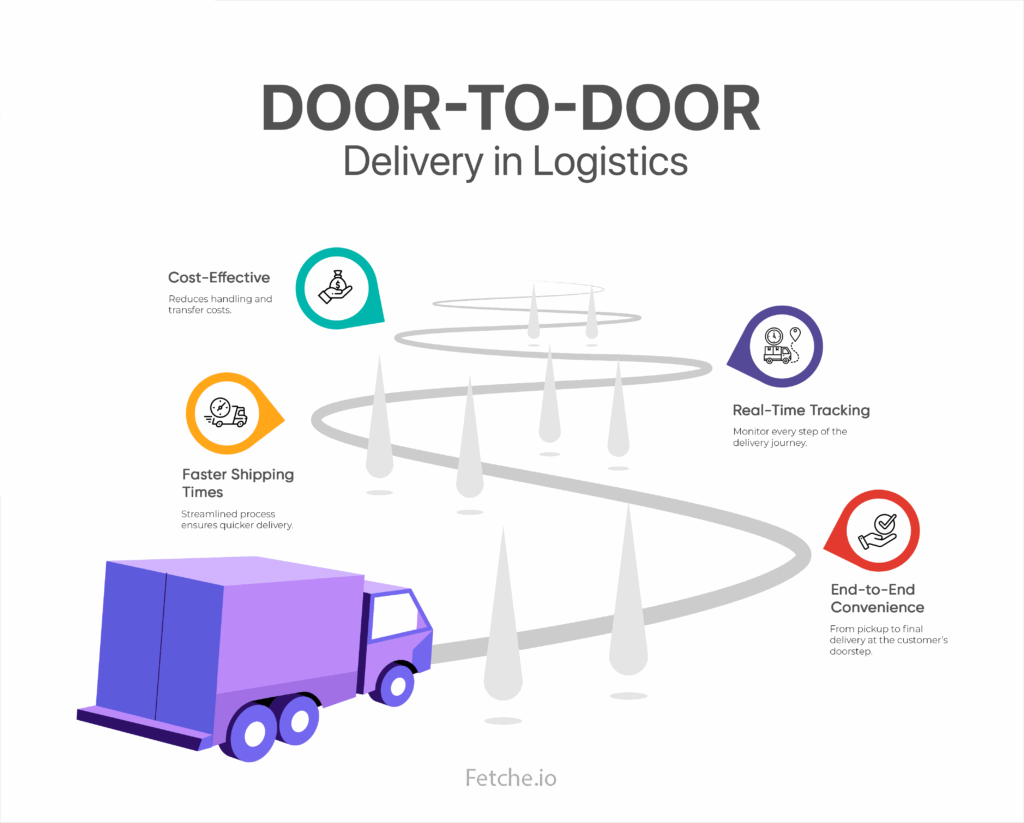
Home delivery is a technology-powered, end-to-end logistics service that guarantees a product to be picked up from the source (usually the shipper or seller) and delivered to the doorstep of the receiver. In contrast to outdated delivery models, contemporary home delivery is completely integrated with logistics software with capabilities such as real-time cargo tracking, timed pickups, route optimization, digital proof-of-delivery (POD), and contactless handovers.
Key benefits of home delivery for cargo include
- Seamless Convenience
- Enhanced Trust & Safety
- Real-time tracking of cargo
- Advanced delivery windows
- Premium Brand Perception
- Tech-Enabled Scalability
Pickup vs. Home Delivery: What’s the Real Difference?
| Aspect | Pickup Points | Home Delivery |
| Cost per Shipment | Lower on a per-unit basis due to bulk drop-offs | Slightly higher, but decreasing with tech-driven routing |
| Customer Effort | Requires travel, queuing, and time commitment | Zero effort—delivery at the customer’s convenience |
| Delivery Success Rate | High for pickup (no missed drops) | Higher with flexible slots and smart notifications |
| Infrastructure Need | Requires physical hubs or lockers | Needs an efficient last-mile fleet and smart routing |
| Technology Reliance | Minimal (barcode scanning or SMS) | High—real-time tracking, dispatch platforms, delivery apps |
| Scalability | Limited in semi-urban/rural areas | Scalable with modern logistics software and mobile networks |
| Experience Factor | Functional but impersonal | Personalized, branded, and trust-building |
Why Door-to-Door Delivery Became the Gold Standard in Cargo Logistics
Door-to-door delivery is considered the best cargo delivery method due to the following reasons:
- What was once a value-added premium has become a standard expectation for consumers and B2B customers alike in the era of e-commerce.
- Consumers expect transparency. Live tracking, links, and active alerts have established real-time cargo tracking as an integral component of the delivery experience, especially in international door-to-door cargo.
- B2B deliveries can be coordinated to warehouse windows, inventory replenishment, or time-sensitive delivery—something pickup models can’t really provide.
- Even in smaller towns and rural clusters, logistics companies are now making secure, tech-enabled door-to-door delivery available to stay ahead of digital adoption and increasing consumer expectations.
Who’s Fueling the Shift? Demand-Side Pressure
The increasing move away from pickup models is being driven by changing consumer expectations in both B2C and B2B markets. Leading the charge are Gen Z and Millennials, who expect a mobile-first, real-time, and frictionless delivery experience. It’s inconvenient for them to commute to a pickup site—delivery has to come to them, not vice versa. At the same time, D2C brands and SMEs are depending substantially on door-to-door logistics to create speed, consistency, and control over the customer experience.
The post-pandemic world has only reinforced this habit. Contactless, doorstep delivery, which was a COVID-19 safety requirement, has now become a convenience default—even for staples.
Breaking the Cost Myth: Is Personal Delivery Really Expensive?
While many understand the door-to-door delivery model as being costly, contemporary logistics data is different. Present-day personal delivery systems are driven by route-optimizing engines that minimize idle time and fuel consumption and maximize delivery density, reducing operational costs considerably. Apart from cost per shipment, customer retention and Net Promoter Scores (NPS) also tend to increase significantly with door-to-door shipping service. However, reverse logistics expenses are reduced because fewer deliveries fail and there is more predictable customer behavior at home. Simply put, when executed properly, doorstep courier services are just the same as any other.
What’s Next in Personal Delivery?
The future of logistics is likely to provide a wide array of possibilities and would probably be highly personalized. Industry experts are already incorporating drones, delivery robots, and electric vehicles (EVs) into their fleets to minimize carbon footprints and enhance reach in tight spaces.
APIs are also facilitating on-demand delivery integrations, allowing marketplaces and D2C companies to access hyperlocal carriers without having to operate their own fleet. AI-driven predictive ETAs are improving the accuracy and transparency of deliveries, reducing customer stress, and improving SLA compliance.
In the future, doorstep courier services will even be a subscription service—much like streaming or groceries—sold as an embedded experience on platforms. Logistics will no longer be transactional. Tomorrow’s customers won’t merely want delivery; they’ll anticipate effortless, branded, personalized shipping with security, constructed totally around them as the digital economy matures.
FETCHE—A Tool to Build Door-to-Door Cargo Solutions
FETCHE is a specialized ERP platform tailor-made to transform how logistics businesses operate. From order booking to last-mile delivery solutions, FETCHE integrates each of the functions—sales, warehouse, fleet, finance, and customer service—under one wise, integrated system.
Designed to serve contemporary delivery infrastructures, FETCHE equips logistics providers with such capabilities as real-time vehicle tracking, automated reporting, intelligent inventory management, and real-time analytics. If you are in search of a dispatch management platform to facilitate smooth team coordination or just another logistics software for cargo delivery
to streamline everything from home pickup cargo service to doorstep courier service, you won’t find a better option than Fetche.
Final Thoughts
Nobody wishes to loiter over a package, worrying over delivery options for online orders or cargo delivery to home, speculating whether it will make it today or tomorrow. So when a cargo company promises to deliver parcels to the doorstep, we take it. And if technology could bring shipping convenience for customers, we would choose it.