
Ever wondered what happens to a product after you return it?
For most customers, the story ends the moment a refund is processed, but for businesses, that is just the beginning of another complex journey called reverse logistics. Here comes the importance of reverse logistics.
Reverse logistics and returns management are pivotal facets of any online retailer’s supply chain. E-commerce and digital logistics have grown nowadays, and so have returns and replacements. They have become as common as purchases. Whether it is a damaged gadget, a wrong-sized outfit, or a product delivered but unable to meet the expectation, customers return them back to the seller or manufacturer. This after-sales process of sending back goods and managing them is called reverse logistics. Managing this process well is very important to maintain the brand’s reputation and trust.
In this blog, we’ll explore what reverse logistics really means, look at some real-world examples, uncover strategies to streamline the return process, and see how modern solutions are helping companies transform returns into opportunities.
What is Reverse Logistics
Reverse logistics is the process of moving goods back to the seller or manufacturer from the customer for return, repair, recycling, or disposal. While traditional logistics focuses on delivering products to the customers, reverse logistics is the opposite of it. It is the process that takes place after a sale. With the working flow of the consumer to the business, reverse logistics makes sure returned items are properly collected, inspected, and processed, and that they are in a safe condition.
The Growing Importance of Reverse Logistics
In an online retailer supply chain, reverse logistics and return management are the essential dimensions. When a customer wants to return or replace their product, the significance of reverse logistics becomes apparent.
- E-commerce Growth: Online shopping’s popularity has increased nowadays, and returns and replacements have become a daily part of it. Therefore, reverse logistics has also become an integral part of the e-commerce business.
- Consumer Expectations: Easy returns, quick refunds, transparent real-time tracking, customers’ expectations, and demands. Businesses strive to meet the expectations to keep the loyalty, and thus, it increases the importance of a strong return management system.
- Sustainability Goals: Sustainable logistics is all the rage these days, and most of the companies are practicing refurbishing, recycling, and reusing returned items instead of discarding them.
- AI in Logistics Management: Artificial intelligence helps predict return patterns, optimize routes for collection, and automate return approval, reducing time and costs.
- Emergence of Smart Logistics Technology: Automated return tracking systems, RFID scanners, and warehouse management integrations have now emerged to enable businesses to have real-time visibility and accuracy throughout the reverse logistics process.
Common Examples of Reverse Logistics
Reverse logistics is not just about returning goods and handling them, it is all about bringing value from those returned products through different modes. Even a small e-commerce store can transform the returned goods into a profitable product. Here comes the importance of reverse logistics to manage them to reuse, recycle, or refurbish. Let’s take a look at the examples of reverse logistics through which you can make value from sent-back products:
- Returns & Exchanges
Returns or exchanges happen when customers send back unwanted products to the seller or manufacturer. They are the most common form of reverse logistics. Popular e-commerce sites like Amazon and Flipkart have mastered this by offering simple, automated return systems.
- Refurbishing & Reselling
Most of the returned electronic products or appliances can be repaired and resold. Such reselling products are called “refurbished” products. People can buy them at discounted prices compared to the original price. This helps companies create value from those products while promising sustainability.
- Recycling & Disposal
Items that cannot be repaired or reused can be safely recycled to create any new products. Some items will be disposed of safely without harming nature.
- Repair & Maintenance
Manufacturers collect faulty equipment from customers for repairs and send it back after servicing. Repairing is common in the tech and automotive sectors.
- Repackaging & Restocking
Some products are returned in good or usable condition. So, companies repackage and resell them to create maximum value and reduce waste. Especially in the textile industry, where wrong-size clothes are delivered to customers and people return them, manufacturers supply such products to the right people.
- Asset Recovery
Companies recover valuable parts or materials from used products. Extracting metals from old electronics or reusing components in new manufacturing are the best examples of recovery.
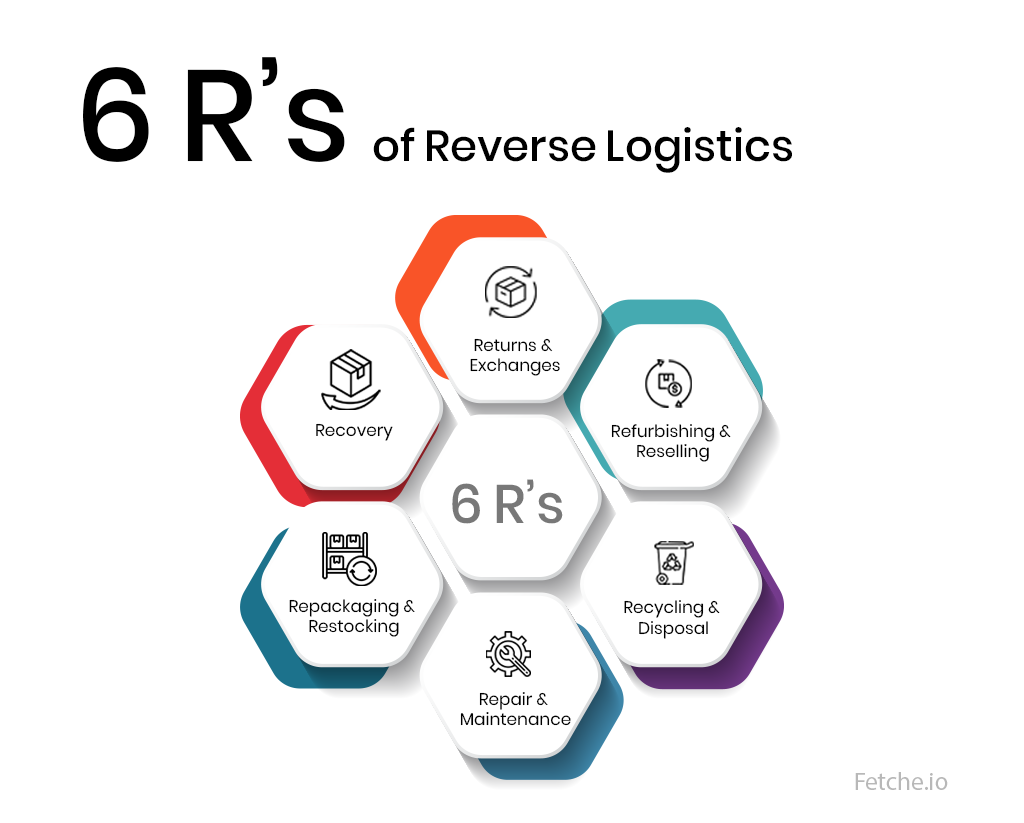
These examples can be made possible with modern strategies through which you can bring value from returned products.
Effective Strategies to Streamline the Return Process
Many logistics companies are leveraging logistics management software or ERP systems for managing the return process or reverse logistics effectively. Here are some strategies that you can implement for streamlining reverse logistics.
1. Review Return Policies
Evaluate your return policies, vendor agreements, and repair procedures regularly, which will help you out of inefficiencies and prevent recurring issues to improve overall working mode.
2. Collaborate Closely with Suppliers
Build strong relationships with your suppliers. This strong and supportive relationship will help you with smooth handling of returned products and faster repairing of them or fast replacement while ensuring quality throughout the reverse supply chain.
3. Leverage Data for Smarter Decisions
Always analyze return data carefully to identify issues and bottlenecks behind the returns. With these insights, you can improve product quality and reduce unnecessary returns.
4. Track Products Forward and Backward
Link raw materials, finished goods, and customer orders to enable accurate tracing during recalls or selective returns. This minimizes costs and speeds up corrective actions.
5. Centralize Return Processing
Use dedicated return centers to sort products efficiently—deciding which items to repair, refurbish, recycle, or dispose of. Centralization increases accuracy and ensures maximum value recovery.
6. Optimize Logistics and Transportation
Integrate forward and reverse logistics wherever possible to reduce costs, save trips, and speed up processing. This includes picking up returns while delivering new products.
7. Automate Returns Management
Automate and track shipments by using digital logistics solutions, ERP systems, and AI-driven tools so that you can issue refunds or exchanges quickly, reduce errors, save resources, and enhance overall customer experience.
Implementing these strategies in your return management system can bring several benefits to your business.
Benefits of a Streamlined Reverse Logistics Process
A well-organized reverse logistics process helps businesses reduce costs, improve customer satisfaction, enhance sustainability, and achieve faster return handling. Here are other key benefits of streamlined reverse logistics:
- Reducing costs of transportation and other unnecessary expenses, along with minimizing manual work through logistics software for the reverse supply chain.
- Better profit margins with a reverse supply chain through returned goods by repairing, refurbishing, or reselling them.
- Customer satisfaction will improve with transparent and simple return processes such as quick refunds, easy exchanges, clear communication, etc.
- Faster processing of goods. Speeds up return inspections and restocking, and provides better warehouse management.
- Achieve sustainable logistics and waste reduction by promoting reuse, repair, and recycling.
- With modern tools that track every stage of the return journey, you will get complete visibility on the reverse supply chain.
- Digital records and automated updates ensure all returns are traceable, compliant, and audit-ready.
To achieve these benefits, logistics companies face many challenges day by day, and efficient logistics management software can be their best companion to overcome those challenges.
The Key Challenges in Reverse Logistics
Managing product returns requires good communication and coordination between teams and people, along with modern tools. Even though reverse logistics is a mirror image of forward logistics, challenges are part of it. Here, listing out some of the challenges faced by reverse logistics:
- Return orders move from customers back to the warehouse sometimes. Otherwise, they will move to warehouses or resellers, often in a non-linear flow. This indicates the need for advanced planning and better coordination.
- Manual processes of returned goods may lead to errors and delays in refunds or replacements.
- Without a structured RMA (Return Merchandise Authorization) process, returns can become disorganized.
- Unorganized documents, processes, and returned goods will lead to confusion in tracking, verification, and processing timelines.
- Limited visibility and tracking system because of not adapted to the modern technologies. Such logistics companies will always be struggling with an outdated ERP system or warehouse systems that don’t support reverse logistics tracking or automation.
- Modern consumers expect instant refunds, easy return options, and real-time status updates — something traditional return systems often fail to deliver.
- Scaling in the era where people prefer online shopping and thus returns have increased, thus increasing operational costs.
- Disposing of returned goods is a challenge, and companies must find ways to refurbish, recycle, or reuse items responsibly, otherwise, it may increase pollution.
The challenges in reverse logistics are most commonly caused by the lack of integration into modern solutions. An effective logistics software can solve the problems and make each challenge a possibility.
How Fetche Simplifies Reverse Logistics
Managing returns and reverse supply chains can be complex, but a smart logistics software makes the process faster and more efficient. Reverse logistics is not a process of loss, it creates new possibilities and opportunities with returned goods. We understand the value of reverse logistics, and that is why Fetche stands as the best logistics management software. It automates the entire return process into one system where you can manage and monitor everything at a time without depending on various systems and manual processes.
Your company’s reverse supply chain will get simplified if you integrate Fetche with your existing ERP system and warehouse management solutions. This digital logistics solution allows seamless visibility across the reverse supply chain so that you can track each return, get updates on inventory, maintain accuracy in financial documents, and get everything in a centralized platform. When your return management system becomes streamlined, you can improve customer satisfaction through faster processing, accurate and instant refunds or replacements, clear tracking of returned goods, etc.
Here’s how Fetche logistics software streamlines reverse logistics:
- Automate and optimize the returns process to recover maximum value from every product.
- Get real-time visibility on each item returned from customer pickup to warehouse processing.
- Use AI insights to predict return trends, minimize errors, and optimize workflows.
- Manage inventory, refunds, and finances effortlessly within one connected platform.
- Deliver faster refunds, accurate updates, and a seamless return experience your customers will love.
- Cut waste, lower costs, and build a greener, more efficient logistics system.
As e-commerce grows drastically, reverse logistics has become a pillar in the supply chain rather than being a secondary process. Therefore, investing in an efficient return management system is not an expense; it is a necessity. Automation, real-time visibility, AI-powered insights, and sustainability are the future of reverse logistics, and businesses that adopt it will gain a strong presence and growth.
From automating returns and tracking every item to integrating ERP systems and providing actionable insights, the software simplifies complex operations into a single, smart solution.
If you’re ready to make your reverse logistics faster, greener, and more profitable, it’s time to switch to Fetche, the modern way to manage logistics.