
Today, customers often experience a sense of interconnectedness when shopping online. Different elements of the shipping experience can be modified according to their whims. What makes this possible? Most customers won’t wonder about this pertinent question. But we, as business owners, need to understand this phenomenon. A smooth customer experience doesn’t just happen on its own. It depends on something much bigger working quietly in the background. And we call that process omnichannel logistics.
It sounds a bit complex. In fact, the whole process is a bit complex. But this blog was curated to break down this complex topic. Most importantly, our humble aim is to help you get it right, overcoming all the challenges thrown at you.
Understanding Omnichannel Logistics
As the term suggests, omni-channel concerns multiple sales channels and fulfillment operations. Omnichannel logistics connects these channels and integrates them into a single seamless channel.
With omnichannel logistics, a customer can order a pair of earrings from an online site. Behind the scenes, the nearest location/store where the accessory is available is tracked and then shipped accordingly. This saves delivery costs and enhances customer experience in supply chain operations through faster fulfilment. Without omnichannel logistics, the order might be assigned to a central warehouse that is further away. This would have resulted in higher delivery costs and delays.
In short, omnichannel logistics is about unifying multiple channels and platforms so that information, inventory, and fulfillment work together.
Multichannel vs Omnichannel Logistics
Omnichannel logistics is not to be confused with multichannel logistics. In multichannel logistics, the “multi-channel” stands for multiple platforms. In other words, you are selling on multiple platforms. On the other hand, in omnichannel logistics, there are multiple sales channels and fulfillment operations. So, it is about unifying those channels so that everything works together seamlessly.
Why Does it Matter So Much?
Customers today don’t think in terms of “channels.” From their point of view, convenience and consistency are what matter. If they see a product online, they expect to know if it’s available nearby. If they buy through an app, they expect real-time tracking. If something goes wrong, they expect to return it anywhere.
This shift in customer expectations means that the focus has shifted from simply having multiple selling options to offering one connected experience across all of them. This is why many brands now rely on omnichannel ecommerce fulfillment systems to synchronize stock, delivery, and communication across every touchpoint.
Simply put, omnichannel logistics matters because it:
- Offers speed and transparency as per customer expectations
- Provides real-time supply chain visibility
- Prevents stock issues through visibility
- Enhances efficiency and reduces costs
- Builds customer loyalty through consistency
Omnichannel Logistics – In Practice
All that we have outlined till now might have made omnichannel logistics look great on paper. But in practice, it is much more complex. It is a maze of moving parts, integrations, and human coordination. This is precisely why many businesses fail at implementing it successfully.
If you get it wrong, here’s what can happen:
- Stockout and lost sales due to outdated inventory data
- Increased returns due to incorrect or delayed deliveries
- Higher logistics costs when routing isn’t optimized
- Customer frustration when experiences differ across platforms
Even a single poor experience can undo months of marketing or customer acquisition efforts.
Consider this example –
A fashion brand is running flash sales online. Their website sells out certain items, but store staff are unaware and continue to promise in-store pickup. By the time they realize the mismatch, hundreds of orders have to be cancelled or delayed. Ultimately, this turns a successful sale into a customer service crisis.
This real-world omnichannel logistics example highlights how easily customer trust can be lost. Efficient omnichannel logistics could have averted that crisis. After all, omnichannel logistics is not just about connecting systems. It’s also about keeping promises. Because every broken promise costs money and credibility.
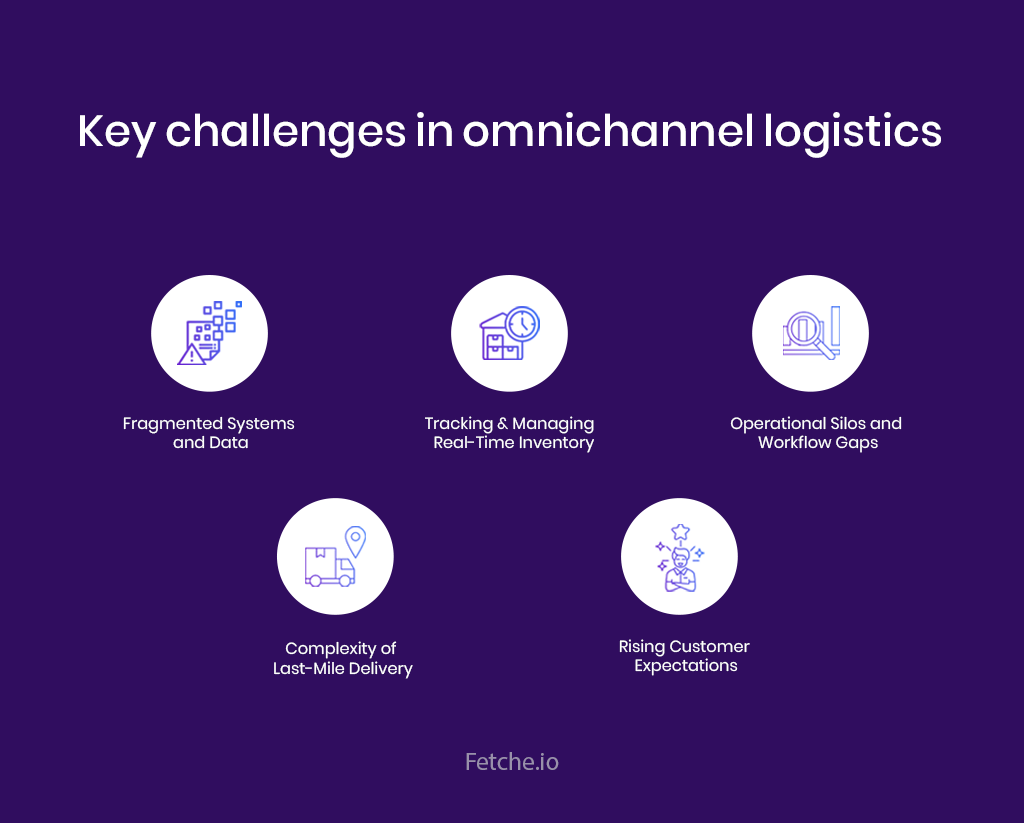
It might now have dawned on you that it is imperative to get this right. And for that, all you have to do is overcome the key omnichannel logistics challenges in your journey.
Let’s look at the key challenges that make omnichannel logistics so difficult to perfect.
1. Fragmented Systems and Data
Many businesses started their digital journey piece by piece. They might have started with one software for order management, another for warehouse control, and another for delivery. The problem is that these systems often don’t communicate well with each other. This results in:
- Delayed updates on stock levels
- Misaligned order information
- Duplicate data entries
In logistics, even small inconsistencies can cause big problems. A delay of a few minutes in syncing stock could mean selling items that are no longer available. A business might think it’s operating omnichannel, but without true data synchronization, it’s still stuck in silos.
Solution – This challenge arises because businesses use disconnected inventory management solutions that don’t communicate with their logistics or order systems. So, the first step is to make your systems talk to each other. When each platform (orders, stock, or delivery) runs on its own, errors are inevitable. Here’s what you can do to combat it:
- Integrate the systems to create one version of the truth using logistics management software
- Implement real-time data sharing to help avoid duplication and delay
Result – Once everything moves together, decisions start coming from clarity, not assumptions.
2. Tracking & Managing Real-Time Inventory
When you have multiple locations to track, it becomes difficult to manage inventory.
Here is an example of inefficient omnichannel logistics –
A customer is ordering a product from an online site. But while the order is being processed, the last item sells in-store. The system doesn’t update fast enough. Now you’ve got an unhappy customer and a fulfillment headache.
To truly operate omnichannel, businesses need real-time data flows between systems, not batch updates that run every few hours. This requires reliable integrations and constant system monitoring.
Solution – Inventory should move as quickly as your customers do. The problem often lies in delayed updates or manual processes. Here’s how to overcome this challenge:
- Use real-time tracking in logistics to close the gap
- Use tools like barcode or RFID scanning to make visibility instant
Result – The more live your data is, the fewer surprises you’ll have at checkout or dispatch.
3. Operational Silos and Workflow Gaps
Sometimes the challenge is not the tech, but the people. When different teams handle online sales and distribution, their goals and KPIs don’t always align. For example, store teams may hesitate to fulfill online orders because it reduces shelf stock. Or warehouse teams might prefer bulk shipments over small orders. There are no shared goals or shared accountability in this setup.
Solution – Technology alone can’t fix silos. It’s the people behind it who make the difference. Here’s what you can do to fix operational silos and workflow gaps:
- Impress upon your workforce that their goals are shared
- Implement better collaboration and communication between departments
Result – When the coordination feels effortless, the customers feel it too.
4. Complexity of Last-Mile Delivery
The last mile, the final step to the customer, is the trickiest and costliest part of logistics. This already complex step gets even more complicated in omnichannel logistics. The orders can originate from multiple points, like stores, hubs, or partner warehouses. Coordinating that without raising costs or delaying delivery requires precision. In other words, everything from route optimization to carrier selection has to work in sync for an efficient last-mile delivery process.
Solution – Last-mile delivery is where precision meets pressure. Here’s what you can do to simplify the process and reduce costs:
- Partner with local delivery networks
- Use smarter routing tools and digital freight platforms
Result – Last-mile delivery optimization ensures you can fulfil your orders without raising costs or delaying deliveries.
5. Rising Customer Expectations
From a customer viewpoint, today’s “fast” is tomorrow’s “slow.” Customers expect perks like free shipping, instant tracking, and more. Each of these expectations will put a strain on your business.
Solution – The key here is to stay consistent. Here’s what you can do:
- Give regular status updates
- Offer flexibility through options like store pickup, easy returns, or alternate delivery slots.
Result – When customers know what to expect, they rarely walk away disappointed.
Conclusion – The Future of Omnichannel Logistics
Omnichannel logistics is no longer a future trend. It’s the new normal. Customers now expect brands to be everywhere they are, without feeling the difference. The future will thus witness omnichannel logistics providers offering tighter integrations, smarter automations, and greater visibility across the entire supply chain.
To truly keep up, businesses need more than just good intent. They need the right tools. A connected logistics management software like Fetche can help unify your workflows, link every channel, and bring real-time visibility to your operations. That’s what turns a complicated process into a controlled, efficient system. Remember, omnichannel success doesn’t happen by chance. The people, the processes, and the platforms of your logistics business have to move together.