
The Courier, Express, and Parcel (CEP) sector is growing at a dizzying pace, and with it, operational costs are also rising. Consequently, the priority of most CEP businesses has shifted to cutting fuel costs, eliminating last-mile inefficiencies, and meeting rising customer expectations. And all this is only possible with the right strategies.
This blog puts together some logistics cost reduction strategies that have proven effective among our clients.
Rising Operational Costs in CEP Logistics
Cost pressure is not a new thing in logistics, but it is quite intense in the CEP sector. So, before we go any further, we need to understand the factors that have contributed to this pertinent issue. Here are some of the major factors that drive up costs in the CEP sector:
- Increased fuel prices that has a big impact on delivery margins
- Increased fuel consumption due to wasted kilometers
- Reduced productivity due to idle time and manual dependency
- Delayed decision-making and lack of visibility due to operational silos
- Failed deliveries and redeliveries that affect last-mile delivery efficiency
- Higher expectations for same-day and next-day deliveries
Actionable Strategies to Cut Costs in the CEP Sector
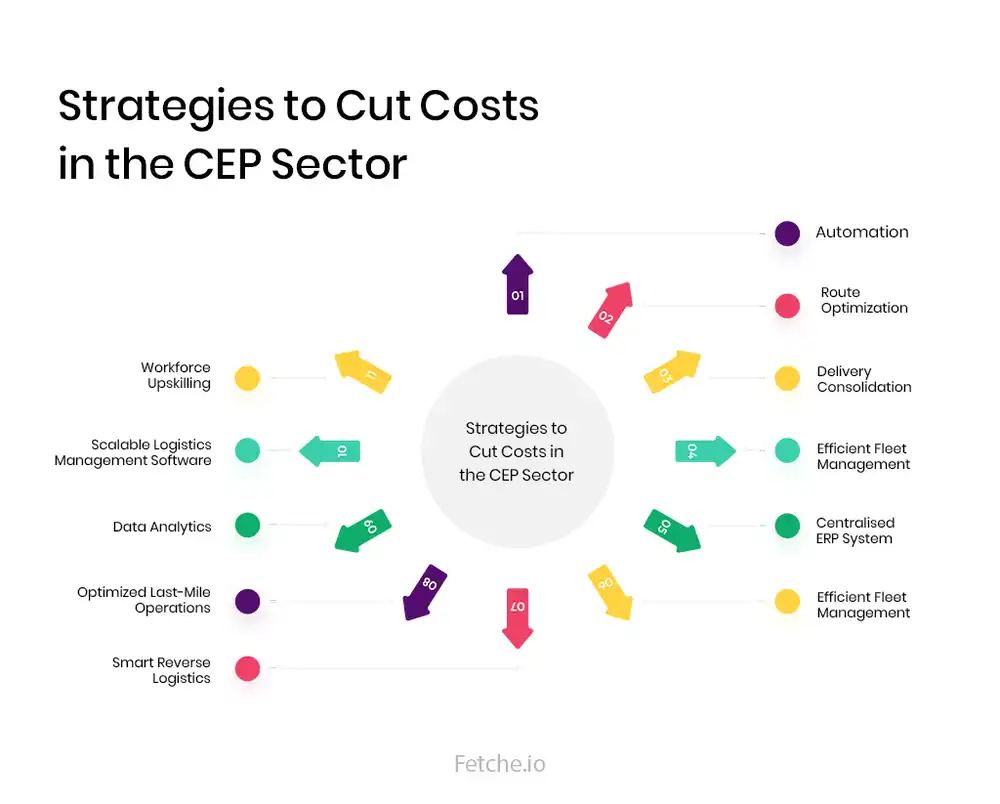
- Automation
Tasks like data entry, dispatch planning, and invoice processing are slow, error-prone, and drain valuable human time. Automating these tasks saves hours every day. Automation tools can handle shipment updates, billing, customer notifications, and reports with minimal supervision. Your team can then focus on the work that actually matters – planning, solving problems, supporting customers.
- Route Optimization
Route planning is at the core of CEP operations. Yet many businesses still depend on manual planning or driver familiarity. This leads to wasted kilometers, more fuel consumption, and unpredictable delivery times.
Using route optimization software changes that. It calculates the shortest, fastest routes using real-time traffic data. It factors in delivery priorities, vehicle capacity, and time windows. Fewer kilometers. Less fuel. On-time deliveries.
- Delivery Consolidation
A cost-effective logistics solution like shipment consolidation can bring a noticeable difference. Shipment consolidation involves the following steps:
- Combining multiple deliveries going to the same area
- Working with partners for joint distribution networks, where possible
- Scheduling bulk deliveries for recurring customers
Consolidation saves fuel and time. It also makes deliveries more predictable, which customers care about as much as speed.
- Efficient Fleet Management
Fleet costs are unavoidable. But underused vehicles and frequent breakdowns are not. When trucks or vans sit idle, they still cost money.
A fleet management software supports logistics optimization by tracking usage, maintenance history, and driver performance. You spot problems early and fix them before they escalate.
- Centralised ERP System
One of the biggest cost factors in CEP logistics is operational fragmentation. When different departments use separate systems, the lack of coordination leads to delays and duplicate work.
A centralized ERP system brings all these operations together. It acts as the single source of truth for every activity, whether it’s shipment tracking, invoicing, or inventory control. Systems like Fetche are designed exactly for this purpose. They connect every part of your logistics process, improve visibility, and make decision-making faster. This level of integration naturally cuts down both time and cost.
- Efficient Warehouse Management
Warehouses can either be cost centers or value drivers. It depends on how they are managed. Inefficient layouts, poor space use, and manual tracking can slow everything down and drive up storage costs.
Warehouse automation can fix that. A good WMS automates inventory tracking, optimizes storage, and improves order accuracy. Less picking errors. Less idle time. Lower labor costs. Moreover, real-time stock visibility prevents overstocking and stockouts.
- Smart Reverse Logistics
Returns are inevitable in the CEP sector, especially with e-commerce growth. However, reverse logistics often remains the least optimized part of the chain. Handling returns manually or without structure can increase both costs and delays.
A smart reverse logistics process uses technology to track, sort, and route returned parcels efficiently. With digital return labels and automated tracking, items can be redirected to the right destination faster, whether that’s restocking, repair, or disposal.
Faster reverse processing improves customer experience and reduces the cost burden of returned shipments.
- Optimized Last-Mile Operations
Last-mile delivery is the most expensive and complex part of CEP logistics. It often accounts for more than half of total delivery costs.
You need technology to plan routes, track drivers, and manage deliveries. A TMS (Transportation Management System) gives real-time visibility. You monitor driver performance, track parcels, and share live updates with customers. This also means lower fuel costs and lower labor costs.
- Data Analytics
Every trip, delivery, and return generates data. But many businesses neglect this treasure trove of data.
Proper data analytics can help reveal valuable data like high-cost routes, underperforming areas, and repeated inefficiencies. This will, in turn, help you make informed decisions. It will enable you to predict demand better, plan inventory smarter, and catch rising logistics costs early.
Over time, this becomes how you keep improving.
- Scalable Logistics Management Software
Your software should grow with your business. Outdated systems slow you down as you expand. They increase costs.
A scalable logistics management software adapts to changing volumes, new routes, and more users without major upgrades. You add modules, integrate systems, and manage multiple branches without disruption.
This prevents expensive overhauls later.
- Workforce Upskilling
Technology automates tasks. It doesn’t replace skilled people.
Your team needs training on new tools, dashboards, and data-driven decisions. Upskilling helps them work smarter. A trained team spots inefficiencies early, adapts to new systems quickly, and maintains service quality.
Investing in people gives the best return. Skilled workers make every system perform better.
Final Thoughts
By adopting the right mix of CEP logistics optimization strategies, your business can stay lean, agile, and ready for the future. Because cost-cutting is not just about reducing expenses, it’s about reinvesting wisely. Every rupee saved from process improvements can go into technology that drives more efficiency. Because technology is a cost enabler, not an expense.
Fleet monitoring tools, real-time dashboards, data analytics, and integrated ERP systems like Fetche make a long-term difference. Fetche, for instance, helps businesses automate operations, manage resources better, and analyze cost data – all from one dashboard.
Many logistics businesses hesitate to invest in technology because they view it as an expense. In reality, it’s the opposite. Automation, ERP integration, and data analytics are enablers. They reduce hidden costs that manual operations never reveal. In essence, technology doesn’t just cut costs. It creates room for growth.
Ready to cut costs and boost efficiency in your CEP operations?