
As Cargo movement no longer depends on thick bundles of handwritten bills of lading, customs declarations, and stamped clearances like the good old days of overseas trade, the freight forwarding business isn’t the same either.
What once required stacks of paper, days of correspondence, face-to-face negotiations, and a lot of confusion is now driven by novel digital platforms, instant data exchange, and real-time visibility.
The role of the freight forwarder has evolved from managing paperwork and manual coordination, which was the norm for a long time, to leveraging technology for speed, transparency, and efficiency—an evolution best captured in what we can now refer to as a Digital Freight Forwarder Platform.
This shift has, in all its glory, revolutionized global trade, making the movement of goods across borders faster, more reliable, and far more scalable than ever before.
Although a good deal of challenges still remain in adopting these platforms, this article will help you to explore how to overcome each of them, what digital freight forwarder platforms are, and how logistics businesses can access and leverage them to streamline operations and gain a competitive edge in the global market.
What is a Digital Freight Forwarder Platform?
A digital freight forwarder platform is an advanced, technology-driven solution that streamlines how international shipments and freight forwarding are managed.
Unlike traditional freight forwarding companies that rely heavily on manual documentation, phone calls, and emails, these platforms integrate digital tools such as ERP software for freight forwarding, AI-based logistics optimization, and real-time freight tracking to do the job several times faster, smoother, and more coordinated.
The goal is to bring efficiency, transparency, and scalability to global supply chains while simplifying freight management for local and global businesses.
Key Challenges in Global Freight Forwarding
Despite all its importance, freight forwarding is still considered one of the most complex areas to tackle in the logistics sector. And this can be blamed on the fact that some of the most pressing freight forwarding challenges take up the ease of operation. Take a look at a few of them:
- Fragmented Communication – Stakeholders like shippers, carriers, customs, and agents often work in silos, causing delays and increasing the chances of miscommunication.
- Lack of Visibility – As traditional freight forwarding methods do not offer real-time updates, unexpected disruptions were always part of the system.
- Manual Documentation – Routine Paperwork around customs, compliance, and invoices, as you can imagine slows down the processes, increases errors and thereby elevate expenses.
- High Operational Costs – Without freight management ERP systems in place, companies spend more time, energy, and money in coordinating simple routine tasks, which can be totally avoided.
- Scalability Issues – As businesses grow and progress, bringing in a greater ROI, manual processes cannot really keep pace with customer expectations.
These challenges highlight why companies are nowadays turning toward digital freight forwarding software.
How Digital Freight Forwarder Platforms Solve These Challenges
1. Centralized Communication
Digital platforms provide unified dashboards where all stakeholders involved in the business can easily collaborate on a platform, making the communication easier and the business a lot more coordinated.
2. End-to-End Visibility
With real-time freight tracking, businesses can gain complete control over shipments and keep their customers happy and satisfied with real time updates. Dashboards that highlight or update delays, reroutes, or customs holds instantly, helps the teams to act fast or take measures even before any disruptions could potentially escalate.
3. Automated Documentation
By digitizing customs declarations, invoices, and bills of lading, freight forwarding ERP software essentially cuts down human errors and any compliance risks associated with those mistakes.
4. Cost Optimization Through ERP Integration
Digital freight forwarder platforms use freight management ERP systems to optimize routes, select cost-effective carriers, and automate any repetitive workflows, thereby reducing operational expenses to a great extant and improving ROI.
5. Scalable Growth with AI & Analytics
Advanced platforms and experiences logistics digitization partners integrate the latest logistics optimization tools powered by AI. Businesses can therefore predict demand, assess risks, and scale seamlessly without the bottlenecks that manual operations bring.
Why Businesses Should Be Adopting Digital Freight Platforms
For companies navigating international trade, adopting a digital freight forwarder platform is no longer optional—it’s a competitive necessity. Key benefits include:
- Faster turnaround of international shipments.
- Improved transparency across supply chains.
- Compliance assurance with digitized customs documentation.
- Enhanced customer experience with timely updates.
- Stronger partnerships with freight forwarding companies through seamless data exchange.
Businesses that integrate digital freight forwarding software also align themselves with broader industry shifts. (For more on the subject, read: The Logistics Shift to Digital Freight Platforms and Why You Cannot Ignore It).
Maximizing ROI: Why Digital Freight Forwarding is Worth the Investment
Investing in a digital freight forwarder platform gives you concrete financial returns that are so much more than merely operating convenience. Let’s see how:
- By automating gateways these platforms cut down on manual labor expenses to a great degree and eliminate human errors that can cause delays, penalties, or even loss of shipments.
- Faster turnaround times and streamlined processes, the byproducts of digitization, accelerate the flow of goods, allowing businesses to meet customer expectations more efficiently and handle higher shipment volumes without adding staff.
- Integrated analytics and route optimization software takes one step further to 3 increase cost-effectiveness by determining the lowest-cost shipping options and thus saving on fuel or carrier costs considerably.
Collectively, these improvements translate into measurable ROI: lower operational costs, improved accuracy, faster delivery cycles, and the ability to scale logistics operations much more sustainably.
How to Choose the Right Digital Freight Forwarder Platform: A Checklist
When evaluating a digital freight forwarder platform, check for the following:
- Analytics & Reporting – Look for a platform that provides advanced dashboards, predictive analytics, and performance reports to make smarter logistics decisions.
- System Compatibility – Confirm that the platform you choose integrates well with your ERP, accounting, and inventory management systems for full end-to-end visibility.
- Customer Support & Onboarding – Choose an experienced service or system provider that offers responsive support, training, and onboarding to minimize disruptions during adoption.
- Scalability – Make sure the platform you opt for is capable of growing alongside your business, and would be able to handle higher shipment volumes and new trade routes without compromising speed or reliability.
- Security & Compliance – Verify that the system in question has a history of protecting sensitive cargo and customer data, meeting global compliance and cybersecurity standards.
- Automation Features – Check if the system provides automated documentation, smart contracts, and exception management tools to reduce manual errors and speed up processes.
By using this checklist, you maybe able to choose a platform that not only streamlines daily operations but also strengthens long-term growth, protects and competitiveness in global trade.
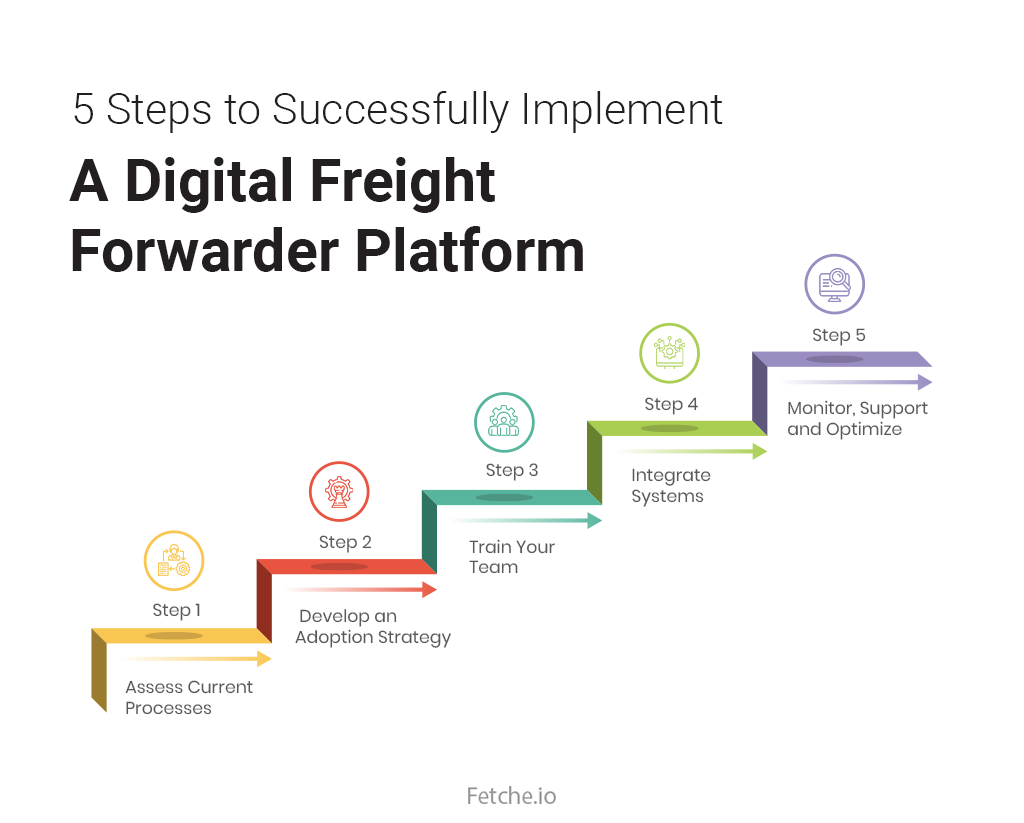
5 Steps to Successfully Implement a Digital Freight Forwarder Platform
- Step 1: Assess Current Processes
Analyze your existing logistics workflows to identify pain points, bottlenecks, and areas where a digital platform can deliver the most impact.
- Step 2: Develop an Adoption Strategy
Create a clear roadmap for platform deployment, including timelines, phased rollout plans, and resource allocation to ensure minimal disruption.
- Step 3: Train Your Team
Provide comprehensive training so staff can effectively use dashboards, track shipments, and leverage analytics tools.
- Step 4: Integrate Systems
Ensure seamless connection with existing ERP, accounting, and inventory management systems for end-to-end visibility.
- Step 5: Monitor, Support, and Optimize
Conduct regular progress reviews, gather feedback, address challenges promptly, and utilize provider support to ensure smooth adoption.
What does the Future of Freight Forwarding with Digital Platforms look like?
The future of freight forwarding lies in automation, AI, and ERP-driven software ecosystems. Industry trends show rapid adoption of digital freight forwarding ERP software to integrate procurement, warehousing, and last-mile delivery. Moreover:
1. AI-Powered Predictive Supply Chains
Platforms will not just react to disruptions like today—they will forecast demand, port congestion, geopolitical risks, and weather events to reroute shipments proactively.
2. Hyper-Connected Global Trade Networks
Fully integrated platforms will connect carriers, forwarders, customs, ports, and clients worldwide, creating a single ecosystem for frictionless trade which is one of the most revolutionary changes to takes place in the global trade in the near future.
3. Smart Contracts with Autonomous Execution
Blockchain-based smart contracts will come into the picture. They will automatically trigger payments, insurance claims, or compliance checks when predefined conditions are met.
4. Sustainability-Driven Routing and Carbon Credits
AI will optimize routes for the lowest emissions, calculate carbon footprints, and allow forwarders and shippers to earn tradable carbon credits automatically.
5. Quantum-Enhanced Logistics Optimization
Advanced quantum computing algorithms could soon solve complex routing and inventory problems in seconds, far beyond classical computing limits.
6. Augmented Reality (AR) for Real-Time Monitoring
Warehouse operators and forwarders could visualize cargo in 3D, inspect shipments remotely, and guide operations using AR interfaces like we see in the futuristic movies.
The future of freight forwarding seems bright with many progressive ideas and possibilities like fully autonomous, predictive, sustainable, hyper-connected, and intelligent, self-optimizing global supply chains driven by digital freight forwarder platforms and their future successor platforms.
Conclusion: Why Now is the Time to Switch
Freight forwarding challenges are real, but they’re not insurmountable. A digital freight forwarder platform might be the real answer to all the challenges we discussed as it offers the tools to overcome inefficiencies, reduce costs, and build resilient supply chains.
For businesses aiming to stay ahead in global trade, investing in digital freight forwarding software like Fetche will be the biggest step you could trake to ensure smarter, faster, and more reliable logistics operations.
Ready to transform your freight forwarding? Explore the future with Fetche today.
FAQ
It is an online system that manages shipments, documentation, and communication in one place. Unlike traditional forwarding, it replaces emails and paperwork with automation and real-time tracking.
These platforms reduce manual paperwork, poor visibility, and communication gaps between shippers, carriers, and customs. They also help avoid delays, errors, and high operating costs.
Users get real-time tracking and status updates through a single dashboard. All stakeholders can collaborate instantly without long email chains.
Yes, automation cuts repetitive work and documentation errors. Smarter routing and carrier selection further improve efficiency—similar to how Logistics ERP software in Singapore optimizes operations.
Key features include system integrations, analytics, automated documents, scalability, and strong customer support. These ensure smoother and future-ready logistics operations.
The future will focus on AI planning, predictive analytics, blockchain security, and sustainability tracking—capabilities seen in the Top Logistics ERP Software in India today.