
The logistics sector, increasingly digitalized, faces a growing number of cybersecurity threats every other day.
With interconnected systems, IoT-enabled warehouses, and reliance on global supply chain data, logistics operators are particularly vulnerable to ransomware, phishing, and insider breaches.
IBM’s global security report points to supply chains as among the most common targets for cyber attackers, with ransomware attacks increasing year on year.
Industry discourses highlight that logistics companies are no longer viewed as mere physical transporters of merchandise but as custodians of sensitive digital information—shipping information, customer data, and real-time IoT sensor feeds.
And therefore, data security in logistics is not a peripheral concern anymore but the very foundation of operational trust and resilience. The good news is that technology itself gives us the means of defense: advanced logistics management software, cloud-based logistics security frameworks, and standardized protocols that protect sensitive information without giving up speed or efficiency.
But how do you understand the risk or adopt proven best practices, and most importantly, align with global standards in logistics cybersecurity?
Well, you could search the internet to gather info regarding this, or simply go ahead and read this article to get a clearer picture of the subject!
Common Data Security Risks in Logistics
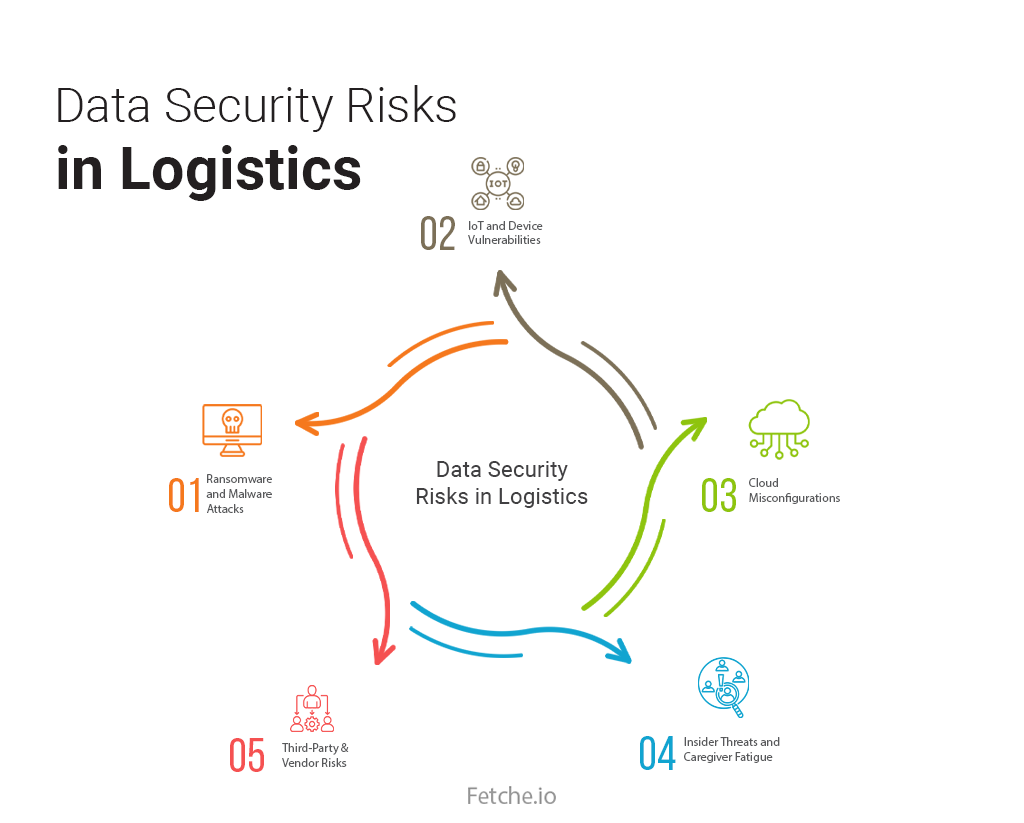
The logistics ecosystem is one of the most complex and, therefore, one of the most vulnerable to cyberattacks. Some of the most pressing risks include:
- Ransomware and Malware Attacks
Logistics operators are prime targets for ransomware because downtime equals immediate disruption in global supply chains. As the Maersk NotPetya attack showed, one breach can cripple entire networks and cost billions. - IoT and Device Vulnerabilities
With the rise of smart containers, GPS trackers, and warehouse IoT devices, weak security protocols in endpoints create multiple entry points for hackers. A single compromised device can compromise supply chain data security end-to-end. - Cloud Misconfigurations
While cloud-based logistics security is powerful, misconfigured systems or poorly managed credentials open the door to unauthorized access. - Insider Threats and Caregiver Fatigue
Manual errors, weak passwords, or, perhaps on purpose, data leaks by employees are valid risks. Not taking precautionary measures for cyber threats in logistics businesses is like leaving the back door open in broad daylight.
- Third-Party & Vendor Risks
Logistics chains involved serious dependence on multiple partners, ranging from customs brokers to freight forwarders. Weak security in one of these partners means weak security for the whole of the supply chain.
These together highlight the importance of secure logistics management systems supported by an active cybersecurity framework.
Best Practices for Data Security in the Logistics Sector
Securing logistics operations requires more than just firewalls. It demands a layered, adaptive, and standards-driven approach:
- Adopt Zero Trust and Microservices Architectures
Modern transportation management software security must follow a “never trust, always verify” model. By combining Zero Trust verification with modular microservices, logistics firms can ensure every access request is authenticated, encrypted, and traceable. This limits lateral movement inside networks and strengthens overall logistics software data protection.
- Leverage IoT Security with Blockchain and AI
Pairing IoT sensors with blockchain ensures tamper-proof tracking data, and anomaly detection based on AI may detect likely suspect activity in advance. Multi-signature authentication adds privacy layers for sensitive shipments.
- Implement Risk Quantification Models
Frameworks like FAIR (Factor Analysis of Information Risk) give logistics leaders a quantitative approach to assessing vulnerabilities. Instead of vague risk statements, FAIR translates cyber threats into financial impact, helping companies prioritize investments in cybersecurity for logistics companies.
- Strengthen Vendor and Partner Oversight
No logistics firm acts independently. Integrating cyber supply chain risk management (C-SCRM) into contracts, onboarding, and vendor testing helps you to stay under strict logistics compliance and regulation standards.
- Generate Incident Response and Escalation Pathways
From ransomware attacks to IoT intrusions, timing is critical. Predefined escalation plans, quick-response nursing-equivalent squads (in IT parlance), and real-time notifications ensure small breaches don’t escalate to disaster status.
- Align with International Security Standards
When you have ISO 28000, ISO 20243 (O-TTPS), and NIST cybersecurity guidelines in place, you no longer have to worry about any kind of security threats. These and secure freight management software systems may bring you the peace of mind you long for.
Role of Logistics Management Software in Data Protection
Logistics Management Software is considered a security hub rather than an operational tool. Such Modern platforms integrate:
- End-to-end encryption of shipment information, financial transfers, and customer information.
- Automated Compliance Audits that cross-match logistics procedures with GDPR, HIPAA, or local logistics regulations and compliance.
- Real-Time Tracking of shipments, warehouses, and vehicles, which minimizes blind spots open to hacker attacks.
- Layers of Access Control that ensure that only authenticated users are exposed to sensitive shipment data.
When implemented as secure logistics management systems, these tools not only make operations leaner but also proactively harden the organization against cyberattacks.
Compliance and Regulations for Logistics Data Security
Regulatory landscapes for data privacy in logistics are evolving rapidly. Companies must stay ahead by aligning with:
- ISO 28000: Security management systems for supply chains.
- NIST C-SCRM: Formalized approaches to supply chain cyber risk.
- GDPR & CCPA: Critical for protecting personal shipment and customer data.
- C-TPAT & ISPS: For international trade security, ensuring data integrity during cross-border transactions.
Any compliance failure is not only a breach of law, but could be an ingredient that could potentially destroy the reputation of the company, erode the trust with clients, and disrupt the smooth running of the organization. A cybersecurity strategy grounded in these guidelines is the minimum that a global logistics player can ensure it has covered.
Future Trends in Logistics Data Security
The next decade will witness logistics cybersecurity move beyond the defense mode that has been practised for the last couple of years into predictive, AI-driven resilience.
Here are a few pillars that are likely to take over the industry in the coming years:
- AI & Predictive Analytics are mainly used to identify threats before they materialize and take over.
- Quantum-Safe Encryption to alert and prepare for post-quantum cybersecurity in logistics.
- Autonomous Logistics Security Agents embedded in transportation management software security platforms.
- Holistic Total Security Management (TSM), where logistics giants integrate data protection into every decision, from procurement to customer experience.
The future of logistics cybersecurity will demand systems that adapt in real time, ensuring both stability and trust.
Conclusion – Securing Your Logistics Operations Starts with the Right Tools
Without a well-crafted data security in logistics, even the most effective supply chain will fall apart with just one breach. The faith that you have established with your clients over the years, the business empire that you have built with your sweat, shall all crumble with just one breach.
The right logistics management software helps you not only to move goods across nations smoothly but also to move them securely, compliantly, and confidently. The companies that understand how important is Cybersecurity for logistics companies today and come up with a cyber security plan will no doubt be the ones defining global logistics tomorrow.
FAQs on Cybersecurity in Logistics
1. What is the most common data security threat in logistics?
Ransomware and phishing attacks are the most commonly observed data privacy threats that most logistics companies come across. They are also the most feared threats as they exploit mild human error and are capable of halting global operations instantly.
2. How can logistics management software improve data security?
Logistics management software improves data privacy by integrating encryption, access control, and compliance automation into its system, turning it into a secure logistics management systems that is capable of actively defending against any future cyberattacks.
3. List a few regulations that logistics companies are required to comply with in relation to data privacy.
ISO 28000, GDPR/CCPA, NIST C-SCRM, and sector-specific regulations such as C-TPAT are the most common global regulations that logistics firms are supposed to follow.
4. How often should logistics data be backed up?
Ideally, we recommend a data backup daily, and it should in any case be off-site and encrypted backups.
5. Is cloud logistics software secure to hold sensitive shipment information?
Yes, provided it is coupled with the appropriate cloud-based logistics management software with encryption, multi-factor authentication, and rigorous access controls, any sensitive data contained within would be secure and protected.