
Logistics has never been cheap. But it has only become unpredictably expensive in the last few years.
Fuel costs vary.
Labor is scarce in warehouses and transport hubs.
Delivery needs to grow faster than operational capabilities.
Inventory resides in the wrong location when consumers need faster service somewhere else.
Each small inefficiency might seem entirely manageable on its own, but together they slowly eat into already tight profit margins.
And therefore, for many logistics companies, cost optimization is no longer a question of finding ways to cut budgets but rather finding ways to maintain competitiveness and, more, survival.
And this is where the much-used and discussed buzzword “AI in logistics” actually becomes a much-needed reality.
Across transportation, warehousing, and inventory planning, artificial intelligence is basically reshaping how a logistics company operates. By utilizing artificial intelligence, companies have succeeded in reducing their operational expenses to a huge extent by providing better and faster services to their consumers, which was unthinkable up until a couple of years ago.
In this article, we’ll explore three key areas where AI helps or can help reduce costs across end-to-end logistics operations, along with practical insights into how businesses can make it work in real-world scenarios and under real-pressure situations.
So buckle up; you are in for a big ride!
Why Traditional Cost-Cutting Methods No Longer Work
For years, logistics companies relied on conventional methods:
- Hiring more staff during peak seasons
- Adding extra vehicles to meet demand
- Increasing safety stock levels
- Negotiating transport contracts annually
- Reacting to problems as they appear
Modern logistics networks are too complex for manual optimization. Demand fluctuates hourly. Traffic changes minute by minute. Inventory movement spans continents. So basically, human planning alone cannot keep up.
This is why logistics operations automation powered by AI is becoming more and more essential.
The Three Cost Centers Where AI Makes the Biggest Impact
Most logistics costs concentrate in three operational zones:
- Transportation and route planning
- Warehouse and operational efficiency
- Inventory and demand forecasting
AI transforms each of these areas in distinct ways, creating measurable savings.
Let’s break them down, one by one.
Cost-Saving Area #1: Transportation & Route Optimization AI
It is said that transportation typically consumes 40–60% of logistics operating budgets. Even small inefficiencies scale into massive losses.
AI-driven route optimization has emerged as one of the fastest-return investments in logistics cost optimization.
Instead of static route plans, AI systems continuously analyze live data to improve decisions.
How Route Optimization AI Saves Costs
Fuel savings through adaptive routing : AI dynamically calculates the delivery routes by considering the pattern of traffic, weather conditions, vehicle load, and delivery windows. Vehicles avoid congestion and detours wastefully, saving lots of fuel.
Higher fleet utilisation : AI identifies delivery clustering opportunities so vehicles can carry fuller loads and reduce empty return journeys, therefore maximizing asset utilization.
Reduced delivery delays and penalties : Most late deliveries result in penalties, redelivery attempts, and dissatisfaction from customers. Predictive routing minimizes delays while improving on-time performance.
Predictive Vehicle Maintenance : The performance data monitor enables AI to predict the risk of breakdown, which can be serviced beforehand in order to avoid expensive downtime and emergency repairs.
Driver productivity optimization : Smarter dispatching decreases waste from truck idling, increases the utilization of shifts, and raises the capacity for daily deliveries without increasing fleet size.
The result?
Companies commonly report massive reductions in transportation costs after implementing AI-powered routing solutions.
Multimodal Transport Optimization: AI’s Next Cost Frontier
As the complexity of the supply chain increases, logistics companies are adopting the use of various transport modes—the combination of road, rail, sea, and air transport modes. Traditionally, companies use static approaches and decision-making to select the most cost-efficient transport combination.
Artificial intelligence systems are now being used to analyze the impact of the transit time, variations in cost, risks of traffic congestion, and environmental effects during the selection of transport modes.
As such, AI optimizes the needed flexibility of the transport services, resulting in reduced transport volatility.
Cost-Saving Area #2: Warehouse & Operations Automation
Warehouses are not given due consideration as cost centers, though inefficiencies that exist inside them are continually eroding profits.
Misplaced inventory, slow picking activity, labor misallocation, and inefficient layout contribute to increased order fulfillment time and higher operation costs.
AI improves warehouse efficiency in the following ways:
- Smart picking routes minimize walking distance for workers.
- Automated slotting optimizes the placement of fast-moving products.
- Robotics-assisted picking helps increase speed.
- AI-based workforce planning matches the workforce to demand peaks.
- Consumption is minimized via predictive facility management.
Unlike traditional warehouse optimization processes, AI adjusts according to demand patterns.
Operational Outcomes Companies See
- Faster order processing
- Reduced picking errors
- Lower labor overtime expenses
- Improved warehouse throughput
- Reduced operational bottlenecks
Warehouse AI adoption often results in a high percentage of productivity gains, reducing overall operational expenses.
Cost-Saving Area #3: Inventory & Demand Forecasting Optimization
Inventory mismanagement is one of logistics’ most expensive hidden problems.
Too much inventory locks up working capital, while too little results in emergency shipments.
AI does this through predictive analytics.
How AI Optimizes Inventory Costs
Precise demand forecasting: AI analyzes historical trends, seasons, promotions, and external factors that are used for demand forecasting with high levels of accuracy.
Dynamic replenishment planning: Goods move based on the forecast made rather than a fixed order point.
Network-wide inventory visibility: AI provides transparency of stock availability at locations, avoiding duplicate inventory holding or holding excess safety stock.
Reduced emergency shipping costs: Proper planning helps in avoiding last-minute and costly air shipping due to stockouts.
Working capital optimization: Businesses free up cash previously tied up in excess inventory.
Organizations using AI forecasting report considerable reductions in excess inventory, directly improving financial performance.
AI for Reverse Logistics: Changing Back-End Operations from Loss Centers to Cost-Driven Entities
Reverse logistics entails issues of returns, repairs, recycling, and redistributions.
Traditionally, reverse logistics have been achieved through the use of returns that are processed manually. However, now, AI assists companies in predicting the return patterns, creating automation workflows for inspection, and deciding on the most profitable course of action for the returned items—be it restocking, refurbishing, selling, or recycling.
This intelligent recycling of returned or wasted products to the nearest recycling or selling center eliminates waste and saves companies money on transportation.
Organizations that are already embracing artificial intelligence-based reverse logistics strategies are slowly turning an operational burden into a partially profitable one.
Advanced Cost Savings Areas Few Companies Discuss
Besides transport, warehousing, and inventory management, AI offers new opportunities for cost savings.
Strategic Applications Emerging Today
- AI-based carrier selection optimizes freight contract costs by selecting the best carriers based on performance and pricing.
- Digital twin logistics networks allow companies to simulate their operations to identify inefficiencies before investing in changes.
- Using AI for carbon optimization saves fuel and ensures sustainability compliance.
- Predictive disruption management considers delays due to weather, traffic, and port access.
- Tools for differential pricing can be beneficial.
Businesses that start to use these sophisticated applications reap a competitive advantage with a corresponding reduction in the level of operational risk.
Real ROI Outcomes: What Companies Actually See
Across global logistics networks, companies that acquire AI-driven logistics process automation benefits report consistent improvements.
Common measurable outcomes include:
- 10–25% reduction in transportation fuel costs
- 15–30% warehouse productivity improvement
- 20–40% reduction in excess inventory
- Faster order fulfillment
- Improved delivery reliability
- Reduced operational disruptions
These savings compound over time, significantly improving margins.
This is why AI-powered logistics cost savings case studies are increasingly influencing logistics investment decisions.
AI in Customer Communication & Service Cost Reduction
Customer service is rarely recognized as a cost center within logistics, though answering delivery inquiries, shipment tracking requests, and complaints consumes significant operational resources. AI-powered logistics platforms now use automated communication systems to proactively update customers about shipment status, delivery windows, and delays.
Predictive notifications reduce inbound service calls, while intelligent chatbots and service automation handle routine requests instantly. This cuts customer support staffing costs and minimizes failed delivery attempts due to miscommunication.
The companies also experience improved customer satisfaction, contributing to higher retention and lower dispute resolution costs. In high-volume logistics operations, these service efficiencies quietly convert into measurable savings.
Concerns Logistics Companies Often Have About AI Adoption
Despite the benefits, many logistics companies hesitate due to practical concerns.
Common concerns include:
- High implementation cost
- Integration challenges with existing systems
- Workforce resistance to automation
- Data readiness and quality issues
However, modern AI adoption is often phased.
Companies usually start with pilot projects—such as route optimization—and expand gradually after seeing results.
Today’s AI platforms are increasingly designed for compatibility with existing logistics systems, lowering adoption risks.
When Should Logistics Companies Start AI Adoption?
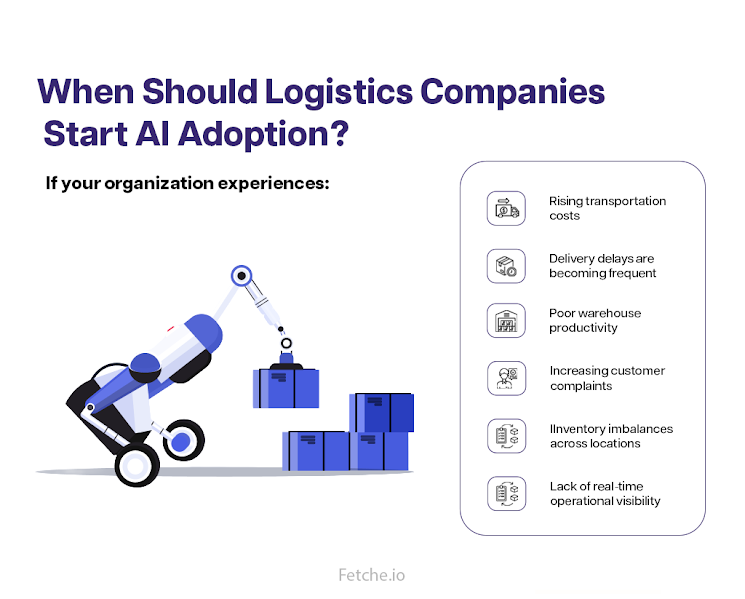
Certain operational signals indicate the need for AI adoption.
If your organization experiences:
- Rising transportation costs
- Delivery delays are becoming frequent
- Poor warehouse productivity
- Increasing customer complaints
- Inventory imbalances across locations
- Lack of real-time operational visibility
…it may already be time to evaluate AI solutions.
Early adopters are currently gaining competitive advantages in service quality and cost control.
The Future: AI-Driven Logistics Networks by 2030
Looking ahead, logistics operations will become increasingly autonomous and predictive.
Expected transformations include:
- Self-optimizing delivery networks
- Autonomous warehouse coordination
- Predictive supply chain planning
- Dynamic routing across multimodal transport
- Zero-waste inventory management
AI applications in end-to-end logistics will shift from optimization tools to core operational infrastructure.
Companies preparing now will lead tomorrow’s logistics landscape.
Final Thoughts: AI is Becoming Essential for Logistics Survival
Logistics operations have reached a complexity level where manual decision-making alone cannot keep up.
AI enables logistics leaders to:
- Reduce operational costs
- Improve delivery performance
- Optimize assets
- Improve customer satisfaction
- Protect margins
The question today is not whether AI works in logistics. The question is how quickly organizations adopt it to stay competitive.
The question today is not whether AI works in logistics. The question is how quickly organizations adopt it to stay competitive.
FAQs: AI in Logistics Cost Optimization
AI cost reduction in logistics operations takes place by providing route optimization, efficient running of the warehouse, more accurate demand forecasts, and automation of operational decisions.
No, because many modern logistics AI applications are scalable and suitable for the mid-size operator, too.
Most companies realize measurable benefits within 6–12 months, especially on the optimization of transportation.
Most of the new artificial intelligence systems are designed to integrate with the existing logistics management software through APIs and modular solutions.
Closing Insight
Every kilometer saved, every route optimized, every pickup made faster, and every prediction improved adds up to profit.
AI simply ensures those decisions happen every second, across every operation, without human limitation.
And that is where the real savings begin.