
A TMS or Transportation Management System helps plan and optimize the physical movement of goods. This movement can refer to any mode of transport, like air, water, or land. If the primary focus of your company is transportation and logistics management, a TMS can offer you substantial benefits.
But how do you choose the right TMS software?
We realized that many logistics businesses are grappling with that question. This blog is our way of answering that question. If you were struggling with how to choose the right TMS, you will find this blog comprehensive and filled with actionable insights.
Choosing the Right TMS
Choosing the right Transportation Management System (TMS) can be tiring. There are plenty of options available today in the market. And yet you cannot just choose the cheapest one or the most popular one. You need to consider a multitude of factors like your budget, your requirements, your order volume, and much more. Ultimately, your choice can make or break your logistics operations. Therefore, you cannot afford to go wrong with this decision.
Why it Matters
The right TMS can:
- Cut route miles and reduce fuel costs
- Improve driver productivity
- Minimize manual paperwork
- Assist fleet managers in planning, tracking, and reporting
- Support smarter, data-driven decision making
This is exactly why choosing the best TMS software matters. When you have the right TMS, your drivers are calmer, your deliveries are faster, managers lack visibility, and your customers are happier. On the other hand, with the wrong software, your drivers become confused, your deliveries are delayed, managers lose visibility, and your customers remain unsatisfied.
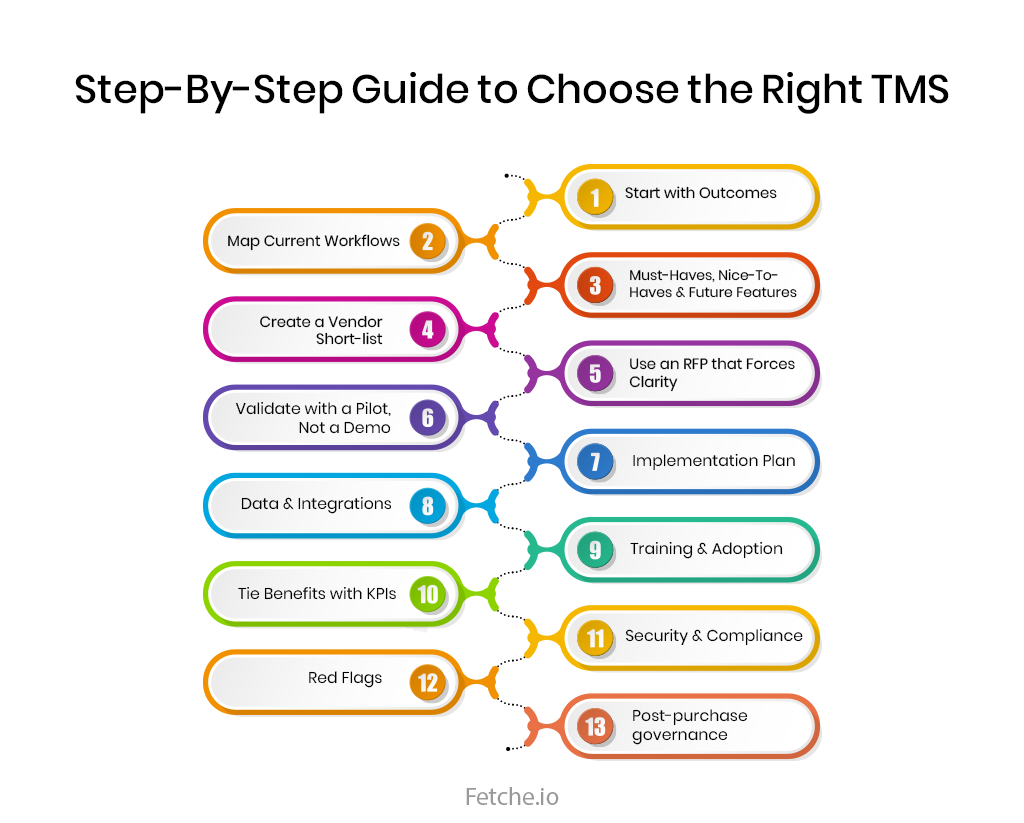
Step-By-Step Guide to Choose the Right TMS
1. Start with Outcomes
Write down what success looks like. You can list out goals/outcomes that you wish to achieve. Be specific. These goals guide everything else.
Here are some examples:
- Cut route miles by 15% in 6 months
- Improve on-time delivery to 90%
- Reduce operational costs by 20%
2. Map Current Workflows
Walk through a live day of operations. Note every handoff. Capture pain points.
You can use a simple checklist like this:
- Order received – Who inputs it?
- Dispatch – How are routes made?
- Driver handoff – How do drivers get tasks?
- Proof of delivery – Format and storage?
- Exceptions – How are delays recorded?
- Billing – Who prepares invoices?
Also, record times and error rates where possible. These will serve as your baseline.
Mapping workflows like this helps identify where route planning and scheduling software or staff management systems can reduce friction and improve accuracy.
3. Must-Haves, Nice-To-Haves, & Future Features
Split requirements into three groups:
- Must-Haves (Deal Breakers):
- Route optimization with constraints (time windows, vehicle types)
- Real-time GPS tracking and ETA
- Mobile driver app (digital POD, signatures)
- Carrier selection & tendering
- Basic integrations: WMS, ERP, Fleet Management Software, Accounting
- Nice-to-Haves:
- Predictive ETAs using AI
- Live chat between driver & dispatcher
- Built-in fuel management.
- Future Features:
- Multi-modal planning.
- Customs or cross-border workflows.
Vendors often sell nice-to-haves to distract you. But you have to stick to the must-haves. Without them, the TMS remains incomplete. Look for a cloud-based TMS system that combines fleet optimization tools, fleet tracking software, and driver management software in one place.
4. Create a Vendor Short-list
Source 6–8 vendors. You can use:
- Referrals from peers
- Industry forums and groups
- Short online research (product pages, case studies)
Once you have the shortlist, you can cut it down to 3 or 4 finalists based on the must-haves you listed earlier.
5. Use an RFP that Forces Clarity
Send a focused Request for Proposal (RFP). Keep it action-oriented. You can include sections like:
- Company Profile & Volumes
- Number of orders per day/week
- Average stops per route
- Truck types and count
- Functional Questions
- Does the TMS do multi-stop route optimization with time windows?
- Does the driver app support offline mode?
- Can the TMS auto-generate POD and email it to customers?
- What integrations does the software support (ERP, WMS, etc)?
- Non-Functional Questions
- Uptime SLA
- Data retention policy
- Security certifications (ISO 27001, SOC2)
- Backup and disaster recovery
- Implementation & Support
- Typical implementation time for customers of your size
- Training plan and materials
- Local support hours and escalation matrix
- Pricing
- Setup fees, license fees, per-driver or per-transaction costs
- Hidden costs (integration, custom reports)
- Case Studies & References
- Give 2 customers in the same industry with contacts
6. Validate with a Pilot, Not a Demo
A demo shows features. A pilot proves value. So, ask for a pilot with a run period of 4 weeks. Here is a pilot checklist:
- Data import – routes, customers, vehicles
- Train dispatchers and drivers
- Daily standups for week 1, then weekly.
- Final report – compare KPI deltas vs baseline.
A real pilot will help test how well your driver management system and truck management software handle actual conditions on the ground. If the pilot fails, get a refund or a no further obligation clause.
7. Implementation Plan
Keep your implementation phased:
- Phase 1 – Kickoff (2 weeks)
- Data mapping
- Integration plan
- Phase 2 – Configuration & Build (4 to 6 weeks)
- Build rule sets
- Set up user roles and permissions
- Phase 3 – Pilot (4 to 6 weeks)
- Run pilot
- Iterate rules and config
- Phase 4 – Rollout (4 to 8 weeks)
- Rollout by region or depot
- Full training program
- Phase 5 – Stabilize & Optimize (Ongoing)
- Weekly performance reviews for 3 months
- Roadmap for new features
This phased approach ensures your logistics automation system scales smoothly.
8. Data & Integrations
You need to get this right early. Here are some integration points to lockdown:
- ERP – orders, customers, invoicing.
- WMS – inventory, pickup readiness.
- Telematics – GPS, engine hours, fuel.
- EDI or carrier portals.
Here is a data migration checklist:
- Clean and standardize addresses.
- Validate vehicle master data.
- Test sample imports before full migration.
A TMS with flexible APIs can act as a complete logistics management platform.
9. Training & Adoption
The best TMS software for drivers and fleet managers encourages faster learning and better day-to-day adoption. However, adoption can fail faster than software. To avoid that, train like this:
- Role-based training sessions (dispatch, drivers, ops, finance)
- Cheat-sheets and short videos for drivers
- On-site shadowing for the first two weeks
- Gamify early adoption (rewards for accurate PODs and on-time updates)
- Measure adoption (% drivers using app daily, % digital PODs vs paper, avg time dispatcher spends per order)
10. Tie Benefits with KPIs
Tie benefits to KPIs so execs can approve spend.
For drivers:
- Benefit – Clear routes reduce confusion, KPI – Avg stops completed per shift increases
- Benefit – Less paperwork, KPI – Time on admin tasks per day decreases
- Benefit – Better ETAs, KPI – Fewer customer calls per driver
For fleet managers:
- Benefit – Real-time visibility, KPI – Time to detect exceptions decreases
- Benefit – Fuel insights, KPI – Fuel per km decreases
- Benefit – Better scheduling, KPI – Better vehicle utilization
Note – Set targets in contracts or KPIs in vendor SLA where possible.
11. Security & Compliance
You should get the following in the contract:
- Data encryption in transit and at rest
- Role-based access control
- Regular backups and a DR plan
- Compliance – local transport regulations, data privacy laws
12. Red Flags
- Vague answers on integrations
- No local references
- Long, unproven implementation timelines
- Hidden per-transaction charges
- Poor driver app reviews
13. Post-purchase governance
Here is how you can create a post-purchase review plan:
- Weekly KPI reviews in the first month
- Monthly performance meetings in months 2 and 3.
- Quarterly roadmap with vendor
- Assign an internal owner. Make them accountable
Long-Term Impact of Setting Up the Right TMS
Once the right logistics management software is in place and fully integrated, you’ll notice improvements across every level of the operation. Here are a few of them:
1. How the Right TMS Impacts Business
A well-chosen TMS doesn’t just improve operations. It transforms how your logistics business runs day to day. Here’s how:
- Cuts costs – Routes are optimized, so trucks aren’t driving empty or wasting fuel.
- Improves delivery timelines – Automated scheduling and real-time tracking keep deliveries on time.
- Enhances visibility – Managers can see every vehicle, every order, and every delay in real time.
- Reduces paperwork – No more piles of forms or manual updates. Everything is digital and easy to check.
- Makes customers happier – Deliveries arrive on time, and they stay informed throughout.
2. How the Right TMS Benefits Drivers
A good TMS doesn’t just help management. It changes the day-to-day experience for drivers. Here’s how:
- Simplifies their day – Drivers get clear routes and schedules. No more confusing trip sheets or manual updates.
- Reduces idle time – Optimized routes mean less waiting at depots and faster turnaround.
- Fewer calls and manual updates – Real-time tracking lets dispatchers see progress without calling drivers constantly.
- Easier documentation – Digital proof of delivery (POD) replaces paper forms and signatures.
- Better communication – Updates, route changes, and messages appear directly in the drivers’ app.
3. How the Right TMS Benefits Fleet Managers
With the right fleet and transport management software, fleet managers feel the difference first. A well-implemented TMS gives them control and visibility they didn’t have before. Here are some of the benefits that they enjoy:
- Complete visibility – They can see every vehicle, route, and delivery in one dashboard.
- Smarter decisions – Real-time data helps identify delays, reroute vehicles, and respond fast.
- Better performance tracking – Metrics like fuel usage, idle time, and delivery accuracy are tracked automatically.
- Easier coordination – Managers can communicate with multiple drivers at once, assign loads, and update routes instantly.
- Simplified reporting – All data related to fuel, cost, and utilization is available in one place, ready for export.
Tabular Representation of the Long-Term Impact of Setting Up the Right TMS
| Role | Benefit | Long-Term Impact |
| Drivers | Fewer manual tasks, clear routes, digital updates | Higher productivity, lower stress |
| Fleet Managers | Full visibility and faster decision-making | Better utilization, improved KPIs |
| Dispatchers | Automated route planning and assignments | Less manual load, fewer delays |
| Customers | Real-time updates and on-time deliveries | Higher satisfaction and repeat business |
In short, the right system doesn’t just make logistics more efficient. It makes your entire operation more human-friendly.
Why FETCHE Is the Right TMS Solution for Modern Logistics
Now you know what to look for in a TMS. To recap, a TMS should have:
- Clear outcomes
- Must-have features
- Seamless integrations
- Strong support
- Long-term scalability
Fetche checks every one of these boxes. Here are some features of Fetche that make it the right choice among transportation management solutions:
- Built around real logistics workflows
- Smart route optimization
- End-to-end visibility
- Drivers’ app with driver tracking software
- Real-time delivery tracking
- Quick insights on performance
- Role-based access
- Reliable support and training assistance
- Long-term scalability
Final Thoughts
Choosing the right TMS software isn’t about finding the flashiest software. It’s about finding the one that truly fits your workflows, your drivers, and your long-term goals.
If you follow a structured approach, like the one we outlined, you’ll not only pick the right tool but also set up your business for long-term success.
The right TMS brings calm to the chaos of logistics. Drivers stay informed. Managers stay in control. Customers stay satisfied. Moreover, these systems work best when integrated with broader systems like ERPs.