

Does the product or service you receive from an optimized warehouse differ in any way from one that is not optimized?
The answer is Yes, though you might not expect it to be so.
The product or service you receive from an optimized warehouse can be noticeably different from one that is not. Why, you may ask. Well, several factors may contribute to it. Effective warehouses use automation, smart layouts, and warehouse management systems primarily to ensure picking of orders in the proper way, packing them properly, and shipping them speedily, so that you get it in time, undamaged.
It thus permits faster delivery, lesser error, and most importantly, a more reliable end-to-end experience.
On the other hand, a service provided from a non-optimized or manual warehouse can often end up experiencing delays, errors, and even less transparency that can, in turn, affect the speed and quality of service.
Simply put, an optimized warehouse assures a far more streamlined, more accurate process from storage to delivery.
If this subject interests you, go on to reading.
You are up for a treat. We are about to uncover 6 proven tips to improve warehouse operations, which may come in handy if you own or are part of a logistics business.
Optimizing Your Warehouse Could Change Everything
Warehouse Optimization could transform the way your logistics operate. This is because through automation and strategic use of time, space, and resources, optimization helps make warehouse processes smoother, faster, and far more reliable.
Without optimization, warehouses may usually suffer from wasted movement, misallocated space, inventory errors, and slow throughput all of which erode margins and customer confidence.
On the other hand, an optimized warehouse may in fact become a competitive advantage for your business with perks like lower cost per order, higher accuracy, and better scalability for peak demand periods.
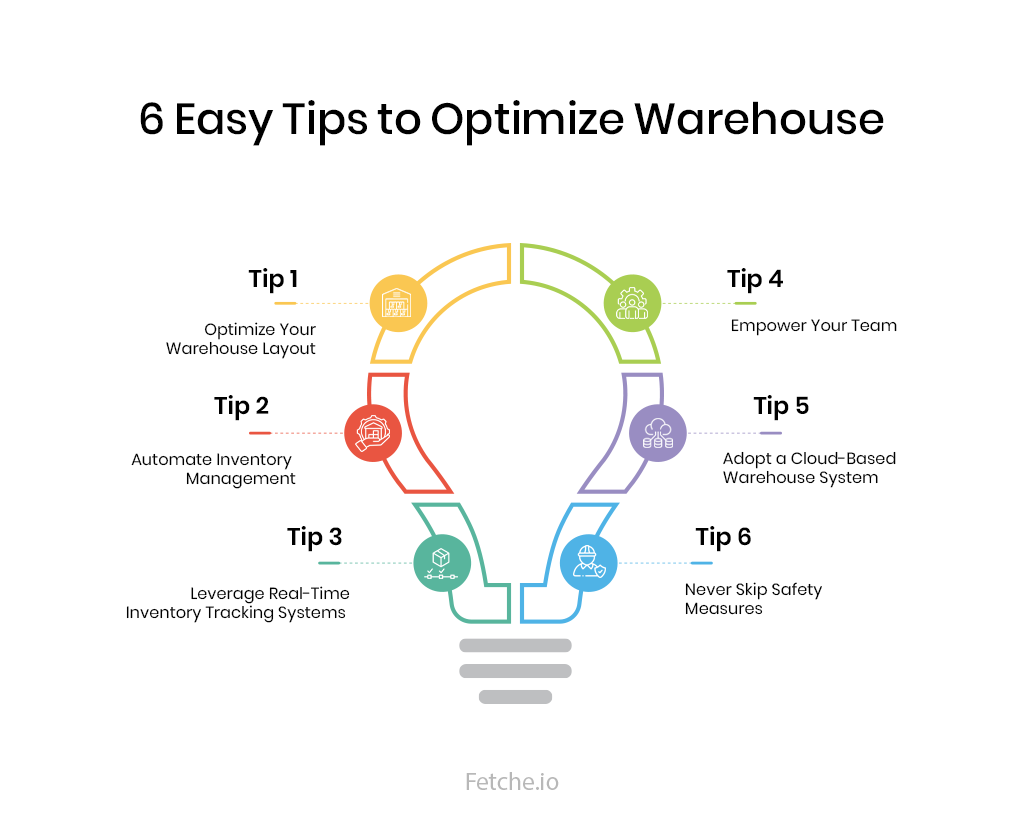
6 Tips for Next-Level Warehouse Management
Below are six concrete, step-by-step Warehouse optimization strategies/ Warehouse efficiency tips:
Tip 1 – Optimize Your Warehouse Layout
A warehouse layout is that which primarily determines how efficiently goods flow from inbound to outbound operations. You can begin by locating high-speed items nearest the picking and packing areas, with bulk storage further back in the warehouse.
Purpose: Minimize wasted travel, group similar SKUs, and reduce picking time.
How Can You Achieve It
- Map operational flow: Map out the path of operation like receiving → put-away → picking → packing → shipping.
- Zone by velocity/demand: Place high-velocity or high-turnover SKUs close to picking/packing/dispatch zones; keep slower-moving or bulk goods further back in the warehouse.
- Utilize vertical space: Use tall racking and modular shelving mainly to expand storage capacity without enlarging the footprint.
- Label clearly & create intuitive zones: Use signage, barcode labels, color coding, and logical zone groupings.
- Seasonal slotting: Rotate product placement in accordance with the seasonal demand.
Tip 2 – Automate Inventory Management
Manual inventory management is the story of another era, and we no longer belong to that era. So why should the story be? Automation through barcoding, RFID tags, and IoT sensors is the tale of today. With the right warehouse automation equipment, you can automatically monitor any movement of stock, monitor replenishment, and lower shrinkage.
Purpose: Minimize errors, improve processing rate, and enhance data consistency.
How Can You Achieve It
- Employ barcode scanning and/or RFID marking: Scan all products, pallets, or cases on receipt, put-away, pick, and ship to keep inventory real-time balance.
- Automated reminders and reorder levels: Reorder based on your system, using the stock level as it falls below the threshold percentage.
- Cycle count instead of all counts: Auto-schedule routine, incremental counts on a regular schedule so that you are consistently ahead of the actual count.
- Integrate with ERP and other systems: Ensure your warehouse management software (WMS) syncs well with your ERP, order management, and procurement systems.
Tip 3 – Leverage Real-Time Inventory Tracking Systems
It goes without saying that if you can’t see it, you can’t manage it either. Well, the topic in discussion is none other than Real-time tracking, the supposed cornerstone of smart warehouse technology. Having a warehouse tracking system in your warehouse can ensure that everything from products, pallets, to shipments is trackable at all times, every day.
Purpose: Know where everything is at all times; identify early warning signs of problems if any problems ever do arise at all; enable quicker and smarter decision-making.
How Can You Achieve It
- Deploy IoT sensors, GPS tags, or smart beacons: Use them to track high-value or sensitive inventory throughout the warehouse or while in transit.
- Real-time dashboards: Display current stock positions, inbound/outbound flows, worker locations, and bottleneck alerts.
- Event and anomaly alerts: Send out notifications whenever any stock goes missing, or there are any delays, or thresholds are violated in some manner.
- Integration with WMS and logistics Management software: All tracking data should feed into your central systems in real time, enabling synchronized workflows.
- Predictive analytics and alerting: Over time, you can utilize the data for any purpose, including to forecast demand, predict peaks, and recommend staffing or slot changes.
Tip 4 – Empower Your Team
Even the best technology may fail miserably if there are no trained forseers to manage it. Thus, a truly optimized warehouse is the one that first recognizes its workforce as the most valuable asset.
Purpose: Make your workmen more effective at work, motivated, and aligned with technology.
How Can You Achieve It
- Comprehensive onboarding and training: Cover technology tools (WMS, scanners, dashboards), safety protocols, and standard operating procedures.
- Feedback loops: Have team members report inefficiencies or be comfortable enough to bring forward any layout or process adjustments that they deem necessary.
- Tools/staff support: Handheld devices, mobile applications, voice-pick or light-directed systems can minimize strain and improve speed.
- Constant coaching: Utilize performance measures (from your tracking systems) to indicate areas where improvement is needed and provide focused training to your workmen periodically.
Tip 5 – Adopt a Cloud-Based Warehouse System
A cloud-based warehouse management system (WMS) is the digital command center of a modern warehouse and one that could ultimately change the face of your business operations on a large scale. Unlike traditional systems that rely on local servers, cloud-based WMS platforms offer accessibility that may be enjoyed from anywhere, anytime.
Purpose: Gain scalability, accessibility, integration, and lower IT overhead.
How Can You Achieve It
- Choose a cloud WMS solution with multi-location, multi-client, and remote accessibility.
- Enable real-time updates across devices: Warehouse staff, planners, and executives should all see synchronized data instantly.
- Automatic updates & upgrades: Cloud systems remove the burden of manual patching or versioning.
- Disaster recovery & security integrated: Cloud vendors generally integrate backup, redundancy, and robust security measures that small internal IT corganizations might not be able to replicate.
Tip 6 – Never Skip Safety Measures
Warehouse safety is never and has never been a negotiable element in supply chain warehouse management. More specifically, it is the cornerstone of sustainable operation.
Purpose: Protect people, prevent losses, and sustain operations.
How Can You Achieve It
- Regular safety audits: Inspect racks, forklifts, PPE, fire suppression systems, and overall facility compliance.
- Clear marking and signage: Mark aisles, forklift lanes, pedestrian zones, hazard zones, and load limits.
- Clutter control: Sweep floor surfaces and clear of clutter; create safe paths.
- Emergency protocols & drills: Fire, spill, accident, or evacuation procedures should be rehearsed periodically.
- Use ergonomic aids and reduce physical strain: Lift-assist tools, proper pallet heights, anti-fatigue mats, and workbench design reduce injuries and delays.
Warehouse Optimization Checklist
Use this final checklist to assess your warehouse’s optimization status:
| Focus Area | Key Question | Status / Actions Needed |
| Layout | Is travel minimized and high-velocity items placed optimally? | |
| Automation | Are barcode/RFID, AS/RS, and auto putaway in place? | |
| Real-Time Tracking | Do you have live dashboards, alerts, and sensor integration? | |
| Staff Empowerment | Are employees trained, cross-skilled, and involved in improvement? | |
| Cloud WMS | Is your WMS cloud-native and integrated with ERP, OMS, etc? | |
| Safety | Are safety audits, protocols, training, and equipment up to standard? | |
| Continuous Improvement | Are you measuring performance and iterating based on data? |
If any of these boxes are unchecked or weak, you know where to invest next.
Your Condensed Cheat Sheet To Warehouse Optimization
Here is a compact, easy, and essential list of things you should be following to optimize your warehouse.
- Design for Flow: Keep high-demand items closer for easy picking, minimize dead zones, and rethink your space every other quarter.
- Digitize Everything: Paper trails will no doubt slow you down. Leave it behind. Go digital with scanning, tracking, and reporting, and all such automation add-ons.
- Track in Real-Time: Real-time warehouse visibility is everything; invest in systems that give you an idea of what’s happening in real time.
- Automate Repetitive Work: If it’s repetitive, it’s automatable. Let software handle the grunt work rather than putting our precious hours into something that can be done in a few seconds with accuracy that no human mind can demand.
- Integrate Your Systems: Your WMS, ERP, and logistics software should understand each other, speak the same language, and work hand in hand.
Conclusion: Why a Smart Logistics Platform (e.g., FETCHE) Helps Realize These Strategies
To Execute all six strategies above — layout, automation, real-time tracking, team empowerment, cloud WMS, and safety you might need a smart logistics platform like FETCHE.
Here’s how a unified solution helps:
- ERP integration for warehouse management that is Fetche Integrates your warehouse management software with ERP, order management, and fulfillment modules
- Centralizes real-time data (inventory, movement, alerts) into dashboards
- Automates repetitious tasks and enforces workflow rules
- Enables remote visibility and management — whether you run 1 warehouse or 10
- Offers built-in analytics for iterative improvement
- Supports safety modules, maintenance scheduling, and compliance logs
- Scales with your business — no forklift-forced replatforming
That is, FETCHE can be the digital spine that connects all six strategies together. Instead of being separate projects, you have synergy: layout changes driven by tracking data, automation cooperating with training, safety measures creating feedback loops into dashboards, and so forth.
By incorporating these six strategies into your operation and empowering them with an able logistics platform, your warehouse will exceed your needs, set to evolve as business continues to do so.