
Last-mile delivery used to be simple. Pick up the package. Drive. Drop. Done. That version no longer works. In high-growth markets, volume is exploding. Customers expect same-day delivery. Cities are crowded. Costs are rising. And one late delivery can damage trust instantly. That’s why last-mile delivery in 2026 looks very different from what companies ran just a few years ago. It’s no longer just logistics. It’s experience. It’s efficiency. It’s survival.
If your last-mile system doesn’t evolve, it doesn’t scale. And if it doesn’t scale, it fails quietly while competitors move faster. So let’s talk about what actually works in 2026 and what doesn’t.
Why Last-Mile Delivery Is Under Pressure in 2026
Growth sounds good. But in logistics, growth creates stress. In 2026, companies face:
- More online orders
- Smaller order sizes
- Shorter delivery windows
- Higher fuel and labor costs
- Urban congestion
- Customer demand for real-time updates
The last mile now eats the biggest share of logistics cost. Not because the distance is long. But because the complexity is high.
One address. One failed attempt. One confused driver. One unhappy customer. Multiply that by thousands of deliveries per day, and inefficiency becomes expensive very fast. That’s where last-mile delivery challenges in 2026 start hurting businesses that still run manual or fragmented systems.
The Shift from Delivery to Experience
Customers no longer judge brands only by product. They judge by delivery. Late deliveries feel like broken promises. Poor tracking feels like silence. Missed slots feel like disrespect for time. That’s why last-mile delivery in 2026 is not a backend function. It’s front-facing brand behavior.
Companies that win treat delivery as part of marketing, retention, and trust.
Why High-Growth Markets Need Smarter Last-Mile Strategy
High-growth markets move fast. Demand spikes. Cities expand. Infrastructure struggles to keep up. In such markets:
- Small inefficiencies scale into big losses
- Manual control collapses under volume
- Customer patience shrinks
- Competition copies faster
That’s why survival depends on structured systems, not heroic effort. You can’t solve 2026 problems with 2020 workflows.
What Fails in Last-Mile Systems Today
Let’s start with what no longer works:
- Manual Planning
Some teams still plan routes in spreadsheets or WhatsApp groups. It looks manageable at small scale. But it breaks under growth.
Manual planning causes:
- Longer routes
- More fuel usage
- Missed delivery windows
- Overloaded drivers
In 2026, volume moves faster than humans can calculate. If your team still plans deliveries manually, you lose time before you even start the engine.
- No Real-Time Visibility
Customers now expect updates like:
- Where is my order?
- When will it arrive?
- Can I change the slot?
If your system can’t answer these instantly, support teams get flooded. Drivers get distracted. Customers lose patience. Without visibility, delivery becomes reactive instead of controlled.
- Disconnected Tools
Many operations still use:
- One tool for orders
- Another for drivers
- Another for billing
- Another for tracking
Nothing talks to each other. Data gets copied manually. Errors multiply. Decisions slow down. In high-growth markets, these disconnected systems don’t scale. They create friction at every step.
- Treating Last Mile as Transport Only
Old thinking says last mile is just moving goods. New reality says last mile is customer experience. If companies ignore communication, reliability, and flexibility, customers don’t forgive delays anymore. They switch.
What Scales in Last-Mile Delivery in 2026
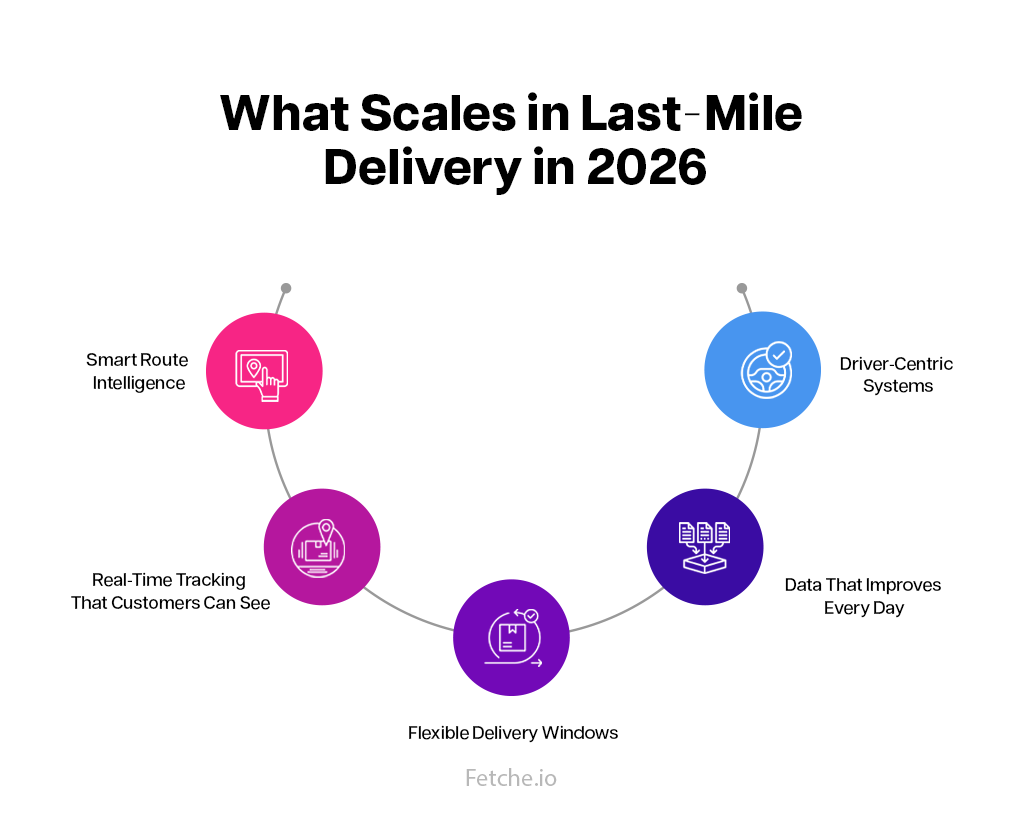
Now, let’s talk about what actually survives growth.
Smart Route Intelligence
In 2026, routes can’t stay fixed. Traffic, weather, volume, and priority change daily. Modern systems use last mile delivery optimization to:
- Smart Route Intelligence
- Auto-plan routes
- Reduce travel time
- Balance driver load
- Adapt to live conditions
Instead of guessing, systems calculate. Drivers stop wasting fuel. Deliveries stay predictable even when volumes jump.
- Real-Time Tracking That Customers Can See
Tracking is no longer internal. It’s customer-facing. With modern setups:
- Customers see live delivery status
- Drivers update automatically
- Delays get flagged early
- Support teams intervene before complaints start
This is where last mile delivery technology becomes more than software. It becomes communication. Good tracking doesn’t just move parcels. It builds trust.
- Flexible Delivery Windows
Customers in 2026 want control. They want to:
- Change delivery slots
- Redirect packages
- Choose safer drop points
Rigid schedules increase failed deliveries. And failed deliveries increase cost. Smart last-mile systems allow flexibility without confusing drivers. That’s how companies reduce reattempts and increase first-time success.
- Driver-Centric Systems
Growth depends on drivers. But many systems still treat them like endpoints. In 2026, scalable operations:
- Give drivers simple apps
- Reduce manual reporting
- Auto-capture proof of delivery
- Provide navigation support
When drivers spend less time on paperwork, they spend more time delivering. Productivity rises without hiring more people.
- Data That Improves Every Day
In older setups, data just gets stored. In 2026, data learns. Modern systems track:
- Delivery success rates
- Delay patterns
- High-risk zones
- Peak volumes
This helps teams improve routes, staffing, and planning continuously. Growth markets don’t allow static systems. They demand systems that get smarter every week.
What Fails vs What Scales in 2026
Here’s a simple comparison that shows the difference clearly:
| What Fails | What Scales |
| Manual route planning in sheets and chats No real-time tracking Disconnected apps for orders, drivers, & billing Fixed delivery slots Paper-based reporting Static reports Delivery treated as transport | Automated route intelligence with live optimization Customer-visible live tracking and alerts Unified last-mile delivery technology platform Flexible rescheduling and redirection Mobile-first driver apps with auto updates Data that learns and improves operations daily Delivery treated as brand experience |
What a Modern Last-Mile Setup Looks Like in 2026
In simple terms, scalable last-mile delivery looks like this:
- Orders flow automatically
- Routes plan themselves
- Drivers update in real time
- Customers see progress
- Managers act on data
No chaos. No guessing. No firefighting every morning. Just controlled movement, even at scale.
Final Thoughts
Last mile used to be the final step. In 2026, it’s the deciding step. High-growth markets don’t forgive slow systems. They reward operations that move with demand, not behind it. If your delivery model still depends on manual planning, disconnected tools, and reactive problem-solving, growth will expose every weakness. But if you invest in last mile delivery optimization, smart visibility, and modern last mile delivery technology, Logistics Management Software, your last-mile operation doesn’t just survive. It leads. Because in last-mile delivery in 2026, speed is expected. Accuracy is assumed. And experience is what sets winners apart.
FAQ
Because customer expectations for speed, accuracy, and transparency are higher than ever, making last-mile performance a key factor in customer retention and scalability.
Modern systems automate routing, tracking, and delivery updates, helping teams reduce delays and handle higher order volumes efficiently.
Live tracking and delivery updates build trust, reduce support queries, and give customers better control over their deliveries.
Solutions like Logistics ERP Software India centralize orders, drivers, routes, and performance data, enabling faster decision-making and smoother operations.
Scalable tools, including Logistics Software in Philippines, help businesses manage dense urban deliveries while maintaining speed and reliability.