
For decades, logistics operations in India have run on paper. Registers. Logbooks. Phone calls. WhatsApp messages. Spreadsheets passed around at the end of the day. And for a long time, this worked. Especially for SMEs, MSMEs, small transporters, regional fleet owners, and family-run logistics businesses. The system was familiar, low-cost, and easy to control.
But today, that same system is starting to crack. Fuel costs are rising. Customers expect real-time updates. Deliveries span cities, states, and regions. And manual tracking simply can’t keep up anymore. This is where the conversation around logistics management software in India becomes unavoidable. Not as a luxury, but as a survival move.
The Reality of Manual Logistics Operations in India
Let’s start with the ground truth. Most small and mid-sized logistics businesses in India still rely on:
- Manual trip sheets
- Driver call-ins
- Paper PODs
- Excel-based billing
- Memory-based planning
This isn’t inefficiency. This is how Indian logistics evolved. But these methods come with invisible costs:
- Delayed billing due to missing documents
- No real-time visibility on shipments
- Dependency on individual staff knowledge
- Errors in fuel, route, and load planning
- Difficulty scaling beyond a fixed fleet size
Manual systems don’t fail overnight. They fail slowly. Silently. And expensively.
Where Small Logistics Businesses Feel the Pressure the Most
For SMEs and MSMEs, logistics is not just about moving goods. It’s about relationships. For instance, look at these scenarios:
- A delayed update
- A missed delivery call
- A customer asking, “Where is my shipment?” for the third time in a day.
These moments hurt smaller businesses more than large enterprises. Why? Because trust is personal. And reputation spreads fast.
In manual setups, this pressure shows up daily:
- Drivers forget to report delivery status
- Office teams depend on phone calls for updates
- Customers wait without clarity
- Billing gets delayed because proof of delivery arrives late
None of this happens because people don’t work hard. It happens because manual systems don’t scale with responsibility. This is where cloud-based logistics management software quietly changes the game for SMEs. Instead of chasing updates, businesses gain visibility. Instead of reacting to customer calls, they stay ahead of them. Instead of managing chaos, they manage flow.
For small transporters and MSMEs, this shift is not about ‘tracking technology’. It’s about reducing daily stress without increasing workload.
Why is the Shift Happening Now?
This transition is not about trends. It’s about pressure. Let’s see what that means:
- Customer Expectations Have Changed
Clients now expect:
- Live shipment updates
- Accurate ETAs
- Proof of delivery without delays
Last-mile delivery tracking is no longer optional. It’s expected.
- Operations Are More Complex
Inter-city, inter-state, and hub-based movements are increasing. This means that manual coordination breaks when:
- One vehicle is delayed
- One driver goes offline
- One document is misplaced
- Margins Are Thinner
Fuel prices. Toll charges. Maintenance. Labour. The margins are getting thinner. There’s no room for guesswork anymore.
To protect margins, businesses need:
- Better planning
- Better visibility
- Better control
This is where logistics management software becomes relevant – not as software, but as an operational backbone.
What Cloud-Based Logistics Management Software Really Means
There’s a misconception that ‘cloud software’ is complicated or expensive. In reality, cloud-based systems are built for Indian conditions. Here’s what cloud-based logistics software actually offers:
- Access from anywhere
- No heavy hardware investment
- Works on mobile and low-bandwidth networks
- Scales as your business grows
For SMEs and MSMEs, this is crucial. You don’t need a data center. You don’t need an IT team. You don’t need to overhaul everything at once. You simply move control and visibility from paper to a digital platform.
Is This Affordable for SMEs and MSMEs?
This is the most common hesitation. And a valid one.
Older ERP systems were expensive, complex, and built for large enterprises. But modern Indian logistics ERP solutions are different. They are modular, subscription-based, and designed for phased adoption. You don’t pay for features you don’t need. You start small. Then expand.
In many cases, businesses recover the software cost simply by:
- Reducing billing delays
- Cutting fuel inefficiencies
- Avoiding repeat operational errors
The question is no longer “Can we afford it?” It’s “Can we afford not to?”
What Actually Changes
The shift from manual to cloud doesn’t mean abandoning experience. It means supporting experience with data and eliminating blind spots. Let’s visualize what really changes.
| With Manual Systems | With Cloud-Based Logistics Management Software |
| You call drivers for updates You wait for paper PODs You plan routes based on habit You reconcile bills at month-end | Shipments update in real time PODs are captured digitally Routes and trips are visible instantly Billing becomes faster and cleaner |
Why Cloud Software Works for Indian Infrastructure
There’s a myth that Indian logistics needs ‘simpler tools’. In reality, Indian logistics needs resilient tools.
Good cloud-based logistics platforms are:
- Mobile-first
- Designed for patchy networks
- Optimised for Indian workflows
- Built around real transport operations
They understand:
- Multiple trip types
- Partial loads
- Driver constraints
- Regional operational realities
This is why logistics management software in India looks very different from global, one-size-fits-all platforms.
Digital Transformation for SMEs and MSMEs
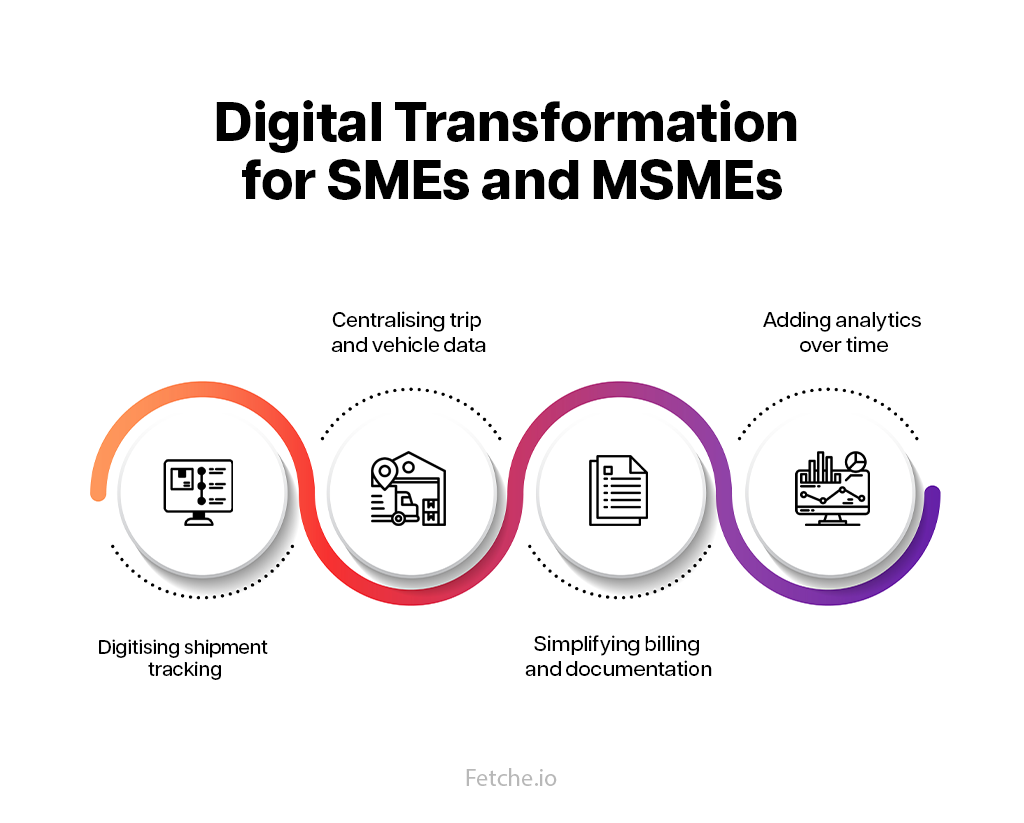
Digital transformation doesn’t have to happen all at once. This is important. Digital transition is not about flipping a switch. It’s about sequencing change.
Smart adoption looks like:
- Digitising shipment tracking
- Centralising trip and vehicle data
- Simplifying billing and documentation
- Adding analytics over time
You don’t replace your system. You upgrade your visibility.
Debunking Common Myths Holding SMEs Back
- “Our business is too small”
Small businesses benefit the most. Less complexity. Faster ROI.
- “Our team won’t adapt”
Most drivers and staff already use smartphones. The shift is easier than expected.
- “Software will slow us down”
Manual coordination slows you down more. Software removes friction.
- “ERP is only for big players”
Modern Indian logistics ERP solutions are built specifically for growing businesses.
What a Successful Digital Transition Looks Like
A successful transition is quiet. No chaos. No forced changes. No overnight disruption. Instead, you notice:
- Fewer follow-up calls
- Faster billing cycles
- Better planning
- Happier customers
That’s how you know it’s working.
Where Fetche Fits Into This Transition
Not all software works for SMEs. The right platform must:
- Understand Indian logistics realities
- Support phased adoption
- Be simple to use
- Offer consultative onboarding
Fetche was built with this exact mindset. It’s not just software. It’s a transition partner. For small-scale transporters and logistics operators, Fetche helps:
- Move from manual to digital without disruption
- Gain real-time control over shipments
- Improve last-mile delivery tracking
- Build operational clarity without high costs
The focus is not ‘technology first’. It is operations first.
Final Thoughts
Indian SMEs and MSMEs are not behind. They are at a turning point. Manual systems built the foundation. Cloud-based logistics management software builds the future. This transition is not about becoming ‘high-tech’. It’s about staying competitive, sustainable, and in control.
With the right tools, the right pace, and the right partner, digital logistics is not intimidating. It’s empowering. And for businesses ready to move forward, platforms like Fetche make that journey practical, affordable, and aligned with how Indian logistics actually works.
FAQ
Because paper, calls, and spreadsheets can’t keep up with today’s delivery volumes. In Logistics for Indian SMEs and MSMEs, cloud systems give live updates, fewer errors, and better control.
Orders get missed, drivers give late updates, PODs get lost, and billing takes too long — which leads to unhappy customers and cash-flow issues.
No. Modern tools, including Logistics ERP software in India, use simple monthly plans that usually cost less than the losses caused by delays and manual mistakes.
Shipments are tracked automatically, delivery proofs come instantly, and invoices are generated faster with much less follow-up.
Yes. Most platforms are mobile-friendly and built for patchy networks, long routes, and multi-stop deliveries common in Logistics for Indian SMEs and MSMEs.
Many think their operation is “too small” or that staff won’t adapt but tools like Logistics ERP software in India are designed to be simple and quick to learn.